

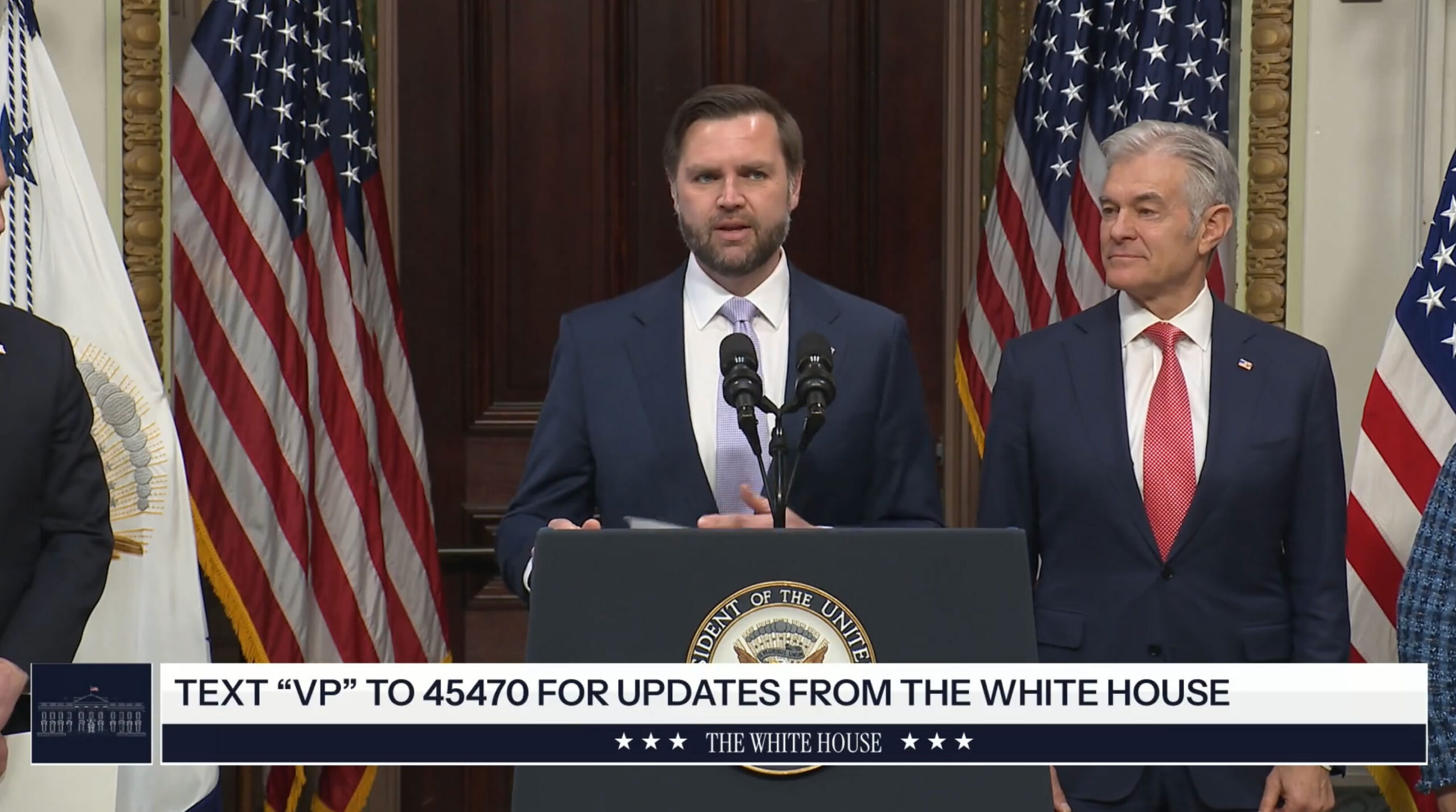
WASHINGTON – Vice President JD Vance announced a sweeping federal crackdown on Medicaid, Medicare, hospice and home health care fraud Wednesday, just hours before traveling to Maine, where he is expected to address fraud concerns during remarks at Bangor International Airport.
Vance is scheduled to speak at 12:30 p.m. Thursday at the Bangor International Airport, where his comments are expected to focus on the fraud concerns that have drawn increasing attention in Maine.
Vance was joined at Wednesday’s press conference by Dr. Mehmet Oz and Andrew Ferguson, executive director of the federal anti-fraud task force, as the Trump administration laid out new enforcement actions aimed at protecting taxpayer-funded benefit programs from fraud and abuse.
Speaking alongside federal officials, Vance said the administration is moving aggressively to protect taxpayer dollars and ensure government assistance programs serve vulnerable Americans instead of enriching fraudsters.
Vance framed the issue as both a financial crisis and a moral one.
According to the vice president, fraud in government benefit programs creates “two fundamental victims”, the American taxpayer and the low-income families, children, seniors and disabled individuals who depend on those services.
The press conference came as Maine continues facing scrutiny over alleged abuse within MaineCare-funded programs, particularly in the home health care, residential care and autism services sectors.
Several Maine providers, including Gateway Community Services, Legit Home Health Care, Luna Home Care and Paradise Residential, have faced growing public scrutiny amid questions surrounding billing practices, oversight and the rapid expansion of MaineCare-funded services.
The concerns have become a major issue in Maine political circles, with critics arguing state leaders failed to act quickly enough as taxpayer spending exploded across portions of the MaineCare system.
Vance said the Trump administration is now demanding states aggressively pursue Medicaid fraud investigations or risk losing federal anti-fraud funding.
“This does not have to be a red state or blue state issue,” Vance said during the press conference. “This is just basic good government.”
The vice president announced the federal government is deferring $1.3 billion in Medicaid reimbursements from California, citing what the administration described as failures to address fraud and abuse within the system.
Vance said some fraudulent providers have pushed unnecessary medications and services onto patients in order to maximize billing revenue, harming both taxpayers and vulnerable patients.
“You assume that your doctor is doing the right thing,” Vance said. “But these fraudulent health care providers are getting rich by giving people medications they don’t even need.”
Federal officials also announced that letters are being sent to all 50 state Medicaid programs requiring them to demonstrate they are effectively investigating and prosecuting fraud.
States that fail to comply, officials warned, could lose federal anti-fraud funding and potentially additional Medicaid-related resources.
Ferguson said the administration will no longer tolerate states accepting billions in federal anti-fraud money while failing to prosecute abuse within their Medicaid systems.
He said Medicaid fraud control units were created not only to protect taxpayer dollars but also to investigate elder abuse and protect vulnerable citizens dependent on government-funded care.
“When the states just take this money and turn it into a jobs program for state lawyers, they are effectively participating in the elder abuse in those states,” Ferguson said.
The administration repeatedly pointed to blue states such as California, Hawaii and New York as examples of states failing to aggressively prosecute Medicaid fraud.
Vance cited Hawaii’s Medicaid fraud program, which he said had produced zero indictments and zero convictions in recent years despite billions flowing through the system.
Federal officials argued the lack of prosecutions sends a signal that large-scale fraud can continue unchecked.
Oz, who now oversees the Centers for Medicare and Medicaid Services, said healthcare fraud may account for roughly half of all fraud across the federal government, estimating approximately $100 billion in theft from Medicare and Medicaid programs.
Oz announced several major enforcement actions Wednesday, including the suspension of 800 hospices that collectively billed taxpayers roughly $1.4 billion last year.
He also announced a nationwide moratorium on new hospice and home health care providers while federal officials investigate what they described as widespread abuse and fraudulent expansion within the industry.
Oz said fraudsters frequently move operations from one state to another once enforcement actions begin.
Federal officials also described cases where Americans had their identities stolen and were unknowingly signed up for fraudulent medical services, leaving legitimate patients unable to access care they actually needed.
The heightened federal focus on fraud arrives as Maine continues facing questions surrounding oversight of rapidly expanding MaineCare-funded programs, particularly in areas involving autism services, residential care and home health providers.
Critics in Maine have increasingly questioned whether state oversight agencies acted aggressively enough as providers rapidly expanded while taxpayer-funded spending surged. Mainers want those who have committed the fraud to be held accountable.
Vance said the administration’s goal is not to eliminate benefit programs, but to preserve them for Americans who genuinely rely on them. Vance acknowledged during a question and answer session with the press, that he will discuss more details about fraud in Maine on Thursday and also will campaign with former Maine Governor Paul LePage who is running for US Congress in the CD 2 region.
“We want to protect these programs for the kids and the families who need them,” Vance said. “We want to ensure that the American taxpayer isn’t getting fleeced.”




Sic Em J.D. sic em.
Great thanks JD, looking for forward for your investigation.
I’d be much happier if those responsible went to jail but I’m not holding my breath with corrupt Maine politics
” comments closed ” on the Collins//Patel Grow Houses. You know, the grow houses Mills turned a blind eye to. Shouldn’t Collin’s have been asking Mills about this all along??
The Marxo-fascist democrats–and their corrupt, tyrannical rule in this state–need to be CRUSHED absolutely. Hopefully this happens, even if the shitty BDN and other fake news purveyors refuse to report it.
And what quietly was pushed thru the last legislative session? A LD now codified into law that says Maine taxpayers will replace any monies withheld by the feds from Medicaid/Medicare for any reason. This appears to be true even when the feds have identified theft or fraud and demands restitution for over payments, the usual legislative suspects have now positioned earning Mainers to pick up the tab for the very fraud and abuse that has/is corrupting these programs. In the meantime, not a single government prosecutor in Maine has even opened a criminal case never mind grand jury presentations. I expect an airline will offer discount prices for flights from the Moo right to the pine tree state where you can now steal the place blind and have the victims pay for it.
The fraud in Maine is bigger than anyone else can imagine…much connected directly to Somali in MN, But much is also non-Somali…and Maine DHHS and others are just covering for them…I have some first hand experience running into these criminals. Need more investigations and ICE in Maine….just for starters.
Well, hopefully something will really happen … not holding my breath, as nothing really ever good come out of that rotten cesspool. How about starting with the CORRUPTION AND FRAUD in WASHINGTON D.C. , CONGRESS !!!
TAKE UP NANCY MACES BILL TO EXPOSE THE AECUAL SCANDALS THAT ALL GET PAID OFF THROUGH THEIR SECRET PROGRAMS WITH OUR TAX DOLLARS!!!! BUNCH OF SICK PEDOPHILES !!! AND LYING ABUSERS. My father said to me yesterday we had the greatest constution in the world, I said yeah we do, but it requires a MORAL, RELIGIOUS , AND JUST PEOPLE TO MAKE IT WORK, WHICH WE HAVE NONE OF IN CONGRESS! they spew all kinds of good “words” but their actions tell the truth! Posion.
Legit Home Health Care . Only in Maine lol
Why are comments closed on the Maine pot growing houses? RINO Collins is going to be up for re election soon, so NOW she is all concerned about Chinese illegal pot and drug dealing? Governor Mills, and her lawyer Brother who has helped with legal work for at least one pot house in Maine, don’t see nothing, don’t hear nothing and don’t do nothing about the hundreds of Chinese pot grows in our State. Are there dollars involved here? Asking for a friend.
Citizens pay for the massive costs of government, and fraud among multiple things have eaten available funds for life and family and enough!. Do we not pay this cost – should not, why others are paid to do that work! , and deserve and demand that ALL involved in any capacity (including ineptness and fail to do their job) are put before a Grand Jury, and trial for those so indicated. We should not pay a dime for these miscreants.
I would like to see Vance investigate DHHS itself.
That outfit is half the problem, and it’s incredibly corrupt.