A slim majority of Independents in Maine are opposed to the use of ranked choice voting in the state, according to the Pine Tree State Poll, a States of Opinion Project conducted by the University of New Hampshire Survey Center.
Mainers took the first step toward using ranked choice voting in 2016 when voters approved a citizens initiative by a margin of about 32,000 votes or 4.2 percent, with 388,273 voting in support of the measure and 356,621 in opposition.
Under ranked choice voting, if a candidate does not receive at least 50 percent of the votes cast in a given election, the candidate who received the least number of votes is eliminated and officials must consider who that person’s supporters indicated were their second choice. Those votes are then distributed to the appropriate candidates.
Depending upon how many candidates participated in the race and how the votes were divided among them, this process may be repeated multiple times, as it must continue until someone emerges with more than 50 percent support.
Nationwide, ranked choice voting is not a common means by which citizens cast their ballots in primary or general elections. To date, the system has only been approved statewide in Alaska, Hawaii, and Washington DC.
That said, there are a number of municipalities that have adopted ranked choice voting for local elections, including in California, New York, Minnesota, and others.
In complying with the Maine State Constitution, ranked choice voting is only used for federal elections, as well as primary races at all levels, because state-level general elections must be called for whomever wins a plurality of the votes cast.
[RELATED: Ranked Choice Voting: A Brief History for Maine and the Nation]
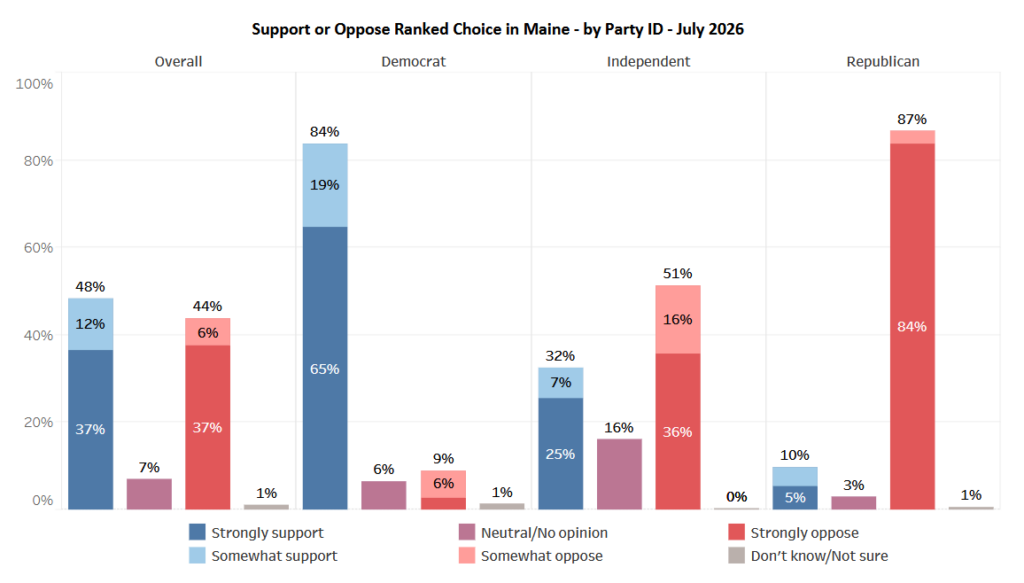
According to the latest Pine Tree State Poll, there is just a four-point difference statewide between those who support ranked choice voting and oppose it, with supporters just barely outweighing opponents.
84 percent of Democrats expressed a favorable opinion of ranked choice, while 87 percent of Republicans said that they were against it.
Among Independents, however, there is less cohesion, as well as less certainty, although the group as a whole leans more heavily towards opposing the use of ranked choice voting in Maine elections.
51 percent of Independents said that they are against the use of ranked choice voting, while just 32 percent are in favor of it. 16 percent, the largest share of any political affiliation, said that they are neutral towards it or have no opinion.