

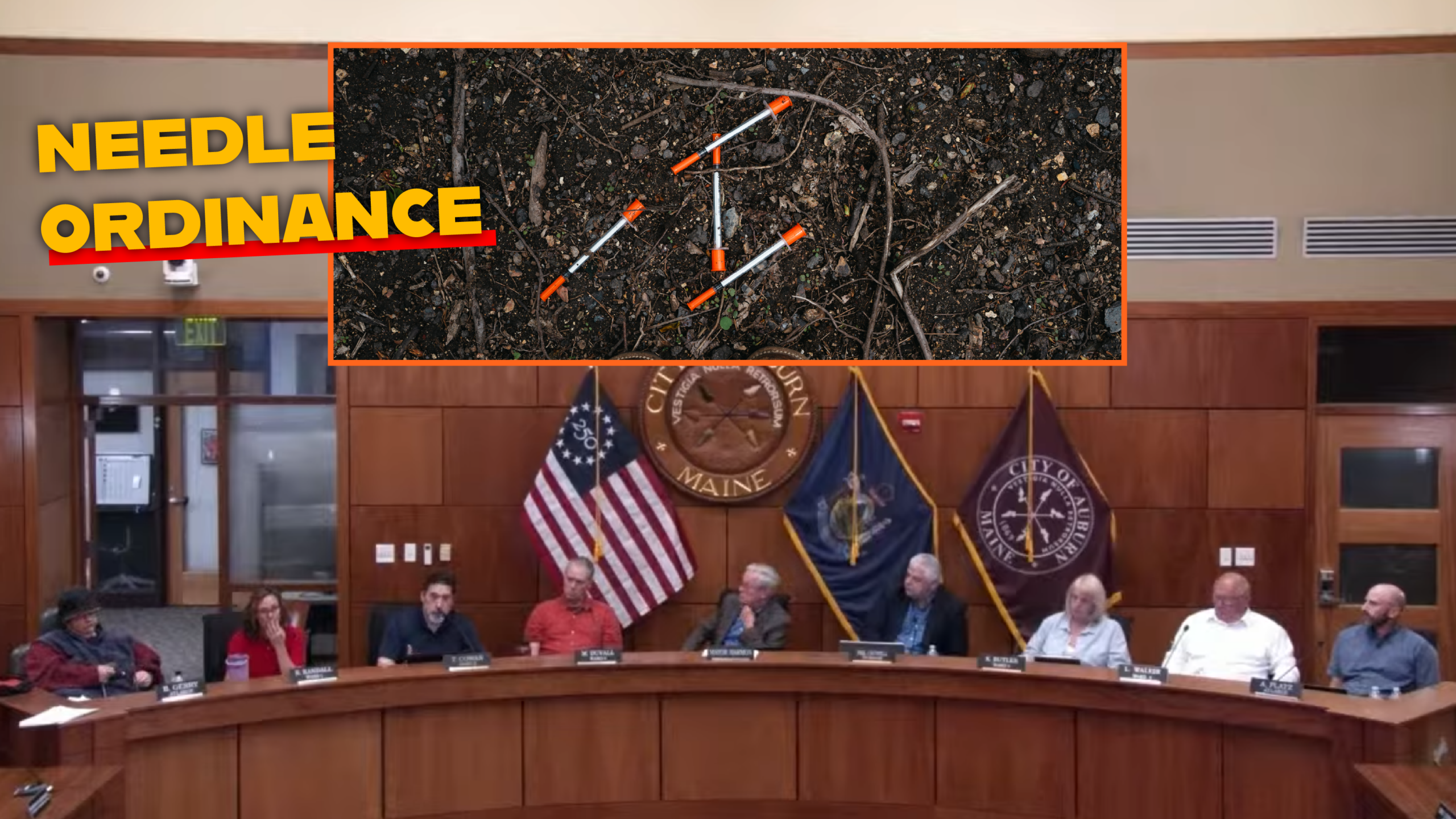
AUBURN, Maine — Following more hours of testimony from state officials, healthcare providers, city staff, addiction recovery advocates and residents, the Auburn City Council voted 5-2 Monday night to approve a new ordinance regulating syringe service programs, concluding months of debate over how the city should balance public health initiatives with growing concerns about public safety and quality of life.
The ordinance establishes Auburn’s first local regulatory framework for syringe service providers and comes as neighboring Lewiston prepares for a November referendum that would impose significantly stricter restrictions on syringe exchange programs. Together, the Twin Cities have become the center of one of Maine’s most contentious policy debates surrounding addiction, harm reduction and community safety.
Mayor Jeff Harmon opened the meeting by acknowledging the unusually large turnout and asking attendees to remain respectful throughout the evening as councilors heard from invited experts before opening the floor to public testimony.
“This is an issue that has generated a great deal of public interest,” Harmon told those gathered at Auburn Hall, emphasizing that the council wanted to hear from all sides before taking a final vote.
State Officials Defend Harm Reduction
Representatives from the Maine Center for Disease Control and Prevention, the Governor’s Office of Policy Innovation and the Future, and the Governor’s Office of Opioid Response urged councilors to approve the ordinance, describing syringe service programs as evidence-based public health tools that reduce the transmission of HIV, hepatitis C and other bloodborne diseases while helping connect individuals suffering from substance use disorder with addiction treatment, healthcare, housing assistance and recovery services.
Throughout the evening, state officials cited multiple scientific studies supporting harm reduction strategies, including a U.S. Department of Veterans Affairs systematic review that they said found syringe service programs reduce disease transmission without increasing rates of drug use or criminal activity.
One of the evening’s most significant moments came during testimony from Gordon Smith, Director of Maine’s Office of Opioid Response.
Questioned about proposed limits on syringe distribution, Smith acknowledged that the frequently discussed 100-syringe threshold was not based on scientific evidence, explaining instead that it originated during legislative negotiations as a political compromise rather than a medically established standard.
The admission became one of the central points of discussion as councilors weighed whether Auburn should adopt regulations that differ from the recommendations of state public health officials.
Spurwink Defends Local Program
Representatives from Spurwink, which operates Auburn’s syringe service program, pushed back against criticism that clients routinely receive hundreds of syringes during a single visit.
Staff testified that first-time participants generally receive between 10 and 40 syringes, depending on individual circumstances, while returning participants may receive larger quantities based on demonstrated need.
Spurwink officials emphasized that syringe distribution is only one part of the organization’s work, describing the program as an entry point for addiction treatment, healthcare, mental health counseling, housing assistance and recovery services.
The organization also presented data showing it collects more used syringes than it distributes, arguing the program removes hazardous waste from the community rather than contributing to it.
Residents Voice Sharp Divide
Public testimony reflected the deep divide surrounding harm reduction policies in Auburn.
Healthcare professionals, addiction recovery advocates and residents who shared personal experiences with substance use argued syringe service programs save lives by preventing disease transmission and keeping people connected to services until they are ready to enter recovery.
Others urged the council to reject the ordinance, arguing taxpayer-supported syringe programs normalize illegal drug use while shifting the consequences onto nearby residents, businesses and neighborhoods.
Several speakers described finding discarded needles on private property, in parks and along sidewalks, while questioning whether syringe exchange programs produce meaningful long-term recovery outcomes.
Council Questions State Officials
Councilors spent much of the evening questioning presenters about disease prevention data, syringe return rates, treatment referrals, neighborhood complaints, program oversight and accountability.
Auburn Public Works officials also discussed complaints involving discarded syringes and homeless encampments, outlining the city’s response efforts while acknowledging the challenges associated with identifying where improperly discarded needles originate.
As testimony continued into the evening, Councilor Rachel Randall successfully moved to suspend the council’s rules and reopen the public hearing, allowing additional residents to address the council before the final vote.
What’s in the Ordinance?
The ordinance creates Auburn’s first municipal licensing and oversight system for syringe service providers operating within the city. While providers must continue meeting Maine CDC certification requirements, the city will now require its own local license before a program can operate.
Among its key provisions, the ordinance:
- Limits Auburn to no more than two licensed syringe service providers.
- Requires providers to maintain both Maine CDC certification and a municipal license.
- Requires operators to submit operating, security, syringe disposal and community engagement plans as part of the licensing process.
- Applies regulations to fixed-site, mobile and delivery-based syringe service programs.
- Prohibits permanent and mobile syringe service locations within 250 feet of a school, while delivery services are prohibited within 1,000 feet of school property.
- Requires providers to install sharps disposal containers and conduct daily inspections and cleanup of areas surrounding program sites.
- Establishes additional reporting and operational requirements intended to increase accountability and provide the city with greater oversight of program operations.
- Authorizes the city to suspend or revoke a provider’s municipal license for failing to comply with ordinance requirements.
Supporters argued the ordinance creates meaningful local oversight while preserving access to public health services they say reduce disease transmission and connect people to treatment. Opponents maintained the regulations still do not go far enough to curb syringe distribution or address concerns over public drug use, discarded needles and neighborhood impacts.
Looking Ahead
Monday night’s vote marks the end of months of discussion within Auburn, but the debate over syringe service programs in central Maine is far from settled.
Just across the Androscoggin River, Lewiston voters are expected to decide this November whether to adopt a citizen-initiated ordinance that would impose significantly stricter regulations on syringe exchange programs, including one-for-one exchanges, daily distribution limits and restrictions on where providers may operate.
With Auburn choosing increased municipal oversight while Lewiston voters prepare to consider a more restrictive approach, the Twin Cities are likely to remain at the forefront of Maine’s debate over addiction policy, public health and public safety for months to come.




They need to return used needle to get a clean one. Return 10 get ten etc..
They are just enabling the behavior and making it easier to be an addict.
Drug heads make good Democrats!
This madness well illustrates how low we have sunk in Maine, as in the nation, on drug abuse and addiction. Let’s facilitate the abuse of drugs by providing the instruments for their use. Supposedly this reduces “harm,” other than the harm of being addicted to drugs. Supposedly it connects the addicts and abusers to treatment, really? What evidence is there that this really happens. None was apparently cited, because of course the claim is ridiculous.
To see this by analogy, it’s like going into the casinos to people with gambling addictions and offering them money to replace what they’ve lost so they can continue to gamble. How much sense would that make?
Living in Portland we see this everywhere. You drive in the city and there’s likely to be a drugged out individual nodding on tranq bent over in the median, head hanging down, likely drugged with instruments provided by the City.
This policy and, frankly, all the policies adopted by our cities and towns (Narcan, anyone) serve mainly to keep addicts addicted, on the dole, and on the streets.
What a joke!