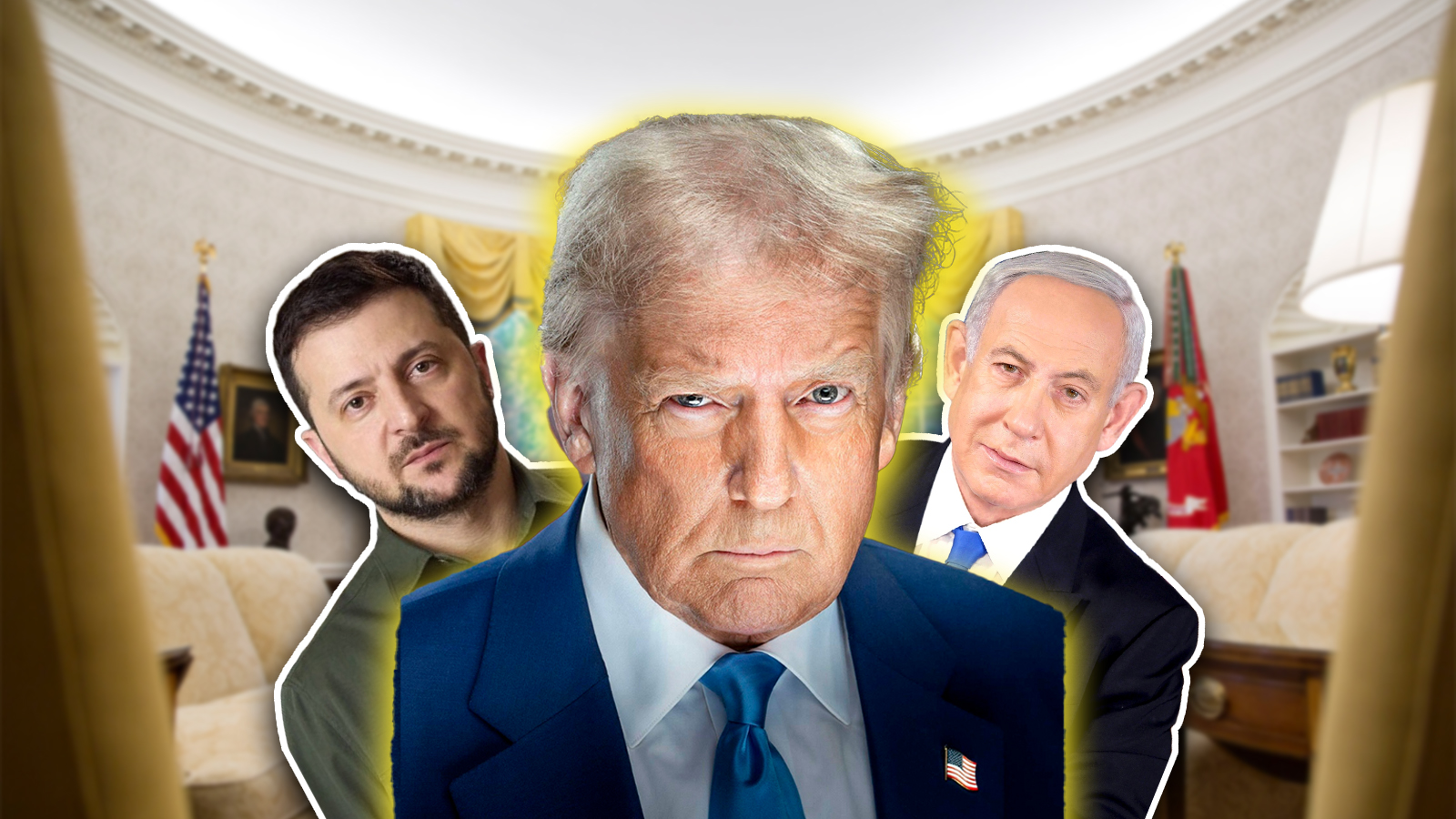
The wartime leaders traveled to Washington for the funeral of the late U.S. Sen. Lindsey Graham before holding separate meetings with President Donald Trump
President Donald Trump is hosting separate, high-stakes Oval Office meetings with Ukrainian President Volodymyr Zelenskyy and Israeli Prime Minister Benjamin Netanyahu on Tuesday as the White House confronts a rapidly converging series of global conflicts.
Both wartime leaders traveled to Washington, D.C., to attend the funeral service of the late U.S. Sen. Lindsey Graham, a longtime champion of their respective causes.
Their parallel visits come as the escalating war in Iran increasingly intersects with the ongoing conflict in Ukraine, placing Trump at the center of two consequential diplomatic discussions.
Trump, Zelenskyy Discuss Peace Framework and Air Defenses
Trump’s closed-door meeting with Zelenskyy was scheduled for 9:30 a.m., with discussions expected to focus heavily on potential peace frameworks and strategic air defenses.
Recent reporting by The Wall Street Journal indicates Trump has warmed to Zelenskyy, moving beyond their past tensions as Ukraine demonstrates battlefield resilience and expands its drone industry.
The meeting follows a recent U.S.-Russia summit in Alaska, where Trump proposed a framework under which the United States would help European countries secure Ukraine through a potential agreement resembling NATO’s Article 5 collective-defense provision.
European leaders joined the Ukrainian delegation to help ensure alignment on any proposed security arrangement.
The meeting also comes amid a dispute over Zelenskyy’s public accusation that Russia has provided Iran with satellite intelligence used to target U.S. military bases.
Trump dismissed the allegation and said he would ask Russian President Vladimir Putin directly to verify the claim.
Trump, Netanyahu Meet Amid Iran Ceasefire Tensions
Trump’s meeting with Netanyahu was scheduled for 11 a.m. and marks the eighth bilateral meeting between the two leaders since Trump returned to office.
The discussion comes amid visible friction between the Trump administration and the Israeli government over the continuing regional conflict.
Relations have become strained after Trump criticized ongoing Israeli strikes in Lebanon and paused U.S. airstrikes to give diplomacy an opportunity following the collapse of an Iran ceasefire.
Netanyahu was also reportedly not consulted before the United States entered into a recent 60-day maritime memorandum with Iran concerning the Strait of Hormuz.
The two leaders enter the meeting with contrasting priorities.
Netanyahu remains focused on confronting the long-term threat posed by Iran’s nuclear advancement and ballistic missile capabilities.
Trump, meanwhile, faces pressure from his political base to stabilize regional energy shipments and bring down gasoline prices.