

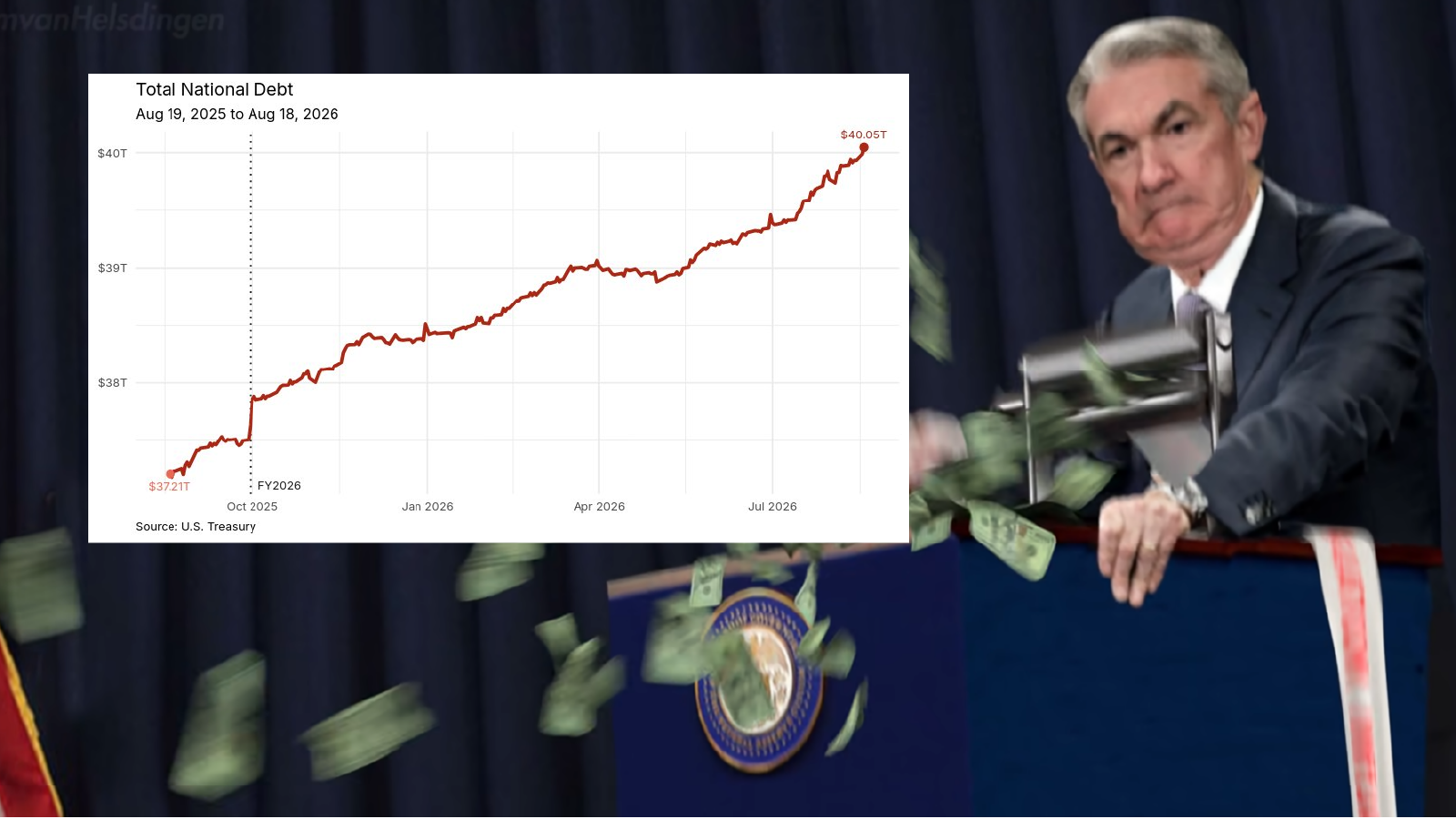
For most Americans, the bond market is something that happens somewhere on Wall Street, far removed from the monthly mortgage payment, the price of a new truck or the federal taxes coming out of a paycheck.
But beneath Washington’s debates over spending, taxes and the national debt sits an enormous financial market that helps determine how much it costs the federal government — and ultimately ordinary Americans — to borrow money.
And when that market gets nervous, Washington has reason to pay attention.
The U.S. Treasury market is where the federal government finances much of its debt. When Washington spends more than it collects in taxes and other revenue, the Treasury Department covers the difference largely by issuing Treasury bills, notes and bonds.
Investors provide the government with money today in exchange for a promise that they will receive interest and ultimately have their principal repaid.
In simple terms, Treasury securities are government IOUs.
But they are also much more than that.
U.S. Treasury securities sit at the foundation of the global financial system. Their yields influence mortgages, business loans, commercial real estate financing and investment decisions around the world.
That makes the bond market one of the most important and least understood forces affecting the American economy.
Washington’s Deficits Have to Be Financed
The basic math begins with the federal budget.
When the government spends more money than it collects during a fiscal year, it runs a deficit. The accumulated borrowing from years of deficits contributes to the national debt.
Treasury must also continually refinance securities that reach maturity, meaning Washington is regularly returning to financial markets for enormous amounts of money.
That becomes particularly important when interest rates rise.
Imagine $1 trillion in government debt carrying an average interest rate of 2 percent. At that simplified rate, the annual interest cost would be $20 billion.
Refinance the same $1 trillion at 5 percent, and the annual interest cost becomes $50 billion.
The amount borrowed hasn’t changed.
The cost of carrying it has.
Apply that concept across trillions of dollars of federal obligations and it becomes clear why interest rates matter almost as much as the headline national-debt figure.
Who Owns America’s Debt?
Despite frequent political rhetoric about America’s debt being “owned by China,” U.S. government debt is held by a sprawling collection of investors.
They include American banks, pension funds, mutual funds, insurance companies, individual investors, foreign investors, governments and central banks.
The Federal Reserve also holds Treasury securities.
Federal government accounts, including trust funds, hold another portion of the debt. That category is generally referred to as intragovernmental debt.
The remaining portion — debt held by investors outside those federal accounts — is commonly known as “debt held by the public” and is particularly important when evaluating the government’s fiscal condition.
China and other foreign governments matter, but no single foreign creditor can simply show up in Washington and demand repayment of America’s entire debt.
Treasury securities have established terms and maturity dates.
A foreign holder can sell its Treasury securities in the secondary market, potentially putting downward pressure on bond prices and upward pressure on yields if the selling is sufficiently large.
But someone has to buy them.
The Bond Market Can Say “Enough”
This is where Washington’s fiscal decisions collide with financial reality.
The federal government can issue more debt, but investors determine what return they are willing to accept for owning much of it.
If investors become increasingly concerned about inflation, deficits or the supply of new Treasury debt entering the market, they can demand higher yields.
That means higher borrowing costs for Washington.
The relationship between a bond’s price and its yield moves in opposite directions: when Treasury prices fall, yields rise.
Consider a simplified example.
If an existing $1,000 bond pays $40 annually, it provides roughly a 4 percent return based on its original price.
But if newly issued securities begin offering 5 percent, investors have little reason to pay $1,000 for the older security paying only $40.
Its market price must decline until its return becomes competitive.
That is why a Treasury selloff generally pushes yields higher.
And those higher yields don’t remain confined to Washington.
From Treasury Bonds to Maine Mortgages
One of the most closely watched securities is the 10-year Treasury note.
Its yield serves as an important benchmark throughout financial markets and has a strong relationship with mortgage rates and other long-term borrowing costs.
When Treasury yields rise significantly, borrowing throughout the economy generally becomes more expensive.
A Maine family shopping for a home can feel the consequences.
So can a small business financing an expansion, a developer attempting to build housing or a company deciding whether a major investment still makes financial sense.
Higher government borrowing costs can therefore ripple outward:
Higher Treasury yields lead to more expensive credit, which can discourage borrowing, investment and economic activity.
The national debt isn’t simply an accounting number in Washington.
Eventually, the cost of money reaches Main Street.
The Potential Debt Spiral
The more troubling scenario is one in which borrowing costs themselves begin contributing significantly to future deficits.
The cycle could look something like this:
Large deficits lead to additional borrowing.
Additional borrowing requires more Treasury issuance.
Investors demand higher yields to absorb that debt.
Higher yields increase federal interest expense.
Higher interest expense makes deficits larger.
Larger deficits require still more borrowing.
That does not mean the United States is currently destined for a debt crisis. Nor is there a single debt figure at which financial catastrophe automatically begins.
But the feedback loop explains why economists closely watch the cost of servicing the debt rather than simply focusing on the total amount owed.
As interest consumes a greater portion of federal resources, Congress has less flexibility to spend elsewhere without increasing taxes, reducing programs or borrowing even more.
Interest payments compete for federal resources alongside defense, Social Security, Medicare, Medicaid and virtually every other government priority.
What Would an American Bond Crisis Actually Look Like?
A U.S. debt crisis would probably not begin with a dramatic announcement that America had “gone bankrupt.”
The warning signs would more likely appear first in financial markets.
Imagine investors becoming increasingly skeptical about Washington’s ability or willingness to control deficits and inflation.
Treasury attempts to sell new debt, but investors demand considerably higher returns.
Yields climb.
Bond prices fall.
Mortgage rates move higher.
Businesses face more expensive financing.
Stocks come under pressure as relatively safer Treasury securities offer increasingly attractive returns.
Banks and other institutions holding large portfolios of older bonds can suffer losses as those securities decline in market value.
Meanwhile, Washington discovers that refinancing its own debt is becoming increasingly expensive.
That is closer to what a genuine Treasury-market crisis could look like.
Why America Isn’t Greece
The United States possesses an enormous advantage that countries caught in previous sovereign-debt crises did not necessarily have.
America borrows overwhelmingly in its own currency.
Greece, for example, uses the euro and does not independently control the currency in which its government debt is denominated.
The United States issues dollars.
That makes an involuntary inability to obtain dollars fundamentally different for the U.S. government.
But it does not mean Washington can spend and borrow without consequence.
The obvious question is why the Federal Reserve couldn’t simply create whatever dollars were necessary to finance the government.
The answer is inflation.
Creating money does not create additional houses, food, automobiles, energy or economic productivity.
If monetary creation substantially outpaces the economy’s ability to produce goods and services, the result can be higher prices and declining purchasing power.
In other words, attempting to solve a debt problem by creating enormous amounts of money risks turning a fiscal problem into an inflation and currency-confidence problem.
The Federal Reserve’s Complicated Role
The Federal Reserve can buy Treasury securities, and it has done so extensively during periods of financial and economic stress.
Large-scale asset purchases, commonly known as quantitative easing, can inject liquidity into financial markets and put downward pressure on longer-term interest rates.
But there is an important difference between emergency monetary policy and a central bank continually financing government deficits because private investors are demanding rates Washington finds uncomfortable.
If markets began believing the Federal Reserve was effectively required to create money to keep the government’s borrowing costs manageable, concerns about inflation could intensify.
Bondholders care enormously about inflation because they are lending today’s dollars in exchange for dollars returned years or decades later.
If a bondholder expects inflation to significantly reduce the purchasing power of those future dollars, that investor is likely to demand a higher interest rate as compensation.
That could produce the very result policymakers were attempting to avoid: higher long-term borrowing costs.
America’s Secret Weapon: The Dollar
Washington also enjoys another enormous financial advantage.
The U.S. dollar remains central to international trade and global finance, while Treasury securities provide investors with a massive and highly liquid market for dollar-denominated assets.
Foreign central banks, governments, companies and investors consequently maintain substantial demand for dollars and Treasury securities.
That international demand helps America’s ability to finance itself.
It also explains why warnings about “de-dollarization” deserve attention without automatically concluding that the dollar is about to collapse.
A gradual decline in global demand for dollar assets would not necessarily produce an overnight Treasury crisis.
But if demand weakened substantially, Washington could eventually be forced to offer higher yields to attract enough investors.
That would make financing America’s debt more expensive.
The Debt Ceiling Is a Different Problem
Then there is Washington’s recurring fight over the debt ceiling.
The debt ceiling should not be confused with the underlying national debt problem.
Congress passes spending and tax laws. Those decisions can produce deficits and financial obligations.
The debt ceiling restricts Treasury’s legal authority to borrow to meet those obligations.
Refusing to raise or suspend the ceiling does not make the bills disappear.
If Treasury were ultimately unable to make required payments on its securities, the consequences could be extraordinary because Treasury debt functions as one of the fundamental safe assets and forms of collateral underpinning global finance.
That is why even the possibility of a U.S. default can create instability.
Don’t Just Watch the National Debt Clock
The enormous national-debt figure gets the headlines.
But Americans trying to determine whether Washington is approaching a genuine fiscal danger zone should watch several indicators together: debt relative to the size of the economy, annual deficits, federal interest costs, interest expense relative to government revenue, inflation and long-term Treasury yields.
The 10-year and 30-year Treasury yields are particularly revealing.
There is no universally accepted number — $40 trillion, $50 trillion or otherwise — at which the United States suddenly becomes insolvent.
America possesses extraordinary advantages: the world’s largest and most sophisticated financial markets, a massive economy, substantial taxing authority, control of its own currency and a dollar that remains central to global finance.
Those advantages allow Washington considerably more borrowing capacity than most governments.
They are not, however, an unlimited credit card.
The more realistic danger is not waking up one morning to discover that America suddenly has no money.
It is a slower deterioration in which persistent deficits require increasingly large amounts of borrowing, investors demand higher returns, federal interest payments consume more of the government’s resources and higher Treasury yields make borrowing more expensive throughout the private economy.
At some point, Washington would face increasingly painful choices: cut spending, increase revenue, tolerate more inflation, accept higher borrowing costs or some combination of the four.
Politicians can argue indefinitely over spending and taxes.
The bond market doesn’t vote.
It simply determines what price investors are willing to accept to keep lending Washington money.
And if that price begins rising sharply, the consequences won’t stop at the Beltway.
They will eventually reach businesses, homeowners and taxpayers in Maine.




The National Debt became a crisis $40 trillion ago. None of the political class can resist pork and pandering. There is pain in our future whether they vhoose to fix the problem which will take decades or they let it go until collapse. With the cost of interest on the dept, we could pay for many new and old programs that are in trouble like social security, or without the massive fraud and illegals raising the dept more we could have had medical for all CITIZEN’s.