

The Justice Department has dramatically expanded its criminal case against the Southern Poverty Law Center, arresting a former senior official and accusing the prominent civil rights organization of secretly funneling more than $4 million in donated money to individuals associated with extremist groups while allegedly concealing how the money was being used.
A federal grand jury in Montgomery returned a second superseding indictment on Aug. 11, adding 59-year-old Heidi Beirich, a former director of the SPLC’s Intelligence Project, as the first individual defendant in the case. The indictment was unsealed Wednesday, Aug. 12, as Beirich was served with an arrest warrant in California.
The new indictment marks a significant escalation of a case that began in April, when federal prosecutors charged the SPLC itself in an 11-count indictment involving allegations of wire fraud, false statements to a federally insured bank and conspiracy to commit concealment money laundering.
The allegations strike at the heart of one of the country’s best-known, and most politically controversial, civil rights organizations and raise a central question that could ultimately be decided by a jury: Did the SPLC operate a legitimate undercover intelligence network designed to expose violent extremists, or did it deceive donors and banks while moving millions of dollars through a secret financial system?
Federal prosecutors contend it was the latter.
The second superseding indictment charges Beirich and the SPLC with conspiracy to commit wire fraud and conspiracy to submit false statements to a federally insured bank. Beirich was also added to an existing money laundering conspiracy charge, while prosecutors added another concealment money laundering count against the SPLC.
According to the Justice Department, the alleged scheme stretched from 2007 through 2023 and involved more than $4 million in donated funds that were secretly directed to individuals associated with violent extremist organizations. Prosecutors say financial accounts connected to fictitious entities were used in an effort to conceal the source, ownership and control of the money.
The indictment does not simply challenge the SPLC’s practice of paying confidential informants. It alleges that some of those payments were deliberately disguised and, in Beirich’s case, that donated money ultimately flowed into accounts from which she personally benefited.
According to court documents reported by ABC News and The Washington Post, Beirich allegedly approved payments to informants embedded in white supremacist organizations, including an individual identified as an imperial wizard in the Ku Klux Klan.
Federal prosecutors also allege Beirich had a romantic relationship with another informant who infiltrated the National Alliance, a neo-Nazi organization. That individual allegedly received roughly $1.2 million from the SPLC over approximately two decades.
Between 2015 and 2021, prosecutors say approximately $140,000 in SPLC donor money was deposited into joint bank accounts controlled by Beirich and the informant. Authorities allege that money was then used for the couple’s personal living expenses.
Another allegation involves a 2014 break-in at the headquarters of an extremist organization.
According to the indictment, the informant allegedly broke into the group’s headquarters and stole roughly 25 boxes of documents. Those materials later formed the basis of an SPLC article written by Beirich. Prosecutors allege Beirich subsequently paid another informant $6,000 to falsely accept responsibility for the burglary.
The allegations offer prosecutors something more concrete than a philosophical dispute over whether civil rights organizations should be allowed to pay informants. Instead, the government is attempting to establish that SPLC officials concealed financial transactions, made false representations about bank accounts and allowed donated money to be diverted in ways that donors were not told about.
The SPLC vigorously disputes that characterization.
The organization has maintained that its informant network was a legitimate component of its work exposing the internal operations of the Ku Klux Klan, neo-Nazi organizations and other extremist groups. SPLC attorneys have said confidential sources gathered intelligence that was sometimes shared with federal and local law enforcement and that secrecy surrounding payments was necessary to protect people undertaking dangerous undercover work.
“The SPLC did not lie to its donors,” the organization has maintained in responding to the prosecution, arguing that supporters donated precisely because they wanted the organization to identify, investigate and expose extremist groups.
An SPLC spokesperson said Wednesday that confronting violent extremist organizations remains among the organization’s most dangerous and important responsibilities and that the Justice Department’s actions would not change its mission.
Beirich’s attorney, Michael Proctor, has likewise attacked the prosecution as politically motivated.
Proctor described Beirich as a nationally recognized authority on white supremacist and far-right extremist organizations who has spent decades investigating groups including the KKK and neo-Nazi movements. He accused the Trump administration of using the criminal justice system to silence political opponents and vowed that Beirich would fight the charges in court.
That argument echoes the broader defense mounted by the SPLC since the Justice Department first announced charges against the organization in April.
The SPLC moved to dismiss the indictment on the grounds that it was the victim of vindictive prosecution by the Trump administration. A federal judge rejected that argument earlier this month, allowing the criminal case to proceed toward trial.
The prosecution has also unfolded against a backdrop of years of conflict between the SPLC and conservatives who have accused the organization of stretching its definition of extremism beyond violent white supremacist organizations to include political and religious groups engaged in lawful advocacy.
The organization, founded in Montgomery in 1971, rose to national prominence through civil-rights litigation and lawsuits targeting white supremacist organizations. Over time, its annual lists and reports identifying what it considers hate and extremist groups became widely cited by media organizations, technology companies and law enforcement agencies.
But those classifications have also generated intense criticism from conservatives who contend the SPLC has increasingly blurred the line between violent extremism and mainstream political disagreement.
That dispute reached the federal government as well.
FBI Director Kash Patel announced in 2025 that the bureau was cutting ties with the SPLC, ending a relationship in which information from the organization had previously been provided to federal law enforcement investigating domestic extremist groups.
The criminal case now places the SPLC’s internal operations, rather than merely its political influence, under extraordinary scrutiny.
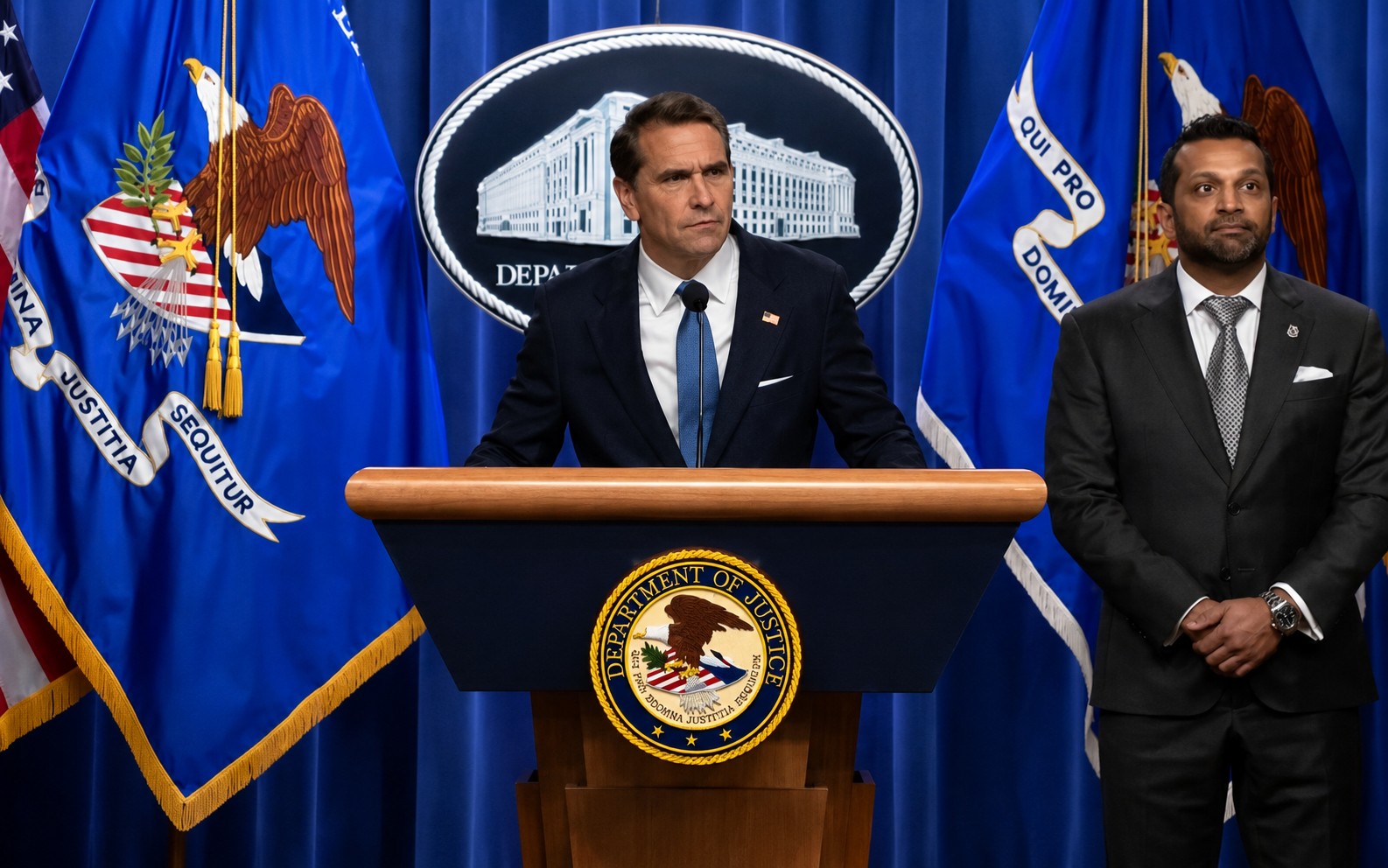
Attorney General Todd Blanche said Wednesday that the expanded indictment demonstrated investigators had continued following the evidence after the original case was filed.
The Justice Department itself has been careful to emphasize that the allegations remain unproven.
“The indictment unsealed today reflects the continued work of federal investigators and prosecutors in examining this alleged scheme,” U.S. Attorney Thomas Govan said. “We look forward to presenting the evidence in court and allowing the judicial process to determine the facts and the defendants’ responsibility for the alleged crimes.”
Beirich made an initial court appearance in Riverside, California, on Wednesday. She did not enter a plea at that hearing and was ordered to surrender her passport and appear in federal court in Alabama within two weeks.
The SPLC case is currently scheduled for trial in October in the Middle District of Alabama.
For an organization that has spent decades investigating and publicly identifying groups it says operate outside the boundaries of acceptable American political life, the coming trial will present an unusual reversal.
This time, the SPLC’s own finances, internal decisions and methods will be placed before a federal court.
Whether prosecutors can prove that those methods amounted to fraud and money laundering — rather than aggressive but lawful undercover investigative work — will ultimately be decided through the judicial process.
The Justice Department noted that an indictment contains allegations only and that Beirich and the SPLC are presumed innocent unless proven guilty beyond a reasonable doubt.




Excellently presented! Thank you for the comprehensive information. Without people like you, Americans would be unlikely to hear much about an event like this, except that its mention in the mainstream media could make use of it to denigrate the Trump Administration. The media coverage would likely accuse the present administration of being intrusive, invasive, and threatening to democracy.
Rule of law. Not rule of lawyers.
I’ll be suitably impressed if this piece of jackass party trash is prosecuted WITHOUT a plea bargain, convicted, and sentenced to the MAXIMUM allowable penalty under the law. Until if and when that happens I’ll remain EXTREMELY skeptical that this is anything more than another Mutt and Jeff show to make the plebs think there’s any accountability.
Now look into the NAACP