

Maine election officials have repeatedly assured voters that the state’s elections are secure, pointing to paper ballots, offline vote-counting machines and layers of local oversight.
But behind the paper ballots sits a statewide computer system that determines who is registered, where they are registered, which legislative district they belong to and how voter records are maintained.
And a growing series of questions, including allegations that roughly 110 Windham voters were shifted between legislative districts without moving, the unexplained difficulty of producing detailed same-day registration reports and last year’s discovery of 250 official ballots inside a package delivered to a Newburgh home — is putting renewed scrutiny on just how secure and transparent Maine’s election infrastructure really is.
The answer is not as simple as declaring the system either safe or unsafe.
Maine’s ballots themselves are overwhelmingly paper-based, providing a physical record that can be reviewed during a recount. The tabulators used to count those ballots are not connected to the internet, an important safeguard against remote manipulation of vote totals.
But the state’s Central Voter Registration system, or CVR, is different.
The CVR is the electronic backbone of Maine’s voter-registration operation. It contains voter names, addresses, party enrollment information, electoral districts, voter participation history and other election-related records.
Municipal and state election officials access the system electronically.
According to a January 2026 report from the Maine Secretary of State’s Office, the current CVR was first implemented in 2007 and is used by election officials across nearly 500 municipalities.
That means a system approaching two decades old is responsible for maintaining records for more than one million active Maine voters.
The state says access to the CVR is protected by passwords, user permissions, firewalls and restrictions preventing municipal users from directly accessing the underlying database servers.
Those are meaningful security measures.
But recent questions surrounding voter records in Windham have focused attention on something that may be just as important as preventing an outside hacker from breaking into the system:
Who can change voter records from inside the system, what changes can they make, and how easily can those changes be audited?
https://www.facebook.com/share/p/19TBScxFsm
Bagshaw Challenges State Over Windham Voters
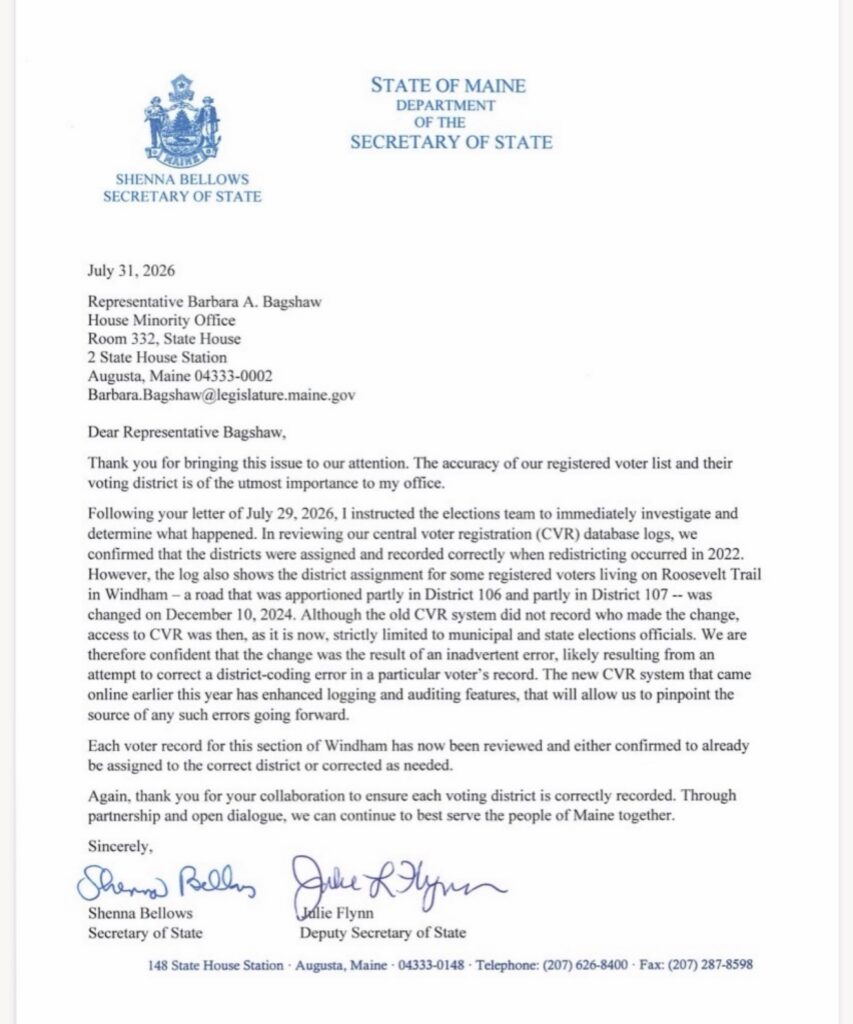
Republican State Rep. Barbara Bagshaw of Windham has raised concerns after discovering what she says were approximately 110 voters who appeared to have been shifted between House Districts 106 and 107.
According to Bagshaw, some of the voters had not moved.
If accurate, that raises an obvious question.
How does a voter who remains at the same residential address suddenly appear assigned to a different legislative district?
The Maine Wire has not independently reviewed the database histories of all 110 voters, and there is currently no evidence establishing that the changes were deliberately made to influence an election.
However, The Maine Wire was in the room with Bagshaw when she directly challenged Deputy Secretary of State Julie Flynn over the discrepancies and repeatedly pressed her for an explanation of how constituents who had not moved could appear to have been shifted into another legislative district.
The meeting, held at the Secretary of State’s Office in Augusta, became heated as Bagshaw continued questioning Flynn about what happened to the voter records.
Flynn became visibly frustrated with Bagshaw’s questioning as the lawmaker sought specific answers about how voters could be moved between legislative districts without changing residences.
That exchange goes to the heart of the larger issue.
If the affected voters never moved, did someone manually change their district designation?
Was the change caused by a street-address database?
Was it the result of GIS mapping or redistricting information?
Was it a batch update affecting multiple voters at once?
And, perhaps most importantly, does the CVR contain an audit trail showing exactly when the changes occurred and what user or automated process made them?
Those questions should be answerable.
A modern voter-registration system should be capable of showing an old value, a new value, the date and time of the change and the account responsible for making it.
If that information exists, releasing an explanation, while protecting voters’ personal information, could quickly resolve Bagshaw’s concerns.
If the state cannot provide such an audit trail, that would raise a much larger question about the system itself.
A System That Changes Every Day
Maine’s voter database is not static.
State officials have acknowledged that municipal clerks and registrars regularly add new voters and modify existing records.
During 2025 alone, Maine municipalities processed more than 76,000 voter-registration applications.
More than 20,000 were new registrations, while over 56,000 involved changes to existing voter records.
More than 31,000 of those were address changes.
The large volume of transactions is not itself suspicious. People move, change party enrollment, register for the first time or update their information every day.
But the scale demonstrates why detailed auditing matters.
When thousands of voter records are being modified every month, Maine voters should be able to have confidence that every meaningful alteration can be traced back to its source.
Why Can’t Maine Produce a Same-Day Registration Report?
Another question raised during the Augusta meeting involved Maine’s same-day voter-registration system.
Maine allows eligible residents to register to vote on Election Day.
That policy means election officials must process registrations while voting is already underway.
The obvious question is straightforward:
How many people registered to vote on Election Day?
This reporter asked Flynn about the state’s ability to produce a report showing same-day voter registrations.
A clear answer was not provided.
That deserves further examination.
Maine’s statewide voter-registration database already tracks new registrations, address changes, voter histories and numerous other election-related transactions.
If the system records when a registration was entered, it would appear technologically possible to query registrations entered on a particular date, including Election Day.
If Maine’s system cannot do that, voters deserve to know why.
If it can do it but the state simply does not routinely produce or release the report, that is a different issue entirely.
The distinction matters.
The question is not whether same-day voter registration should exist.
The question is whether Maine’s election administrators can tell the public exactly how many people used it.
Transparency should make that an easy number to produce.
The Mystery of 250 Ballots in Newburgh
The Augusta meeting also turned to one of the strangest ballot-security incidents Maine has faced in recent years.
In 2025, approximately 250 official Maine ballots intended for Ellsworth were discovered after being delivered to a private residence in Newburgh.
The ballots reportedly arrived inside an Amazon package.
The incident immediately raised questions about chain of custody.
How could hundreds of official ballots destined for one municipality end up at an unrelated private residence?
During the Augusta meeting, this reporter questioned Flynn about the ballots and sought a clear explanation of what happened.
A definitive explanation was not provided during that meeting.
There has since been an important development.
UPS later attributed the delivery to an unintentional shipping error, saying the ballots had been delivered to the wrong address.
The matter had previously been referred to the Maine Attorney General’s Office.
There is no evidence that the blank ballots were used to cast fraudulent votes.
That distinction is important.
But it does not eliminate the security question.
Election security is not simply about proving fraud after the fact.
It is also about preventing mistakes, maintaining documented custody of election materials and immediately identifying when something goes wrong.
If 250 ballots can disappear from their intended delivery chain and arrive at a private home, voters have every right to ask what procedures have since been changed to ensure it does not happen again.
Maine’s Paper Ballots Remain a Major Safeguard
Maine does have significant structural protections.
The state’s reliance on paper ballots means there is a physical record of votes that can be recounted.
The tabulators counting those votes are not connected to the internet.
That makes Maine considerably different from a hypothetical voting system in which ballots exist only as electronic records.
There is currently no evidence that Maine’s statewide election results have been electronically altered.
But securing vote totals is only one part of election integrity.
An election system also depends on accurate voter rolls.
Correct legislative districts.
Secure absentee ballots.
Documented custody.
Accurate voter histories.
Controlled access to election databases.
And clear records showing who altered information and why.
An Aging System Preparing for Replacement
The state’s own reports acknowledge that Maine’s Central Voter Registration system is old.
The current system was implemented in 2007.
Maine has been working toward replacing it with a modernized voter-registration and election-management platform.
That transition itself raises another series of questions.
Has the new system gone live?
Has the voter database been fully migrated?
Who tested the migration?
Was an independent cybersecurity assessment performed?
Does every user accessing the system now use multi-factor authentication?
How many accounts have administrator-level privileges?
Can those administrators make batch changes affecting hundreds or thousands of voters?
Are those changes permanently logged?
Those are not conspiracy theories.
They are ordinary cybersecurity and database-management questions.
Trust Is Not the Same as Transparency
Election officials frequently argue that misinformation about voting systems can undermine confidence in elections.
That is true.
But confidence can also be damaged when legitimate questions are met with vague explanations, anger or an unwillingness to produce underlying records.
The solution to public skepticism is not less scrutiny.
It is more transparency.
Bagshaw’s questions about the Windham voters provide the state with an opportunity to demonstrate how its system works.
Produce the audit history.
Show whether the voters’ addresses changed.
Show when their district assignments changed.
Explain whether the change was manual or automated.
Explain whether other voters statewide were affected.
The same principle applies to Election Day registrations.
If the state can run the report, run it.
If it cannot, explain precisely why.
And regarding the 250 ballots delivered to Newburgh, explain not only how the shipping error occurred but what safeguards were changed afterward.
Maine’s elections may ultimately prove to be exceptionally secure.
But that conclusion should come from independently verifiable controls, records and audits — not simply assurances from the officials administering the system.
There is an important difference between asking voters to trust an election system and giving them the information necessary to verify it.
With Maine heading toward another major election, the question is one state officials should welcome rather than resist:
Just how safe and secure are Maine’s elections?



By not allowing the feds to verify the rolls you lose all creditability.
To anyone asking any questions about the voters district moving from one district to another it’s a simple answer.
The computer automatically done it!
That’s an answer that I personally have been told by a state employee not once but twice about a different issue.
My response to that answer is the computer is only as smart as the individual pushing the button! I feel that dealing with someone that gives you the run around or that kind of response is trying to tell you that you are too stupid to understand how a computer works.
What they clearly don’t understand is I do know how a computer works. You tell the computer what you want to do Not the other way around.
You just need an address and name to vote. So yes, there is corruption.
Corruption where?
Do you mean there’s a bigger bag of maggots in the secretary of State’s office?
I have ZERO TRUST in Sheena Bellows and her merry band of incompetents running an honest election .
Illegal alien Somalis will be voting in November . Non resident college students will be voting .
You know it and I know it .
The DEMOCRATS want it that way .
Maine’s elections will never be legitimate until the voter rolls are cleaned. Then democrats will fall to the wayside.
As long as we have RCV and Bellows breathing the air in Maine, NO TRUST AT ALL.
Oh can’t forget all the illegal relatives from the Congo who requested absentee ballots, those are the ones Hanna wants to bring in. They can’t read or speak English but will vote for Hanna.
Isn’t the internet a wonderful thing.
I was a resident of Montana for three years. I had a MT drivers license. I came back because of covid and went to register to vote again in my small town and had never been taken off the voter rolls. After I switched my license to Maine, I got a letter from MT stating I would be taken off the voter rolls unless I responded. Why cant we do this?
“A clear answer was not provided.”
This leads a Maine voter to NOT feel safe with the system as it now stands. Trump has put forward a plan, but only a start. Why are not the votes in The Congress not there?
How are deceased voters taken off the data bases?