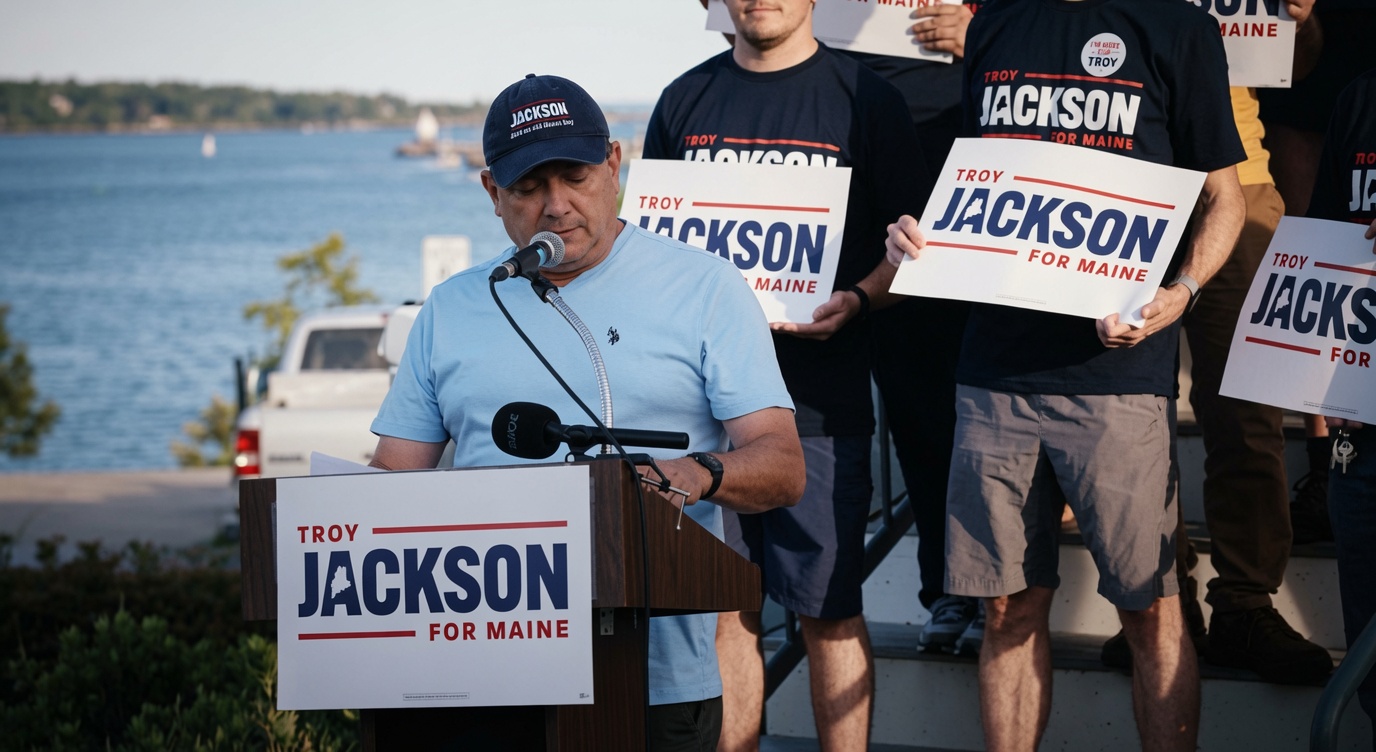
The Maine Secretary of State’s Office is declining to determine whether Democratic U.S. Senate nominee Troy Jackson is eligible to appear on November’s ballot under Maine’s so-called “sore loser” law, leaving the increasingly contentious legal dispute to the political parties and potentially the courts.
In a response to a challenge raised by State Rep. White, Deputy Secretary of State Kate O’Brien said the Secretary of State’s Office will not issue a legal opinion on Jackson’s eligibility.
Instead, O’Brien wrote that the issue is one for the political parties to resolve, not the Secretary of State’s Office. She added that, as far as the state is concerned, Jackson remains on the general election ballot.
The decision leaves unresolved one of the most closely watched election law questions of the 2026 campaign.
The Background
The controversy stems from Jackson’s unsuccessful campaign for the Democratic nomination for governor earlier this year. After losing that primary, Jackson was later selected by Democratic convention delegates as the party’s nominee for the U.S. Senate after the original nominee withdrew from the race.
Rep. White has argued that Jackson’s nomination violates Maine’s “sore loser” statute, which generally prohibits candidates who lose a primary election from appearing on the general election ballot.
White contends that because Jackson lost the Democratic gubernatorial primary, he is barred from appearing on the November ballot as the Democratic nominee for another office during the same election cycle.
Jackson’s supporters dispute that interpretation, arguing the law was intended to prevent candidates from losing a primary for one office and then seeking the same office as an independent or under another party designation, not from later becoming their party’s nominee for a different office after an unexpected vacancy.
Bellows Steps Aside
Secretary of State Shenna Bellows did not personally rule on the matter. Instead, Deputy Secretary of State Kate O’Brien responded on behalf of the office.
Rather than interpreting the statute, O’Brien said the Secretary of State’s Office would not weigh in on the legal merits of the dispute, stating that it is an issue for the political parties to resolve. She further stated that Jackson remains on the ballot unless a court determines otherwise.
The response stops short of declaring Jackson’s nomination lawful or unlawful, leaving the central legal question unanswered.
Legal Challenge Could Follow
The Secretary of State’s decision not to issue a formal interpretation may simply shift the dispute to Maine’s judicial system.
If a lawsuit is filed, a judge would likely be asked to determine whether Maine’s “sore loser” law applies only when a candidate seeks the same office after losing a primary, or whether it also prohibits a candidate from appearing on the ballot for a different office later in the same election cycle.
With ballots expected to be finalized in the coming weeks, any legal challenge would likely move on an expedited timeline.
Until then, Jackson remains the Democratic nominee for U.S. Senate, while the broader legal question surrounding his eligibility remains unresolved.