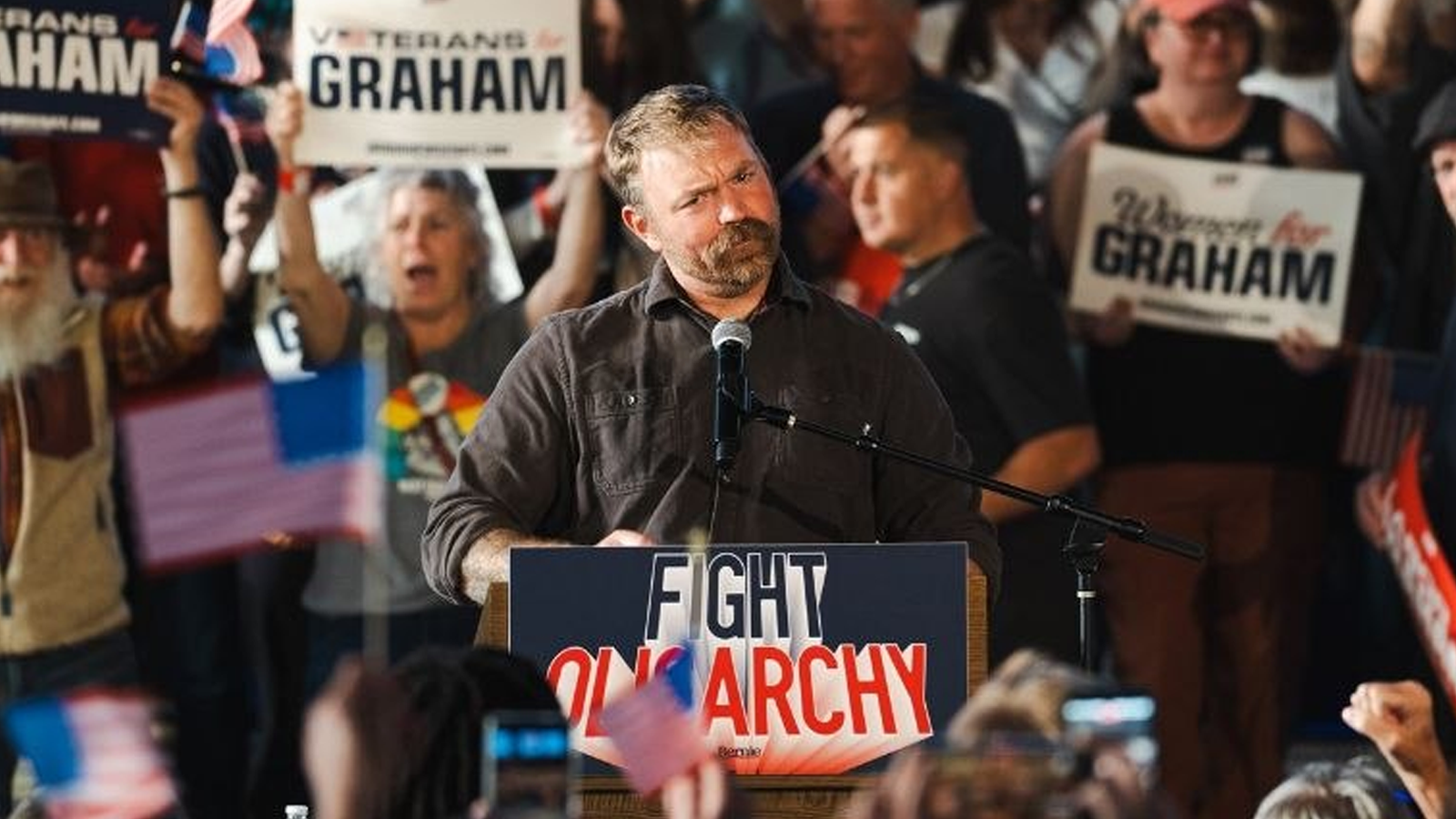
Former Democratic U.S. Senate nominee Graham Platner has been removed from the speaking lineup at an upcoming Labor Day rally in Ellsworth, a significant change as Maine Democrats work to move beyond the controversy surrounding their former nominee and focus on the November battle between Troy Jackson and Republican U.S. Sen. Susan Collins.
Platner, an oyster farmer and Marine combat veteran from Sullivan, had been scheduled to headline the Sept. 7 “Labor Day Rally for Labor” outside Ellsworth City Hall.
The appearance was expected to be one of Platner’s most prominent public events since withdrawing from Maine’s U.S. Senate race in July following a sexual assault allegation from a former girlfriend. Platner has denied the allegation.
Now, organizers say he will not take the stage.
“Graham is not speaking,” Carol Leonard of Hancock County Activists, the progressive organization hosting the event, told the Associated Press.
“The media frenzy got just too insane, and we became concerned about safety,” Leonard said.
Platner is still expected to participate in the event by leading a veterans’ march following the rally.
The change follows criticism over the decision to give Platner a prominent speaking role only weeks after the collapse of his Senate campaign.
Platner had been expected to address the history of the American labor movement and the importance of organized labor, subjects closely aligned with the working-class populist message that propelled his rapid rise through Maine Democratic politics.
But the planned appearance also threatened to return Platner, and the controversies surrounding him, to the political spotlight just as Democrats attempt to consolidate behind Jackson.
Platner decisively won Maine’s Democratic U.S. Senate primary in June after building a grassroots campaign centered on housing, health care, unions and working-class voters.
His candidacy was also repeatedly disrupted by controversies involving past online comments, sexually explicit messages exchanged with women while he was married and a tattoo recognized as resembling a symbol associated with Nazi Germany. Platner said he was unaware of the tattoo’s association and later had it covered.
His campaign ultimately collapsed after a former girlfriend publicly accused him of sexual assault. Platner denied the accusation but withdrew from the race in July.
Maine Democrats were then forced to select a replacement nominee through a special convention.
Former Maine Senate President Troy Jackson overwhelmingly won that contest, receiving 566 delegate votes and becoming the Democratic nominee against Collins.
Jackson now faces the challenge of rebuilding a statewide campaign with only months remaining before Election Day while attempting to separate his candidacy from the political fallout surrounding the man he replaced.
That separation has not always been simple.
Jackson campaigned alongside Platner earlier in the election cycle, but he distanced himself after the sexual assault allegation became public. Jackson has since indicated that he would neither seek nor accept Platner’s endorsement.
Republicans, meanwhile, have attempted to keep the connection alive.
A Republican super PAC released an advertisement following Jackson’s nomination seeking to link the two Democrats, while the renewed attention surrounding Platner’s Ellsworth appearance immediately generated frustration among some Maine Democrats.
Former Maine Democratic Party Vice Chair Peggy Schaffer openly questioned why activists would give Platner such a prominent platform.
“I don’t know what they were thinking,” Schaffer told the Bangor Daily News when Platner’s appearance was initially announced.
The controversy also reportedly caught Jackson’s campaign by surprise.
That matters politically because the Collins-Jackson contest is developing into one of Maine’s most closely watched races.
Collins, a five-term Republican seeking another term, enters the fall campaign with substantial fundraising and organizational advantages. Jackson is attempting to counter those advantages by portraying himself as a working-class alternative with deep ties to northern Maine.
Jackson has also launched a series of public town halls across the state, seeking to draw a contrast with Collins and build his campaign around direct voter engagement.
The last thing Democrats need as that strategy gets underway is another round of headlines surrounding the candidate Jackson replaced.
The Hancock County Democratic Committee initially promoted the Labor Day rally online before removing references to Platner. The committee has stressed that it is not organizing the event and that the rally is not affiliated with the Maine Democratic Party.
The rally itself is being organized by Hancock County Activists.
Platner’s removal from the speaking program does not mean he is disappearing entirely.
He remains expected to lead the veterans’ march, giving the former nominee a public presence without the formal platform that had generated the controversy.
For Jackson, however, the episode illustrates a political problem that may continue through Election Day.