On Feb. 25, the CDC made its expected announcement that it was updating its framework to monitor and contain COVID-19.
“We’re in a stronger place today as a nation with more tools to protect ourselves in our communities from COVID-19, like vaccination, boosters, broader access to testing, availability of high quality masks, accessibility to new treatments, and improved ventilation,” said CDC Director Rochelle Paula Walensky.
Most media headlines focused on the CDC’s relaxed mask guidelines, which advised that most Americans could ditch masks. How the CDC arrived at this conclusion has received little scrutiny, however.
Changing Its COVID Risk Formula
As many people likely noticed, the CDC changed its mask guidance even though COVID cases and COVID mortality remain high. As of March 1, daily new cases stood at roughly 60,000 based on its 7-day rolling average, which is significantly higher than last summer and virtually identical to one year ago. Meanwhile, about 1,600 Americans continue to die each day of COVID-19, according to government data, a figure that is, again, exponentially higher than last summer and similar to a year earlier.
Walensky explained the healthy agency’s reasoning in her call with reporters.
“With widespread population immunity, the overall risk of severe disease is now generally lower,” Walensky said, according to the transcript. “Now, as the virus continues to circulate in our communities, we must focus our metrics beyond just cases in the community and direct our efforts toward protecting people at high risk for severe illness and preventing COVID 19 from overwhelming our hospitals and our healthcare systems.”
There are two takeaways here.
The first is that Walensky’s call to direct efforts “toward protecting people at high risk for severe illness” sounds a bit like the Focused Protection strategy many public health experts and epidemiologists have been advocating all along, some of whom were labeled “fringe” scientists by the government’s top infectious disease bureaucrats.
Second, it’s worth examining how Walensky reached this conclusion. During the call, Dr. Greta Massetti of the CDC noted that “70% of Americans are in areas with low or medium COVID 19 community levels.”
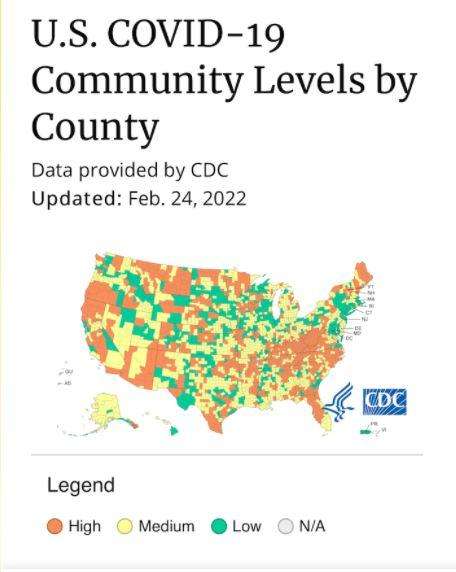
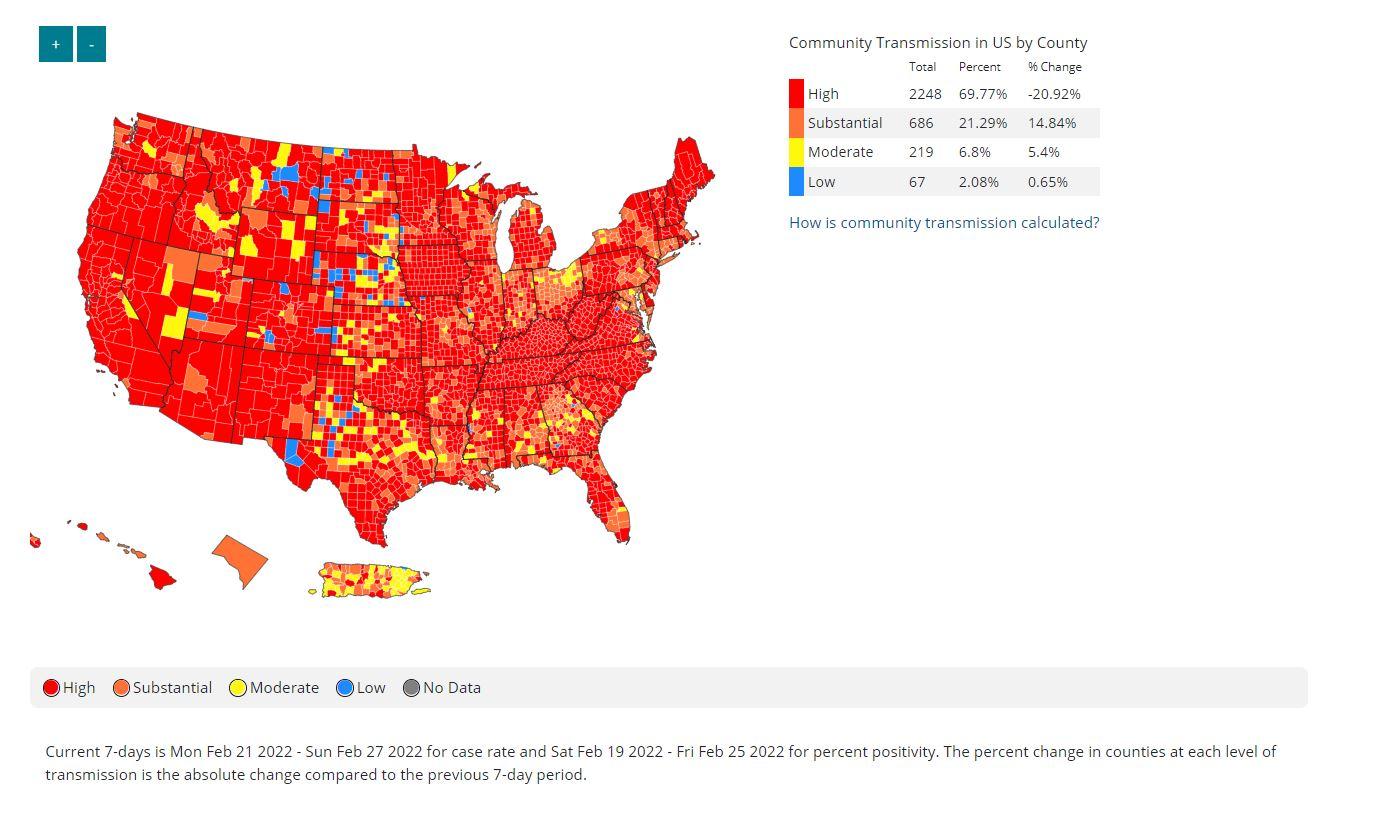
Just days before, however, CDC data showed the vast majority of US counties were suffering from high transmission (see below). Then, virtually overnight, most of the US suddenly was in the low or medium category.
Massetti explains the CDC simply changed the formula it used to measure community transmission, or “updated metrics in this framework,” as she says.
“A community’s COVID 19 level is determined by a combination of three pieces of information,” Massetti explained, “new hospitalizations for COVID 19, current hospital beds occupied by COVID 19 patients or hospital capacity, and new COVID 19 cases.”
By simply changing its formula to include hospitalizations and hospital capacity, the CDC took the vast majority of the US from a state of high community transmission to low or moderate. The color red is also conspicuously absent.
‘It’s Time We Accept COVID Is Here to Stay’?
Many people likely are not angry that the CDC changed its COVID risk formula. The changes are likely going to allow most Americans to resume life in a somewhat normal fashion again, without being forced to show vaccine passports to eat in a restaurant or wear a mask to go to yoga class or run to the grocery store.
Numerous surveys show this increasingly is what Americans want.
A recent Yahoo News/YouGov poll showed that 46 percent of respondents believed Americans should “learn to live with” the virus and “get back to normal,” while only 43 percent said, “we need to do more to vaccinate, wear masks and test.”
An Echelon Insights poll showed an even stronger inclination to stop restrictions, with 55 percent of voters saying that COVID should be “treated as an endemic disease that will never fully go away,” compared to just 38 percent of voters who said COVID should be “treated as a public health emergency.”
Meanwhile, a Monmouth University poll found that 70 percent of Americans agreed with this statement: “it’s time we accept Covid is here to stay and we just need to get on with our lives.” The same poll also showed sharp drops in support for vaccine mandates, social distancing, and mask mandates.
New York Times writer Nate Cohn observed something important about the recent polling and the American mood.
“The [polling] results are especially striking at a time when coronavirus cases, hospitalizations and even deaths are near record highs,” Cohn wrote in February. “Indeed, the same polls showed that the public’s concern about the virus increased during the Omicron wave. But in a telling indication of the public’s attitudes toward the pandemic, greater worry about the virus has not translated to greater support for measures to stop its spread.”
On Friday, the CDC revised its covid risk formula.
— Clarity (@covid_clarity) February 28, 2022
With this single change, the pandemic abruptly eased going from 90% of the United States in High-Risk Red to less than 30%. pic.twitter.com/iwhlxYMPPZ
A Lesson in Economics
The CDC’s sudden and radical change to its COVID risk formula appears to be a response to this change in mood.
Many will contend that this is not how “science” is supposed to work, and they’d be correct. But pandemic policies were never “scientific” because science can never tell us what we should or must do.
“[T]here is no such thing as a scientific ought,” the economist Ludwig von Mises observed, echoing a famous argument by philosopher David Hume. “Science is competent to establish what is.”
Pandemic policies were created by public health officials and politicians. And public choice theory—a field of economics pioneered by the Nobel Prize-winning economist James M. Buchanan—tells us these people make decisions based on incentives just like everyone else.
As I’ve previously explained, early in the pandemic, the incentive for most public officials was clear: take every precaution necessary to avoid being blamed for COVID deaths—regardless of the efficacy or damage of the policies.
“It’s important to remember that politics, above all else, is about self preservation. And imposing government restrictions that don’t work and cause serious harms is a better political strategy for most politicians than telling people to act responsibly, wash hands, maintain a prudent distance, and avoid touching your face,” I wrote in 2020. “So if you’re wondering why our world has begun to resemble a Joseph Heller or Kafka novel where orders and action seem arbitrary, senseless, and counterintuitive, look to public choice theory.”
Social distancing and masking are not more effective today than they were two years ago. Nor are they less effective. The basic science of non-pharmaceutical interventions remains the same, even if some contextual factors of the pandemic have changed (new variants, the presence of vaccines, etc.).
The primary change is the appetite for non-pharmaceutical interventions. Americans have grown tired of them, and this above all else is likely what prompted the CDC to change its COVID risk formula, which virtually overnight took the vast majority of the country from a state of high community transmission to low or moderate community transmission—even though cases and mortality remain high.
The scary color of red is now gone completely from the CDC’s graphics. And all but a handful of Democrats at Tuesday’s State of the Union address appeared with faces bare indoors in a crowded Capitol building.
To understand why and how it happened, don’t look to science. Look to public choice theory.
This article was originally published on FEE.org. Read the original article.
Image: U.S. CDC and @covid_clarity on Twitter