
The U.S. House Committee on Oversight and Government Reform is investigating Maine’s provision of Medicaid benefits to illegal aliens.
But Maine officials may be giving congressional investigators political spin and half-truths instead of straightforward answers to the questions posed in a Sept. 3 letter to Gov. Janet Mills (D), according to records obtained under Maine’s Freedom of Access Act.
The documents show a coordinated effort by Mills administration officials to minimize disclosure and avoid a congressional subpoena, rather than provide the House Oversight Committee with a full accounting of Maine’s Medicaid spending on noncitizens, including illegal aliens.
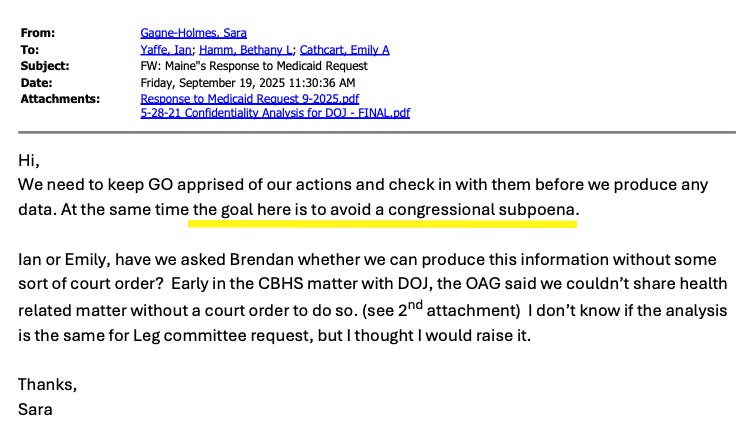
State officials scrambled to respond to the inquiry, launched in a letter from House Oversight Chairman James Comer (R-Ky.), with one senior Mills appointee stating explicitly that “the goal here is to avoid a congressional subpoena.”
Comer’s request for data on Medicaid spending for illegal aliens set off a flurry of activity between the governor’s office and the Department of Health and Human Services, led by Commissioner Sarah Gagné-Holmes. Ultimately, the Mills administration certified under penalty of perjury that Maine spent less than $15 million on emergency Medicaid services for illegal aliens from 2019–2025. But that figure was only reached after narrowing the scope of responsive records as tightly as possible without violating the law.
Congress asked for all Medicaid and Emergency Medicaid procedures and benefits provided to “illegal aliens” or individuals with “unsatisfactory immigration status.” A reasonable person would interpret that as money MaineCare spent on people who are not U.S. citizens or naturalized citizens — in other words, individuals not eligible for federally reimbursed Medicaid.
Maine’s partisan DHHS staff, however, reinterpreted the request’s language to minimize the records provided while maintaining the appearance of compliance. According to the FOAA documents, that strategy appears to have been developed in coordination with other Democratic-controlled states, including Colorado, Minnesota, New York, California, Illinois and Oregon.
While all 50 states must provide emergency Medicaid coverage to noncitizens, Maine and the states with which it coordinated its response are among the minority that also provide full Medicaid benefits to certain classes of noncitizens.
In Maine, all noncitizens under age 21 and all pregnant women — during pregnancy and a post-partum period — receive the same full Medicaid benefits as U.S. citizens.
Inside DHHS, the politically sensitive response to congressional Republicans was led by key officials including MaineCare Director Michelle Probert, Office of Family Independence Director Ian Yaffe, and Assistant Attorney General Brendan Kreckel.
Comer’s letter to Mills and Gagné-Holmes requested eight categories of information about MaineCare. The committee sought the names of all programs that provide health coverage and “other services for illegal aliens,” including Medicaid and Emergency Medicaid; verification procedures for immigration status; the number of people denied coverage or shifted to Emergency Medicaid due to “unsatisfactory immigration status”; and a list of every Medicaid or Emergency Medicaid procedure provided to an illegal alien, along with costs.
The request framed the inquiry as part of a broader investigation into waste, fraud, and abuse in Medicaid programs that serve noncitizens.
On Sept. 16, DHHS General Counsel Emily Atkins Cathcart signed an initial response acknowledging the request and asking for more time.
In a separate communication, DHHS staffer Hamm told colleagues that other states were also delaying production. Minnesota and Colorado were seeking 30-day extensions with no data provided, while New York and California were making limited productions without committing to more.
By then, Maine had produced nothing.
After extensive internal debate, the Mills administration decided to interpret “unsatisfactory immigration status” to include only:
- Individuals who are not eligible for full Medicaid, and
- Are eligible solely for Emergency Services Only coverage.
This interpretation, though technically compliant, excluded the vast majority of Medicaid spending on noncitizens — including lawful-presence noncitizens with limited benefits, refugees and asylees, undocumented children in CHIP/UCO programs, adults under 21, noncitizens receiving full MaineCare, and anyone receiving non-emergency care.
The effect, seemingly by design, was to drastically underreport Maine’s Medicaid spending on noncitizens.
Three days later, on Sept. 19, Commissioner Gagné-Holmes said DHHS needed to keep the Governor’s Office involved and “check in with them before we produce any data,” adding that “the goal here is to avoid a congressional subpoena.”
That message suggests close oversight from the governor’s office — and hints that records produced under subpoena might reveal a different picture of DHHS’ spending on illegal aliens than the voluntary production.
The administration’s sensitivity to subpoenas came against the backdrop of a secretive warning issued by Attorney General Aaron Frey (D), a close Mills ally, on Jan. 10 — just ten days before President Donald Trump’s second inauguration.
In an email to DHHS staff, Frey instructed employees not to comply with any requests from the U.S. Department of Justice or the U.S. Attorney’s Office for the District of Maine.
“All DHHS Departments have received a directive from the Office of the Attorney General (OAG) advising staff that if an attorney, or anyone else, from the Department of Justice or the U.S. Attorney’s Office reach out looking to meet or seeking information, staff should not respond,” according to an internal DHHS email obtained by The Robinson Report.
Maine’s Attorney General has instructed employees of at least one state agency to avoid cooperating with officials from the U.S. Department of Justice or the U.S. Attorney’s Office, according to a Jan. 10 email obtained by the Maine Wire.
As DHHS worked on its response, MaineCare and OFI staff sought guidance on how to interpret terms such as “illegal alien” and “unsatisfactory immigration status.”
In a meeting summary, Yaffe said OFI wanted a consistent definition and planned to footnote the state’s own terminology rather than adopt the committee’s. Yaffe appeared particularly resistant to using “illegal alien,” a legal term used widely throughout federal law.
Probert, meanwhile, recommended limiting data to Emergency Medicaid-only cases. In a Sept. 23 email, she urged excluding CHIP “uninsured children’s option” cases, warning that including them would expand the codes reported and “likely mean a lot of follow up questions.”
Under Maine law, noncitizen “children” covered by MaineCare include individuals up to age 21.
Assistant Attorney General Kreckel advised that the term “unsatisfactory immigration status” could be read to apply only to those ineligible for full Medicaid and eligible solely for emergency services, aligning the interpretation with the committee’s questions on Emergency Medicaid.
Together, these semantic maneuvers and legal interpretations allowed Maine to produce a response that was technically compliant but substantively hollow.
On Oct. 16, Probert signed the administration’s formal response to the House Oversight Committee. The five-page letter, on DHHS letterhead, claimed to respond on behalf of the Office of MaineCare Services and attached the state’s production.
Probert wrote that Maine interpreted “unsatisfactory immigration status” to refer only to noncitizens eligible for emergency-only coverage. She also asserted — without evidence — that the production “is not evidence of ‘waste, fraud and abuse,’ as indicated in the Request.”
The main attachment, a 26-page spreadsheet titled “House Oversight Request – Incurred Years 2019 and Forward (Paid Through July 2025),” listed Emergency Medicaid spending by diagnostic group, outpatient procedure code, clinic encounter and pharmacy class — totaling $14,591,390.26.
In a separate certification, Probert attested that Maine conducted a “diligent search” for all responsive materials and had not destroyed or altered documents after receiving the request.
But because the administration defined the target population so narrowly — excluding CHIP/UCO and other noncitizen categories, adopting a cramped reading of “unsatisfactory immigration status,” and avoiding the term “illegal alien” — the records produced appear far smaller in scope than what House investigators sought.
The internal correspondence reveals a state government more focused on legal defensiveness and political positioning than on answering the core question: How much taxpayer money is Maine spending on Medicaid for illegal aliens and other noncitizens?
Gagné-Holmes’ emphasis on avoiding a subpoena, the persistent efforts to interpret key terms in the narrowest way possible, and decisions to trim categories of data all point toward a coordinated strategy to minimize exposure, not provide transparency.
Taken together with AG Frey’s directive that DHHS staff avoid contact with the Trump DOJ, the Mills administration’s approach is unlikely to ease congressional suspicion that Maine has improperly sought federal reimbursement for noncitizen Medicaid claims to help balance its budget.
Maine would not be the first Democratic state caught charging the federal government for noncitizen Medicaid costs.
In September, news emerged that California had overbilled the federal government by $500 million for Medicaid benefits provided to illegal aliens — prompting efforts by the Trump administration to claw back those improperly claimed funds.