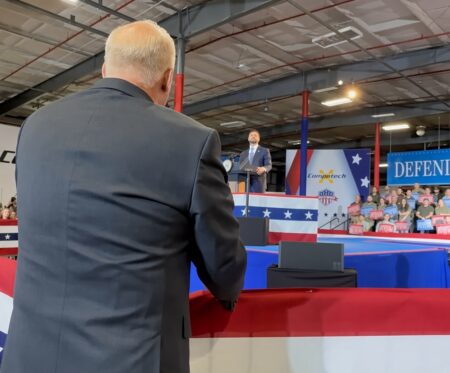
AUBURN, Maine — Owen McCarthy used his remarks Saturday at the Lincoln Dinner to deliver a forward-looking pitch for Maine’s future, arguing that the state is being crushed by bad policy decisions and needs a course correction built on opportunity, affordability, and discipline.
Speaking to Republicans gathered in Auburn, McCarthy mixed personal stories about family, work, and growing up in Maine with a broader political message centered on economic reform, deregulation, energy costs, housing, education, and reviving the state’s traditional industries.
McCarthy began by reflecting on his upbringing, saying he learned the value of hard work early by watching his father leave for work at 2 a.m. and return home at 6 p.m., only to keep working on weekends. He said those lessons, along with the accountability his mother instilled, shaped the way he sees both life and leadership.
He told the audience he was the first in his family to attend college, doing so on scholarship, and later worked in the paper industry, where he gained firsthand experience with one of Maine’s foundational economic sectors.
From there, McCarthy said, he became an entrepreneur and launched multiple businesses, including a technology company focused on helping stroke and Parkinson’s patients improve mobility through rhythm and music. He said the company raised $60 million in venture capital, completed clinical trials, secured a Medicare code, and helped people around the world, all from Maine.
For McCarthy, that experience reinforced a core belief: innovation can happen here, but only if government stops getting in the way.
McCarthy said he is now looking at Maine not just as a businessman, but as a husband and father. With two young sons, Oliver and Theodore, he said he worries that their generation may not have the same opportunities he had growing up.
He argued that working-class Mainers are increasingly being priced out of the state and said that reality is the direct result of policy failures.
McCarthy pointed to rising energy costs, high property taxes, deteriorating schools, the spread of drugs into Maine communities, the loss of basic services in rural areas, and the shrinking availability of healthcare. He cited places like Patten, where he said families now face long drives to reach labor and delivery services.
“We cannot survive this way,” McCarthy said, framing the moment as a crisis that demands a serious long-term plan.
That plan, he said, is what drove the rollout of his “2040: Lead Again” vision, a framework built around three pillars: opportunity, affordability, and discipline in government.
On opportunity, McCarthy said Maine has to fix the fundamentals. He called for an immediate income tax cut and the rollback of regulations that make it harder for businesses to operate or expand in the state.
He also highlighted industries he believes Maine should aggressively support, including maritime innovation and forest products. McCarthy said the United States is making massive investments in small boats and ocean sensing, and argued that Maine’s long boatbuilding tradition positions it to meet that demand and create jobs in the process.
He also warned that policymakers are threatening the forest products industry, which he said still employs 29,000 people. McCarthy specifically raised concerns about dam removal proposals in central Maine, suggesting such decisions could have devastating ripple effects on mills and the broader industry.
He also pointed to new manufacturing possibilities, including carbon fiber and advanced materials, and said Maine should ensure businesses that start here are able to stay and grow here.
On affordability, McCarthy focused on what he described as the three major pressure points facing families: energy, taxes, and housing.
He said Maine needs a more reliable energy base and a long-term conversation about small modular nuclear reactors. On housing, he argued that the state must make it legal and practical to build again, with a permitting process that is predictable and timely.
McCarthy said that in some parts of Maine, the problem is not local hostility to development, but the lack of skilled tradespeople needed to actually get projects built. That, he suggested, is another sign that Maine’s workforce and economic systems are badly out of balance.
Throughout the speech, McCarthy returned often to the idea that Maine’s problems are man-made and can be reversed if state leaders are willing to challenge the status quo.
He also spent part of his remarks answering lighter personal questions, using them to reinforce his broader political message. Asked what makes someone a true Mainer, McCarthy pointed to hard work, self-sufficiency, and problem-solving.
He recalled his first jobs picking rocks and cutting, splitting, and stacking firewood, saying those early experiences taught him grit. He also told a story about helping repair a log cabin wall with his uncle, describing it as a lesson in Yankee ingenuity and the willingness to figure things out as you go.
Those stories, while humorous at times, fit neatly into the larger theme of his speech: Mainers know how to work, build, and solve problems, but government has made too many things harder than they need to be.
Asked about his favorite Saturday night meal, McCarthy said his answer has changed over time. While baked beans and hot dogs once topped the list, he said his favorite now is making chocolate chip pancakes with his children and watching their excitement.
He also spoke emotionally about the people who have had the greatest impact on his life. McCarthy praised his wife, Holly, calling her a rock through the years, and also singled out the late Al Neely, a mentor who pushed him to do more and give back to his community.
McCarthy said Neely, a pulp and paper scholar, World War II veteran, Exxon executive, and longtime Maine lobsterman, left him with a piece of advice that still sticks with him: “Keep pushing on the elephant. Eventually it will move.”
McCarthy closed by applying that message to Maine politics, arguing that if Republicans stay focused and energized in 2026, they can become an unstoppable force for change.
His speech offered a clear picture of the campaign he wants to run: one rooted in Maine’s heritage, focused on economic revival, and aimed squarely at voters who believe the state has become too expensive, too overregulated, and too difficult for working families to thrive.