

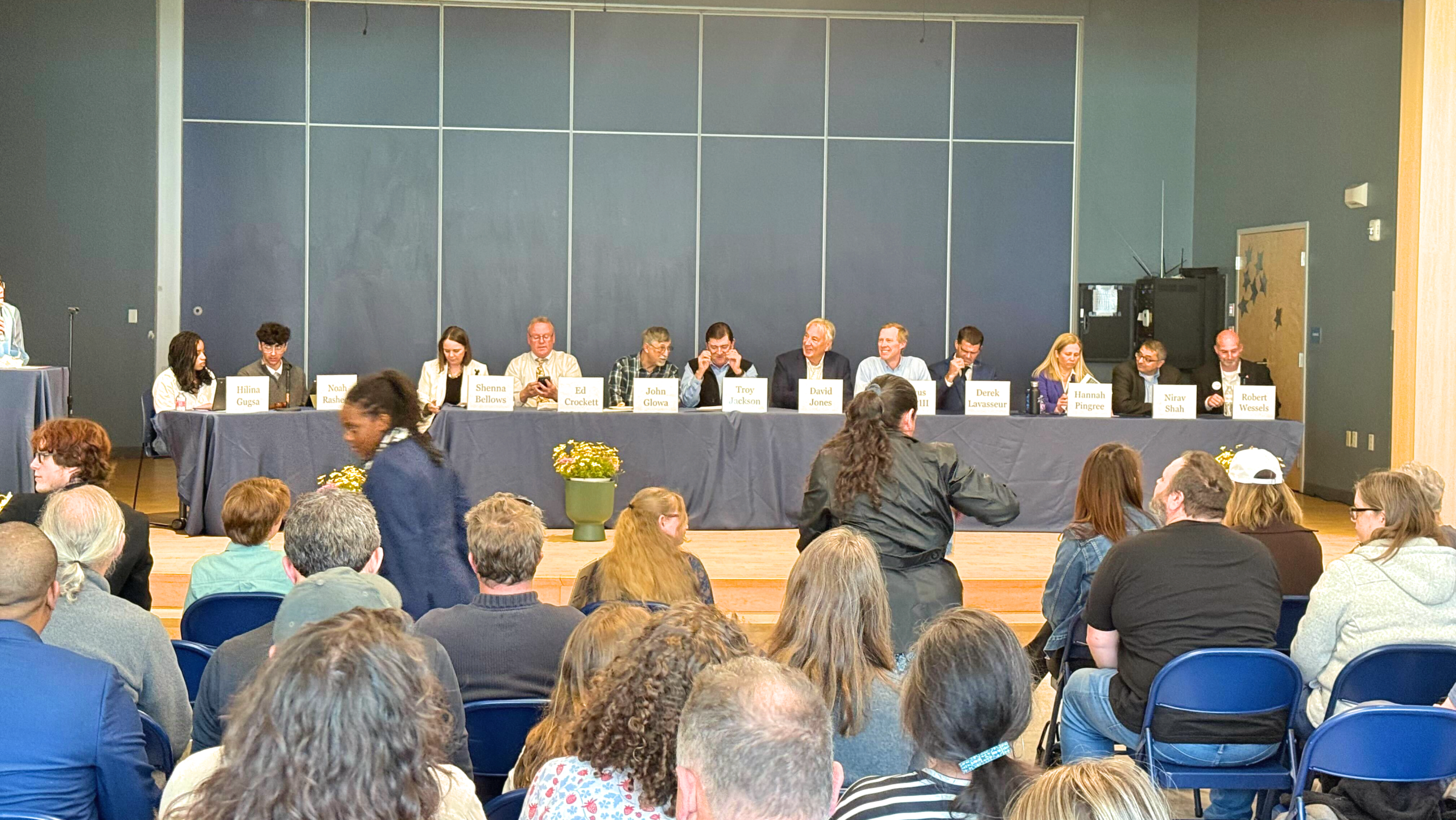
PORTLAND, Maine — Ten candidates for Maine governor appeared Monday evening at Amanda Rowe Elementary School in Portland for a student-led forum that placed Maine’s public schools, falling test scores, immigration enforcement, youth homelessness, and school funding at the center of the 2026 race.
The candidates in attendance were Democrats Shenna Bellows, Troy Jackson, Angus King III, Hannah Pingree, and Nirav Shah; Republicans David Jones and Robert Wessels; and independents Ed Crockett, John Glowa, and Derek Levasseur.
The forum was moderated by students and structured around formal parliamentary rules, with candidates limited to timed responses. Students delivered policy briefings before each question, citing Portland’s role as Maine’s largest school district, the state’s academic decline, the impact of ICE activity on school attendance, the rise in youth homelessness, and concerns over the state’s school funding formula.
Candidates were first asked to identify the most urgent issue facing Maine schools and what they would do in their first 100 days as governor.
Bellows said Maine must overhaul the way it funds schools, arguing that the current system relies too heavily on property taxpayers.
“My first hundred days I will introduce a moral budget that fully funds education,” Bellows said, pledging investments in teacher pay, infrastructure, school supplies, mental health, school-based health centers, meals, special education, and English language learning.
Jones pointed to Portland’s academic numbers and argued that Maine’s education system needs structural change.
“42% math proficiency, 62% reading proficiency, 78% graduation rate,” Jones said. “These are statistics that we all should not want to be proud of.”
Jones said New Hampshire is near the top nationally while Maine has fallen behind.
“Numbers don’t lie, people do,” Jones said. “We need to make some serious structural changes here.”
Wessels said education is one of the main reasons he entered the race and said Maine schools must return to the basics.
“The purpose of education is getting our young people ready for life after school,” Wessels said, arguing that schools should focus on reading, writing, math, science, and preparation for work, college, or the trades.
King focused on literacy, saying Maine must ensure students can read by the end of third grade.
“If you cannot read, everything else becomes hard,” King said.
Jackson framed the issue around teacher pay, recalling that his mother earned just $14,600 in her first teaching contract. He said Maine must raise pay to attract and retain educators.
Pingree said the next governor’s first budget would be critical, pledging investments in teachers, schools, mental health, career and technical education, and other programs she said are proven to work.
Shah described public education as “critical infrastructure,” comparing schools to roads, water systems, and hospitals. He said Maine must address the teacher workforce shortage and protect public schools from federal actions.
Students then asked whether the candidates viewed Portland Public Schools’ diversity as an asset to Maine’s future. The district was described as serving more than 6,500 students, with students from more than 40 countries speaking more than 60 languages.
Several candidates praised Portland as central to Maine’s workforce and economy.
Shah called Portland Public Schools “one of the greatest assets that the state of Maine has,” saying the district is tied directly to economic growth.
Pingree said Portland’s diversity is a strength and called the district one of the most innovative in Maine.
King said Portland educates “the most diverse population” in the state and said that diversity helps Maine welcome new workers.
Jones sharply disagreed with the broader praise for Portland’s school system.
“Portland public schools are the poster child for why we need school choice in the state of Maine,” Jones said. “How do you measure success when you have nothing but failure?”
Jones said Portland has dedicated teachers and some strong programs, but argued those efforts are overwhelmed by “administrative bloat” and ideological mandates.
The forum moved next to academic performance, with students citing 2024 national testing results showing Maine’s math and reading scores at a 30-year low. Candidates were asked what measurable interventions they would use to close the gap between state standards and national proficiency.
Bellows again blamed school funding, saying the state has hidden behind local control while forcing towns to rely on property taxes. She called for greater state support, full funding for special education and English language learning, and accountability for curriculum quality.
Crockett said Maine’s standards are too soft compared with Massachusetts and called for stronger graduation requirements.
Jackson said teacher pay remains central to the crisis and called for a minimum teacher salary of $60,000.
Jones argued that Maine is spending too much money for poor results.
“We spent over $20,000 a year per child and the results are horrible,” Jones said. “We’re in the bottom five.”
He pointed to Mississippi’s academic turnaround and called for a “Maine miracle.”
“You know how miracles happen? By having leadership,” Jones said.
Wessels said Maine needs to focus on fundamentals, introduce competition through school choice, and reduce Augusta’s control over local schools.
“I blame the system,” Wessels said.
Immigration enforcement produced some of the sharpest contrasts of the night. Students said increased ICE operations in early 2026 caused fear among immigrant families and contributed to major absences in Portland schools. Candidates were asked whether they would support state-level safe zones prohibiting immigration enforcement on or near school grounds.
Bellows directly criticized President Trump and ICE.
“Every child deserves to feel safe and welcome and respected in our schools and our streets and our state, and we need ICE out,” Bellows said.
Bellows said ICE had requested undercover license plates from her office.
“I said, hell no, there are no undercover police in a democracy,” Bellows said.
She also referenced threats she received after ruling Trump ineligible for Maine’s ballot.
“I had death threats,” Bellows said. “I had to go live in a safe house.”
Bellows said she would support safe zones, back communities in court, and use state resources if necessary to challenge ICE.
Jones took the opposite position, saying he would not implement sanctuary policies.
“As Governor of the State of Maine, it is my job to enforce the law of the land,” Jones said. “I will not implement any state-level safe zone policies. I am not for sanctuary cities, and I am not for sanctuary states.”
Jones said he would cooperate with federal law enforcement and argued that Maine’s Constitution guarantees public education but does not create “sanctuary schools.”
Jackson said he would have moved aggressively against ICE if he were governor, accusing officers of violating constitutional rights.
King said every child deserves to get to school without fear.
Pingree said governors are on the front lines of protecting constitutional rights and immigrant families.
Shah said the ICE actions were “unacceptable and horrific” and said no child should fear walking to school.
Students also questioned candidates about youth homelessness, citing rising homelessness in Maine and the impact on school attendance and grades. Candidates were asked whether they would restore and expand student homelessness prevention funding.
Bellows said yes, “full stop,” saying students cannot learn if they do not know where they will sleep.
Jackson said homelessness may be one reason test scores are falling, arguing that children cannot learn if they are sleeping in cars or moving from place to place.
Pingree called housing her “favorite issue,” saying that if people do not have homes, “nothing else in Maine works.”
Shah said cutting homelessness prevention funds does not save money, but shifts costs to shelters, municipalities, and families.
Jones said he would not expand the program.
“I definitely will not do it,” Jones said, arguing that government programs waste money and create dependency.
He said Maine can afford to help people in need, but only if taxpayer dollars are spent properly.
Wessels also expressed caution about continuing the program, saying he would need to learn more but would lean against continuing it. He blamed Maine’s housing crisis on overregulation, government costs, and poor housing policy.
On school funding, students asked whether candidates would support allowing Portland to adopt a local option tax, such as a sales or meals tax, to fund schools.
Wessels said yes because he supports local control but warned Portland officials that overtaxing residents could drive people away.
Shah, Pingree, Jackson, Bellows, Glowa, and Crockett all expressed support for local option revenue in some form.
Jones rejected the tax-focused approach and said Republicans believe money is better left in people’s pockets.
“As governor, one of the things I want to do is eliminate property tax on primary physical residence,” Jones said, proposing a higher homestead exemption and audits of state spending.
The candidates were also asked about leadership values. Bellows said her guiding rule is to “do the right thing, even when it’s hard.” Jones said he would be honest, trustworthy, and sincere, with an open-door policy and bottom-up management. Wessels described himself as a servant leader who believes in personal responsibility and smaller government.
In a rapid-fire round, candidates were asked yes-or-no questions on education funding, universal pre-K, free community college, school construction, vouchers, McKinney-Vento transportation reimbursement, free school meals, bathroom and sports policies based on sex at birth, and funding for Wabanaki, African, and Asian studies curriculum mandates.
The forum ended with closing statements.
Jones closed by again calling for a “Maine miracle” in education.
“I want to see our kids do great,” Jones said. “I want to go from the bottom five to the top five.”
Wessels said his answers may not have matched the views of everyone in the room but argued Maine needs less government involvement in schools.
“We need to get Augusta out of our schools,” Wessels said.
Bellows closed by tying her campaign to her public school background and her fights with Trump.
“When he came for your voter data, I said, go jump in the Gulf of Maine,” Bellows said.
The Monday evening forum offered one of the clearest contrasts yet in the 2026 gubernatorial race, with candidates split over whether Maine’s schools need more state funding, more local flexibility, more school choice, or a fundamental overhaul of the public education system.




Maine needs to teach the ABC’s, NOT LGQBT.
Jackson’s MOTHER made 14,000 dollars a year!!!!How many years ago was that!!