

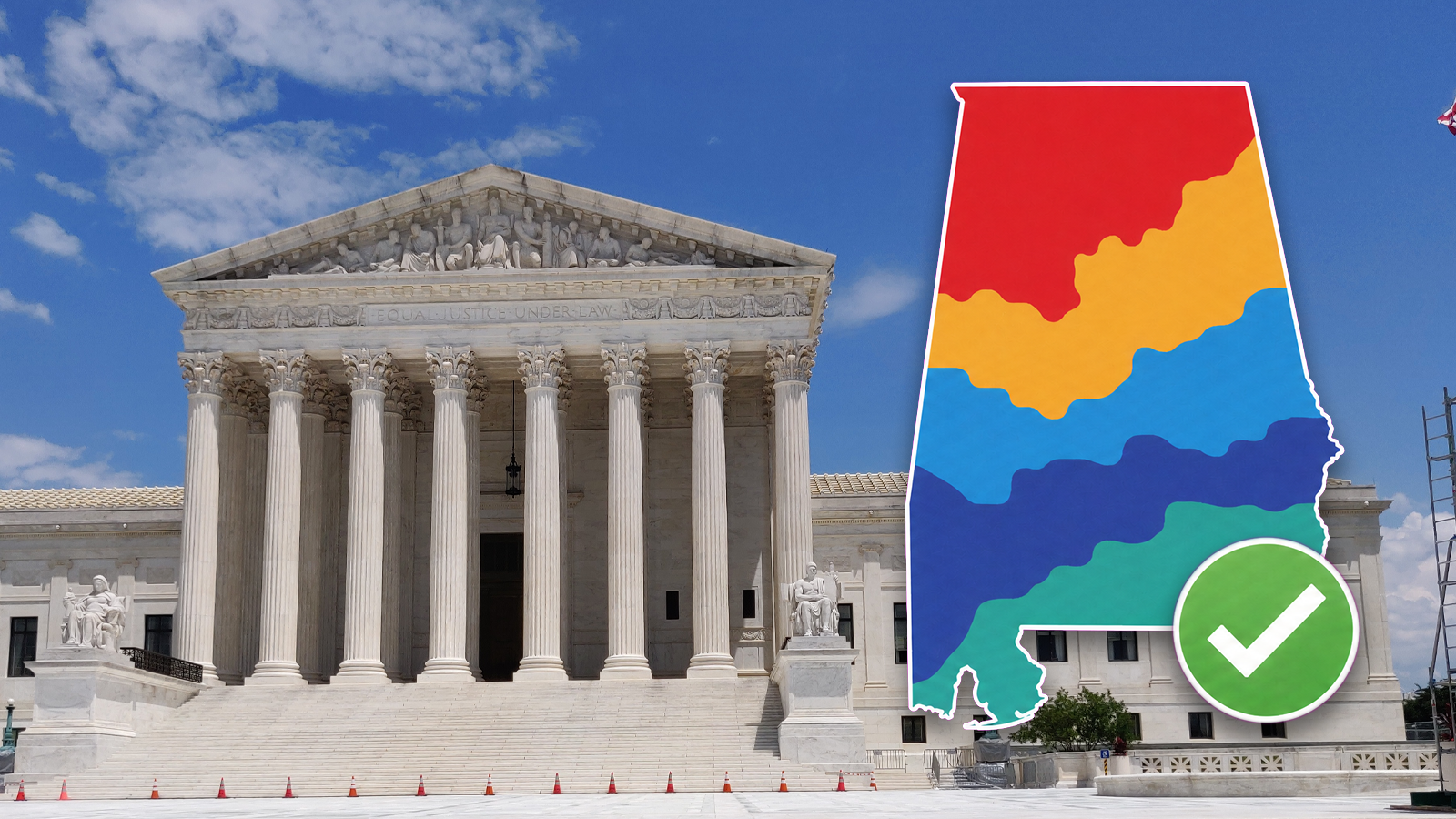
The United States Supreme Court has paved the way for Alabama’s new congressional map, drawn up in 2023, ahead of the 2026 midterm elections.
Justices Sonia Sotomayor, Elena Kagan and Ketanji Brown Jackson dissented from the majority, resulting in a 6-3 decision.
In light of the Court’s ruling last week in a redistricting case out of Louisiana, the majority vacated a lower court’s ruling concerning the Alabama map and sent it back down for further proceedings.
In deciding the Louisiana case, the majority of the Court ruled that compliance with §2 of the 1965 Voting Rights Act, which “prohibits racial discrimination in voting practices or procedures,” does not warrant an exception to the Constitution’s prohibition on race-based discrimination with respect to voting.
[RELATED: Supreme Court Strikes Down Louisiana Congressional Map As An “Unconstitutional Racial Gerrymander”]
Although the majority did not expound upon the reasoning behind their decision in the Alabama case, the dissenting justices offered a brief explanation for their position, arguing that the ruling was “inappropriate and will cause only confusion as Alabamians begin to vote in the elections scheduled for next week.”
“Alabama violated the Fourteenth Amendment by intentionally diluting the votes of Black voters in Alabama,” the dissenting justices said. “That constitutional finding of intentional discrimination is independent of…and unaffected by, any of the legal issues discussed in [the Louisiana case].”
Alabama has been wrapped up in legal challenges over its redistricting attempts since it first adopted an updated map in light of the 2020 census.
While the original map was struck down for allegedly violating the Voting Rights Act by spreading Black voters across multiple districts, a second map that included a single Black-majority district was again challenged despite state officials offering alternative explanations for the boundaries drawn.
In the fall of 2023, the Supreme Court blocked Alabama from using this map in the 2024 election, leading to the implementation of a remedial map drawn by the district court.
With Monday’s ruling, Alabama will now be permitted to use the 2023 map with one majority-Black district for the upcoming elections.
Because this decision came so close to Alabama’s May 19 primary date, Gov. Kay Ivey (R) has scheduled an August 11 special election for the districts impacted by the change.
Attorney General Steve Marshall and Secretary of State Wes Allen praised the Supreme Court’s ruling Monday.
“For too long, unelected federal judges have had more say over Alabama’s elections than Alabama voters. That ended today,” said Attorney General Marshall.
The Secretary of State called the decision a “historic win for Alabama voters.”
[RELATED: Supreme Court Blocks Push to Redraw Only GOP District in NYC Ahead of 2026 Midterms]
Earlier this year, the Supreme Court allowed redrawn congressional maps in both Texas and California to stand despite allegations of racial gerrymandering.
While the Texas map is expected to flip five seats held by Democrats to the GOP, California expects to see five Republican seats go to members of the Democratic party.
California’s redistricting push came as a response to Texas’ own efforts, as Gov. Gavin Newsom (D) promised at the time to take steps to “nullify what happens in Texas,” calling it a “power grab” by President Donald Trump (R).
[RELATED: Supreme Court Allows California to Use Redrawn Congressional Maps for 2026 Election]
Changing California’s congressional maps required voter approval, however, as the new maps would be overriding the ones created by the state’s independent redistricting commission. Residents green-lit the move in November with 64 percent support.
Typically, congressional maps are updated just once every ten years in accordance with the latest Census results.
With both California’s and Texas’ maps in effect for the upcoming 2026 election cycle, their respective impacts on the overall balance of power in Congress are expected to cancel each other out.



Sotomayor , Kagan , and Jackson ALWAYS dissent when it comes to common sense “ AMERICAN “ issues .
Note to Democrats :
Play stupid games . Win stupid prizes.
Keep it up .
November is fast approaching .