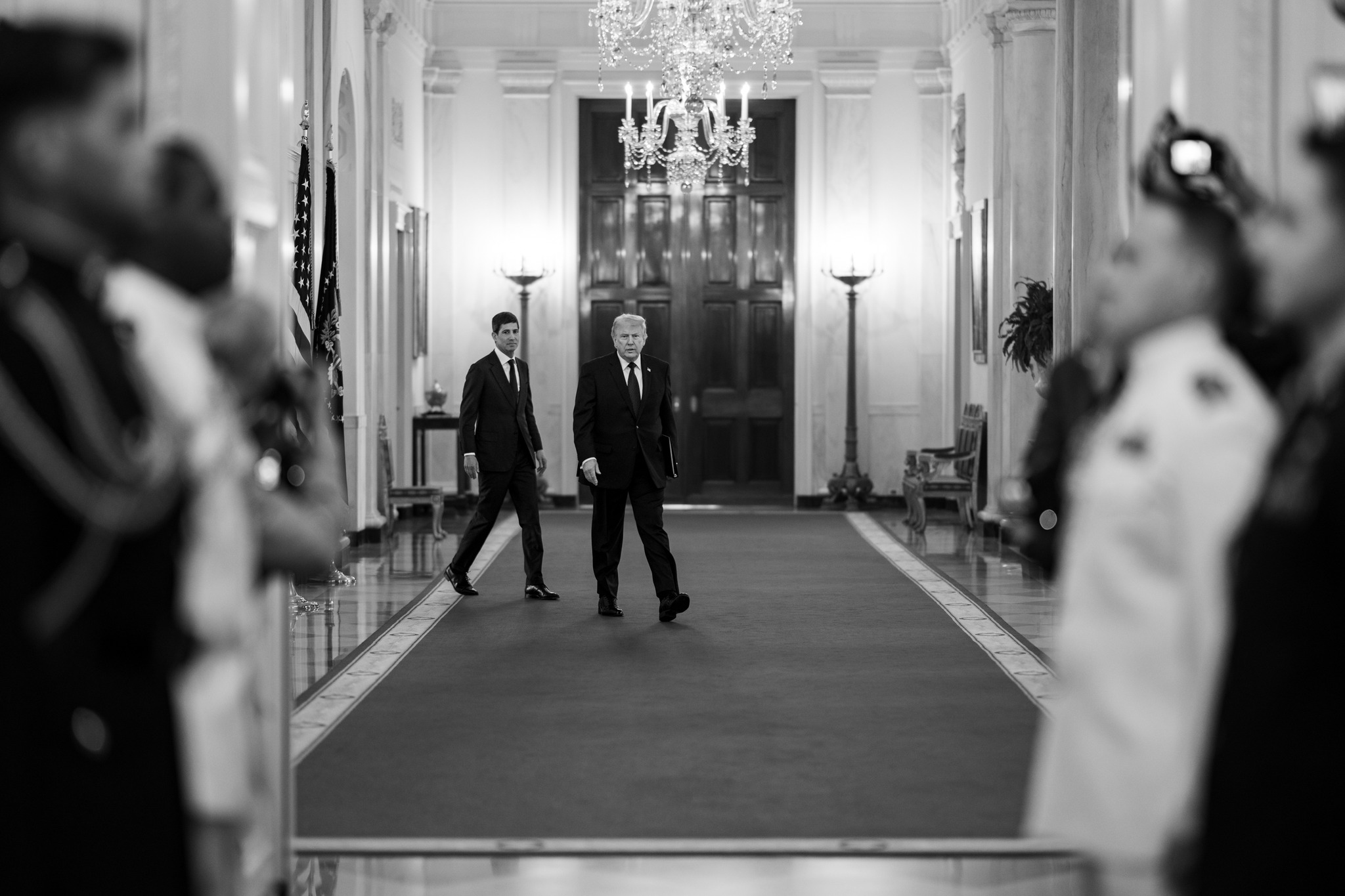
WASHINGTON, D.C. – President Donald Trump is meeting with his Cabinet on Wednesday as his administration confronts a volatile turning point in the four-month-old U.S.-Iran war, following a new round of American airstrikes that has placed an already fragile ceasefire under renewed strain.
Despite the military escalation, Washington and Tehran remain engaged in peace talks mediated by Pakistan and Qatar. Whether those negotiations can produce a final resolution remains uncertain, as Trump faces growing political resistance at home and significant disagreements with Iran over the terms of any agreement.
On Monday, U.S. Central Command forces launched what the Pentagon described as “self-defense” strikes in southern Iran, targeting missile launch sites and speedboats. According to the Pentagon, the targets were preparing to launch missiles and lay naval mines.
The strikes occurred despite a weeks-long ceasefire extension already in place between the two sides. Iran’s foreign ministry condemned the attack, which killed four Iranian soldiers, as a “grave violation” and an act of “bad faith.” Tehran, however, stopped short of abandoning the ongoing peace process.
At the same time, the U.S. naval blockade of Iranian ports remains fully operational. CENTCOM has confirmed that American forces have turned around 108 ships since April 13. Iran has responded by maintaining its own localized shipping blockade near the Strait of Hormuz, one of the world’s most critical maritime routes.
The military developments come as Trump has sent mixed signals about the status and urgency of a possible peace agreement.
Over the weekend, Trump said a deal had been “largely negotiated.” Since then, he has said there is “no hurry” and suggested the eventual outcome will either be a “great deal” or “no deal” at all. The emerging memorandum of understanding would establish a temporary halt in the fighting and allow the Strait of Hormuz to reopen. The framework would then begin a 60-day negotiating period focused on more difficult long-term issues, including the future of Iran’s nuclear program.
That issue remains one of the most significant obstacles to an agreement.
Trump has maintained that Iran will never be allowed to obtain a nuclear weapon. He recently indicated that Iran’s highly enriched uranium could either be destroyed in place or transferred to a neutral location under United Nations supervision.
Iran has expressed a willingness to export the uranium to the International Atomic Energy Agency, but has explicitly refused to surrender it to the United States.
Negotiations have also been complicated by a new demand from Trump that Middle Eastern nations, including Saudi Arabia, Qatar and Pakistan, sign onto the Abraham Accords and normalize relations with Israel as a condition of the broader peace package.
At home, the proposed framework has drawn criticism from hard-line Republicans, who argue that leaving Iran’s underlying nuclear infrastructure in place would make any agreement appear tilted in Tehran’s favor.
Public frustration with the war is also growing. Rising global fuel prices have contributed to increasing opposition among American voters, with recent polling indicating that a majority favor ending military operations even without a final peace agreement.
Trump’s Cabinet meeting comes as the administration weighs those competing pressures: the continued threat of military escalation, an uncertain diplomatic process, criticism from within his own party, and growing public demand for an end to the conflict.