

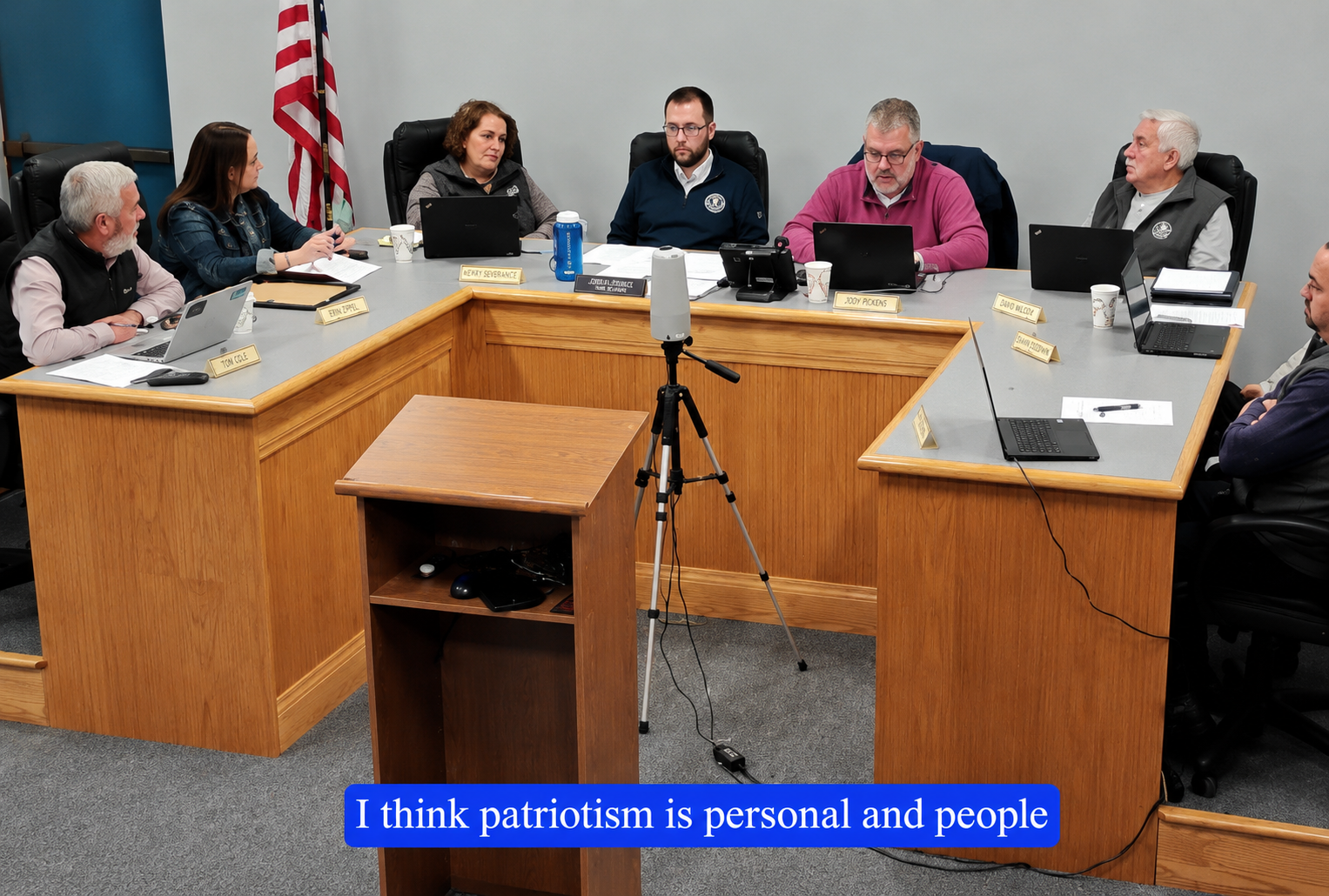
BUCKSPORT, Maine – A proposal to begin Bucksport Town Council meetings with the Pledge of Allegiance has sparked debate among local officials and residents, with supporters calling it a traditional expression of patriotism and opponents warning it could inject unnecessary division into municipal government.
The issue came before the town’s regulatory review committee on May 14, where committee members voted unanimously, 3-0, to table the proposal rather than send it to the full Town Council for consideration.
The proposal was introduced by Council member Teri Doty after residents asked why the Pledge of Allegiance was not already included as a regular part of council meetings.
https://www.wvomfm.com/episode/rewind-06-02-agenda-bucksport-pledge-1330
The discussion quickly grew beyond a routine agenda change, raising broader questions about the role of patriotic traditions in local government and whether adding the pledge would serve as a unifying gesture or create tension in an already polarized political climate.
The Pledge of Allegiance has long been one of the most recognizable civic traditions in the United States. Originally written in 1892 by Francis Bellamy, it was first created to commemorate the 400th anniversary of Christopher Columbus’ arrival in the Americas and was promoted for use in public schools and civic ceremonies.
Congress formally recognized the Pledge of Allegiance in 1942. The words “under God” were later added in 1954 during the Cold War, as the United States sought to distinguish itself from atheistic communism.
Today, the pledge is commonly recited at public meetings, school events, legislative sessions, and ceremonies across the country. Supporters often view it as a symbol of respect for the American flag, military service members, constitutional freedoms, and national unity.
In Bucksport, however, some officials raised concerns about whether adding the pledge to the Town Council agenda would maintain a welcoming environment for all residents.
Deputy Mayor Mark Eastman, who chairs the regulatory review committee, argued against adopting the pledge as part of the official meeting agenda. Eastman said Bucksport officials have intentionally worked to keep national political issues from influencing local proceedings.
Eastman said town meetings are meant to focus on municipal business, not broader national debates that can become divisive within the community.
He also emphasized that patriotism can be demonstrated in many ways outside of reciting the pledge, including volunteering, civic engagement, serving the community, and paying taxes.
The debate reflected differing perspectives among councilors and residents. Some supported Doty’s proposal and viewed the Pledge of Allegiance as a longstanding patriotic tradition that demonstrates respect for the country and its institutions.
Others raised concerns about inclusivity and whether formally adding the pledge to meetings could make some residents feel uncomfortable or excluded.
Councilor Tracey Hair suggested a moment of silence as a possible alternative, arguing it could allow attendees to reflect in their own way while still setting a respectful tone at the start of meetings.
The discussion in Bucksport mirrors similar debates that have surfaced in communities and school districts nationwide in recent years, as local governments weigh how to balance traditional civic customs with the diverse viewpoints of residents.
For now, the committee’s vote leaves the Town Council’s current meeting format unchanged. The pledge will remain off the agenda unless the proposal is brought back for future consideration.


Maine is gone. Thanks to the liberals we cannot even pledge allegiance to our country. Dirigo my ass!!!
It’s getting harder and harder to remember the way life used to be here in Maine
The way it was supposed to be
It’s not that way any more .
I don’t where all these assholes came from but we’ve sure got a bumper crop .
Welcome to The People’s Republic of Maine – The Way Life Shouldn’t Be
what a joke for all of Maine. NOT performing the pledge? And you have to think about that? Shame on you all, Shame on you.
“Others raised concerns about inclusivity and whether formally adding the pledge to meetings could make some residents feel uncomfortable or excluded.”
If the Pledge of Allegiance makes you uncomfortable or excluded, may I suggest Canada?
The Pledge is an affirmation of being an American. Love of country. Not political.
UNLESS, you want the American Republic to fail.
“I pledge allegiance to the Flag of the United States of America, and to the Republic for which it stands, one Nation under God, indivisible, with liberty and justice for all.”
An expression of loyalty to your nation should NOT offend residents of your community. This is outrageous. In my opinion, to keep the Pledge out of a meeting because someone in the room doesn’t “like it” is an act of cowardice and shows an unwillingness to support our nation, not necessarily referring to its government. As Mark Twain famously said, “Patriotism is supporting your country all the time and your government when it deserves it.”
Residents? How many people in Bucksport are noncitizens? That’s a good question to ask. Maybe require proof of citizenship for town meetings. The meetings are part of our political system which guides our towns. Shouldn’t citizenship be required? Seems best to me if the people running the show are citizens rather than unvetted masses from away.
I’m a conservative independent and a patriot (The Constitution is essentially my “Bible” of sorts.), but the Pledge of Allegiance was written by a company that manufactured flags as a marketing ploy. This is a FACT, folks. Why conservatives hyper-ventilate about this confounds me. The Pledge is a poor litmus test for patriotism, IMHO. Just sayin’. The illiberal Marxo-fascist democrats are nihilists and tyrants though, for sure, and must be utterly destroyed for our country to survive.
What is wrong with you people in Bucksport? Have all of you lost your minds? Seriously if you don’t want to recite the Pledge of Allegiance then get on a plane for China, Russia or Iran. Also revoke your USA citizenship. You people make me sick.
“Deputy Mayor Mark Eastman, who chairs the regulatory review committee, argued against adopting the pledge as part of the official meeting agenda…He also emphasized that patriotism can be demonstrated in many ways outside of reciting the pledge, including volunteering, civic engagement, serving the community, and paying taxes”
The tradition of the Pledge of Allegiance prior to public meetings is entirely voluntary for those present to unify in their culture as Americans. It is a voluntary declaration, No one is forced to recite it.
Using his logic that “patriotism can be demonstrated in many ways outside of reciting the pledge, including volunteering, civic engagement, serving the community, and paying taxes”, let him prove that belief by making Bucksport property taxes voluntary so all can substitute their tax paying as a way to demonstrate their patriotism!
The Marxists play the long game. One step at a time. Infiltrate the schools and then get prayer out of the schools. Infiltrate the government and then take steps to make it more welcoming so as not to offend the immigrants. Before one knows it, all will be lost. The UK doing the same thing by taking down the nations flags being flow on public streets!
If you can’t pledge allegiance to this country get to F*** out!
Sad, just sad. Shame on the town council.
Can we get rid of the highly divisive Homosexual flag? Better yet the whole foolish “Pride” month?
If you do not like saying the Pledge move to a some other country
It is the Mary Jane grow house. Every one.s brain has gone to mush.
Good grief. I’m guessing those opposed to the pledge of allegiance are liberals.
Having lived within 25 miles of Bucksport for the past fifty years, I have always wondered why the huge mill there was closed. Perhaps the capitalist businessmen who ran the mill began to sense socialism was working its way into Town management and that life in Bucksport was no longer the way life in Maine is supposed to be. Any thoughts on that, Mr. Eastman?