

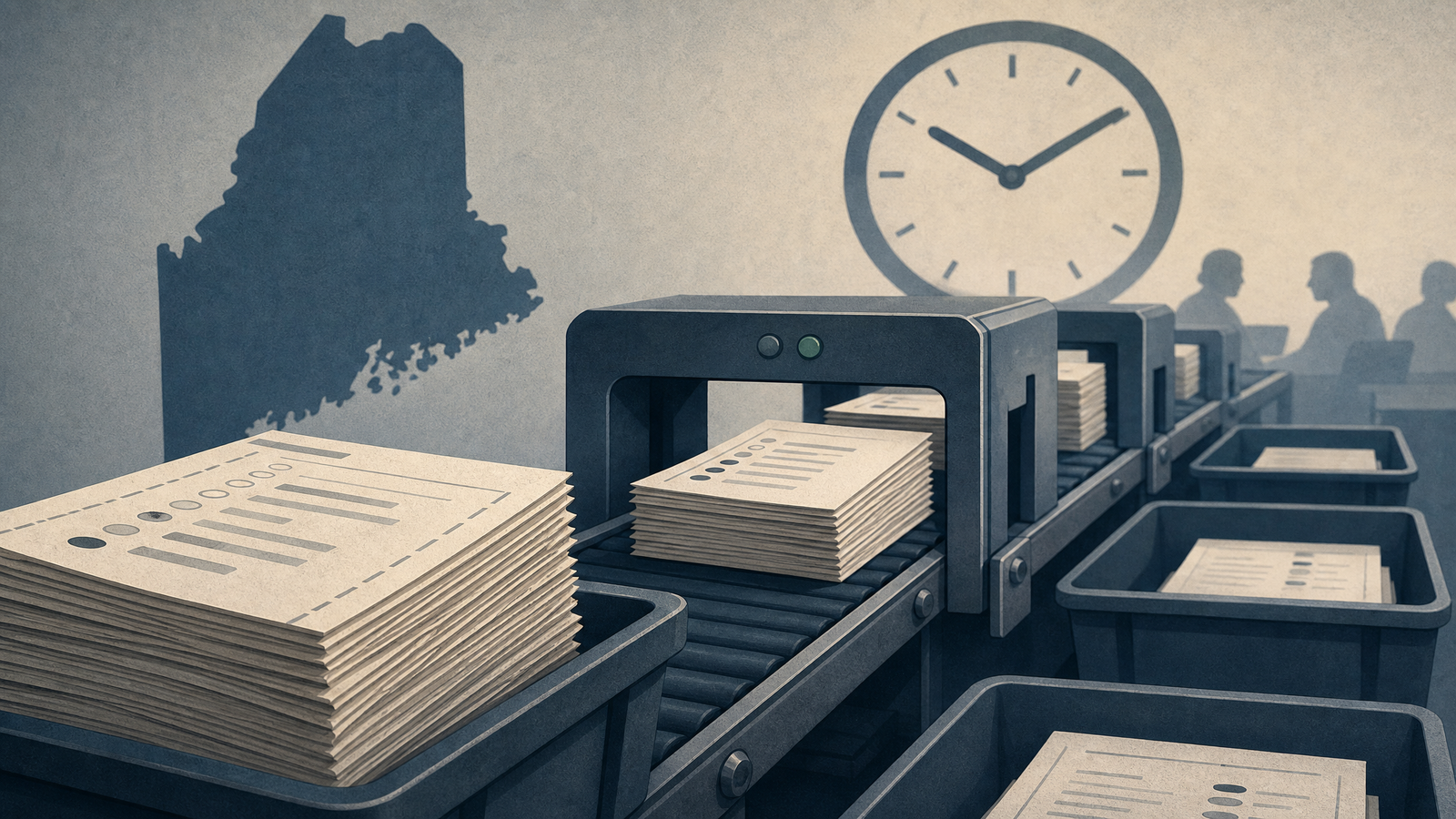
Nearly a week after Maine voters went to the polls, the final results in three major primary races remain undecided as state officials continue the ranked-choice voting tabulation process in Augusta.
The races still pending include the Democratic primary for governor, the Republican primary for governor, and the Democratic primary for Maine’s 2nd Congressional District. Each contest moved to ranked-choice voting after no candidate received more than 50 percent of first-choice votes on Election Day.
The Maine Secretary of State’s Office began the ranked-choice tabulation process Friday, June 12, at the Maine Department of Public Safety headquarters in Augusta. State officials have said they expect the process to be completed before Juneteenth, Friday, June 19.
That means voters who cast ballots June 9 may have to wait more than a week before knowing who won some of the state’s most closely watched primary races.
The delay has renewed questions about the cost, complexity, and transparency of Maine’s ranked-choice voting system, which requires ballot data from across the state to be collected, transported, uploaded, reviewed, and centrally tabulated before final results can be announced.
The actual ranked-choice calculation does not take long. Once all ballot data is loaded and verified, the tabulation itself can be completed in minutes. The lengthy part is the process required before that calculation can happen.
Under Maine’s system, municipalities do not simply conduct their own local ranked-choice counts and report final results to the state. Instead, ballot data and, in some cases, physical ballots must be gathered and processed centrally.
Roughly 330 municipalities that use precinct scanners must have their memory devices uploaded to secure, offline computers. Smaller towns that do not use scanners must have their ballots processed through tabulators in Augusta. Ballots that cannot be read by machines must be reviewed and handled separately.
State officials have said the process includes chain-of-custody controls, law enforcement supervision, and public observation. The computers used for the ranked-choice tabulation are not connected to the internet, according to state election officials.
The Secretary of State’s Office has also made the process available to the public through livestreaming and in-person observation.
Still, the delay is significant. In a traditional plurality election, the leading candidate is often known on election night or early the next morning. Under ranked-choice voting, voters and candidates may be left waiting for days as election materials are transported, checked, uploaded, and reconciled.
The cost of the 2026 ranked-choice tabulation has not yet been publicly released as a single, race-specific figure. But the process carries obvious expenses, including staff time, ballot transportation, law enforcement support, secure equipment, software, public livestreaming, and the administrative work required to verify results from hundreds of municipalities.
Those costs come on top of broader ranked-choice voting expenses, including ballot design, voter education, equipment needs, and the additional time required from municipal and state election workers.
Supporters of ranked-choice voting argue the system ensures that nominees have broader support from voters, especially in crowded primaries. Critics argue the system delays results, adds cost, and makes elections harder for the public to follow.
In Maine’s current primary contests, the public may know the unofficial winners sometime between June 16 and June 18, if the state’s projected timeline holds. Official results must be posted within 20 days of the election.
For now, the outcome of three major races remains unresolved, and Maine voters are once again waiting on Augusta to complete a process that has become a defining feature of the state’s modern elections.



I say again, look at the Republican primary where one candidate got 39% of the vote more than twice with any other candidate got. Yet it’s theoretically possible for him not to win this election.
That is a sort of thing that discredit elections in general. It’s also the sort of thing that would hand the Blaine House to the Democrats because a lot of pissed off Republicans would not bother to vote in November and perhaps that’s the intent.
And why can’t these ballots be counted by the voting machines?
Ballots that cannot be read by machines must be reviewed and handled separately.
Would they be mail in ballots or mail in ballots from places like Africa ? In other words illegal ballots?
Talk about complicated and Corruption!!
If Bobby Charles loses, I expect his voters to either stay home or vote democrat. Then again if there had not been so many other choices, Bobby might not have won, obviously he did not have 50% support. I can say he was my 4th choice, but will vote for the GOP candidate in the fall
The main thing is to hold your nose and vote republican, they will all be an improvement.
Maine voters voted for THIS SYSTEM twice .
Twice .
Twice .
The “ majority “ of Maine voters are idiots .
Those who rally against uncovering voter fraud are benefiting from it.
You can bank on that.
Bellows will count until she comes to the conclusion she wants. Totally corrupt.
The Democrats used the police they want to defund to collect the RCV ballots
And we all know why, because they keep counting until their man wins
who runs barter town
“The Secretary of State’s Office has also made the process available to the public through livestreaming and in-person observation.”
Oh how nice of them…The fact is that ranked choice is corrupt as hell. One person, one vote, it’s pretty damn simple.
I don’t even think most people know that there are…what 4 different correct ways to fill out a ballot.
Freaking ridiculous.
Maine and Democratic politics is a joke.
MAINER’S NEED TO TAKE THEIR STATE BACK FROM THIS SCUM!
Bellows is rubbish
We can’t trust Bellows to verify, never mind. We can’t trust Bellows, period.
What happened over 200 plus years to maintain our democracy ; one vote per candidate which worked. Need to abolish “ranked choice” asap.
California was THE FIRST State to use RCV. Annddd they were the FIRST TO ABOLISH IT!! They found a better way to CHEAT!!!
The department in Augusta in charge of vote counting is called “Corporations and Elections”. When a particular election is difficult to tally (which I assume is all of them now) or a recount is necessary the Corporation side of the department is called in to help and operates understaffed. After 8 years of Dem control there probably aren’t many businesses to incorporate so everything should be fine. My money is on Sidewinder Bellows being one of the three winners.
Rank Choice Voting. RCV,= reshuffle, count (again) by villains.
Just more commie bellows trying to take out the most likely opponent to win.