

President Donald Trump announced Sunday that a long-negotiated peace agreement between the United States and Iran has been completed, marking what could become one of the most consequential diplomatic developments in the Middle East in years.
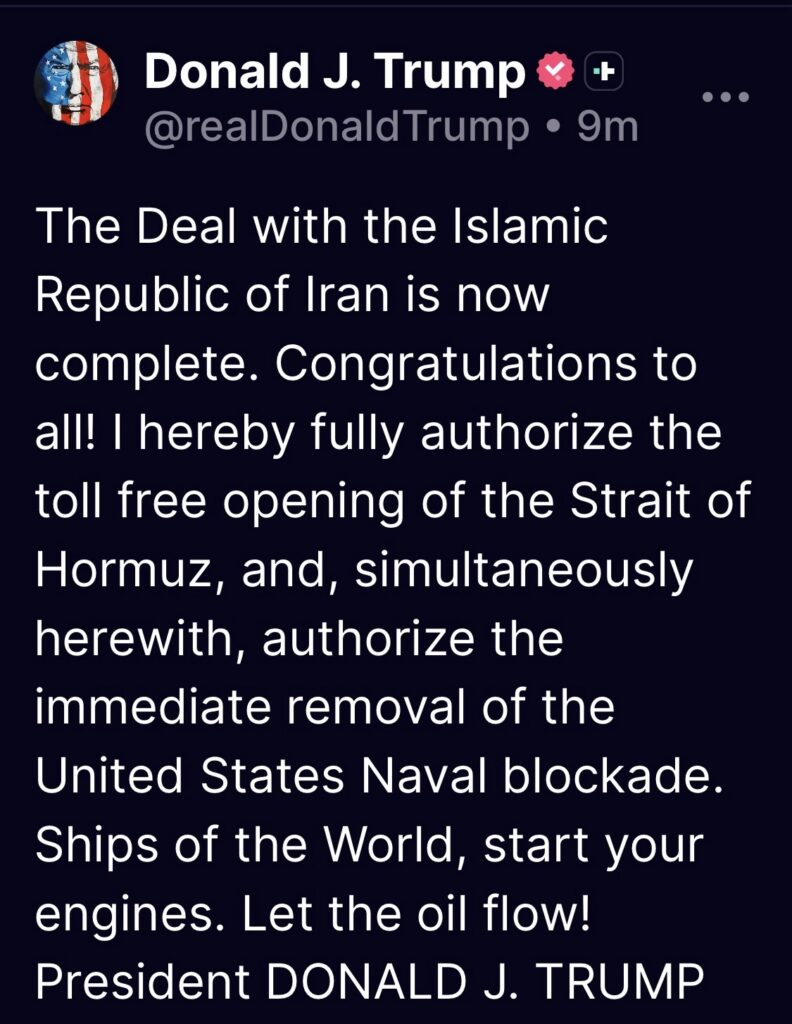
In a post published Sunday afternoon on Truth Social, Trump declared that “The Deal with the Islamic Republic of Iran is now complete,” adding that he had authorized the “toll free opening” of the Strait of Hormuz and the “immediate removal” of the United States naval blockade on Iran.
The announcement comes after weeks of escalating military tensions, backchannel diplomacy, and repeated warnings that the conflict could spiral into a broader regional war.
Trump’s statement signals that commercial shipping traffic through the Strait of Hormuz — one of the world’s most critical oil transit chokepoints — could soon resume at full capacity after months of disruption that rattled global energy markets.
What the Proposed Deal Includes
According to multiple international reports, the draft agreement includes several major components aimed at de-escalating the conflict and reopening global trade routes.
Among the reported terms:
- Iran would reopen the Strait of Hormuz to international commercial shipping.
- The United States would begin lifting its naval blockade on Iranian ports.
- Iran would agree not to pursue nuclear weapons development.
- Temporary sanctions, relief and oil export waivers would be implemented.
- Technical negotiations over Iran’s nuclear program would continue during a proposed 60-day ceasefire extension.
Reuters reported that Iranian officials confirmed portions of the framework, including sanctions waivers and the release of frozen Iranian assets.
Pakistan and Qatar reportedly played key roles in mediating the negotiations, with Pakistani Prime Minister Shehbaz Sharif announcing that a ceasefire framework was already “in place.”
Iran Still Signaling Caution
Despite Trump’s declaration, Iranian officials have continued to publicly urge caution, warning that legal and technical reviews are still underway and that final implementation details remain unresolved.
Iranian hardliners have also criticized the framework, arguing that Tehran gave up too much leverage without securing permanent sanctions relief or stronger guarantees regarding regional security issues.
At the same time, tensions remain volatile in the region.
Israeli strikes in Beirut over the weekend threatened to derail negotiations, prompting Trump to publicly call for restraint and warn that additional attacks could jeopardize the fragile peace process.
Iran later warned that retaliation against Israel could be “imminent,” underscoring how delicate the agreement remains despite Sunday’s breakthrough announcement.
Oil Markets Watching Closely
Global oil markets have reacted sharply to the possibility of the Strait reopening.
Energy prices have fallen in recent days amid growing expectations that oil shipments through the Persian Gulf could soon normalize after months of instability and military confrontation.
Before the conflict escalated, roughly one-fifth of the world’s oil supply moved through the Strait of Hormuz, making it one of the most strategically important waterways on the planet.
What Happens Next
While Trump now says the deal is complete, several major questions remain unanswered:
- When the formal signing will occur.
- How quickly sanctions relief will begin.
- Whether Iran fully complies with nuclear restrictions.
- How Israel responds to the framework.
- Whether regional proxy groups will honor the ceasefire terms.
Reports indicate a formal signing ceremony could take place later this week in Switzerland following additional technical talks between negotiators.



Trump declares!!!
Yes and the moon is made of cheese.
Oh no!!! The Democrats ain’t going to be happy about this. Just imagine a country without nuclear weapons. They’ll soon be hollering about racial discrimination again. Or still. .
Is this a joke!?
“Iran would reopen the Strait of Hormuz to international commercial shipping.”
The straight was already open before Trump started an illegal war!?
“The United States would begin lifting its naval blockade on Iranian port”
The US will lift its illegal blockade of Iran’s right to control the waters off its coast.
“Iran would agree not to pursue nuclear weapons development.”
Iran is not nor has it sought a nuclear weapon. Both N.Korea and Pakistan offered nuclear weapons to Iran and Iran turned them down. US intelligence confers Iran is not seeking a nuclear weapon. Iran was part of the nuclear nonproliferation treaty before Trump “ripped up” the JCPOA (Joint Comprehensive Plan Of Action) which also limited Iran’s nuclear enrichment.
“Temporary sanctions, relief and oil export waivers would be implemented”
This is not a win. This is a huuuge embarrassment for Trump and his jew donors. Trump is losing bigly. This is akin to Trump taking a knee. It has also been reported that the U.A.E has transferred $3 billion and USA has release $6 billion of the $24 billion in frozen assets
“Technical negotiations over Iran’s nuclear program would continue during a proposed 60-day ceasefire extension.”
This is the US attempting to get the JCPOA deal back under another name so Trump can have a better deal than Obama.. Iran has already said it won’t happen.
Trump is a loser. Hegseth is a woman beater. Rubio is a dirty Cuban. Patel is a dirty Indian.
“Trump is a forever war pig loser” Racist things you say. You forgot to include the Israel’s in your bit.Saving that for later?
The USA has lost more fixed wing A/C in South West Asia (illegal Iran and Yemen wars) in last year under loser Trump than all fixed wing A/C in both George’s illegal Iraq wars.
That’s a fact. Trump lost (destroyed) 75+ fixed wing A/C trying to be a tough guy. Trump lost bigly. Trump is a loser.
God bless President Donald J. Trump and God bless The U. S. A!
And thus begins another sad week for democrats…
It is not “Peace” it is an Armistice. It is not signed yet, and the conditions are unfinalized but rather a work in progress if signed. Trump is not a doped up bleary eyed left wing progressive dancing around a Maypole voting for Platner like so many dumocrats are, Thank Goodness. This may help him in the midterms though if the “deal” is ultimately finalized.. . .
“Iranian officials have continued to publicly urge caution, warning that legal and technical reviews are still underway and that final implementation details remain unresolved.”
I would like to reiterate for the Prez, not that He needs my help. It’s a two way street Iran. The United States urges caution as well.
Meanwhile back at the Ranch. Let’s see what Nancy has cooked up for sides at this fish fry. Hey, Grampa what’s fer supper! Yum Yum.
Sorry, not buying it. You can’t negotiate with evil. He had the chance to sever the head of the serpent and he blew it. This will seal the Democratic sweep in 2030 staging mandatory renewables, packing SCOTUS, blanket amnesty and a host of other Socialist agenda items. Like lowering gas prices is a long term goal? Angus King wants us all to stay warm using renewable cow shit. Maine is so screwed.
Well do I detect an angry lunatic distressed evil democrat wishing the war in Iran was still ongoing?
Or perhaps it’s a socially mentally ill looser libration? Or both! I hear Minnesota is a great place to be they will great you with open arms.
Either way I wish they would pack their bags and leave the state. Maybe the Ukrainians will take them to fight over there.
Option 2 leave the US and go to Iran and take your pride flags over there. The Iranian’s would love to display those pride flags proudly and properly for you. You could impose DEI on them too.
PRESIDENT TRUMP is WINNING for the US!!!