

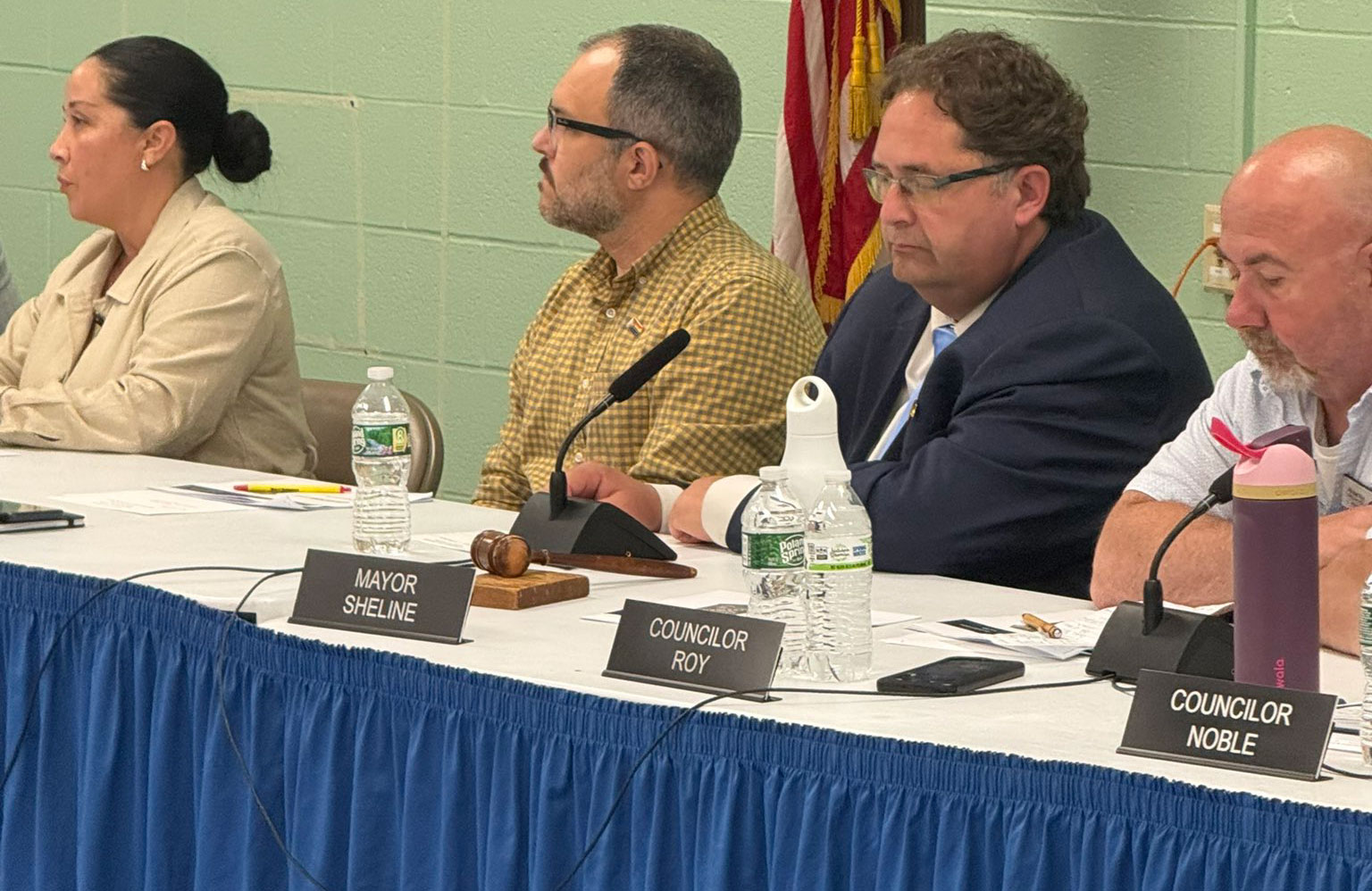
More than three hours of testimony from police, prosecutors, educators, juvenile justice officials and community leaders painted a sobering picture of a city struggling to contain a surge in youth gun violence. But when the special Lewiston City Council meeting adjourned Tuesday night at Lewiston High School, residents were left with one overriding takeaway: no plan had been adopted, no votes were taken, and no immediate action was approved.
The meeting brought nearly every agency involved in Lewiston’s juvenile justice system as officials attempted to explain why the city has experienced a sharp increase in shootings involving young offenders. Throughout the evening, speaker after speaker acknowledged the seriousness of the crisis, but solutions often centered on additional funding, legislative changes in Augusta and expanded intervention programs rather than immediate local action.
Lewiston Police Chief Carly Conley opened the meeting by reporting that the city has recorded 19 shootings so far in 2026, matching last year’s total at this point in the year. Twelve of those shootings involved juveniles, while seven involved adults.
Despite operating with 11 vacant officer positions and another officer out on medical leave, Conley said the department has solved 13 of the 19 shootings, a 68 percent clearance rate that is more than double the national average. Police have arrested eight adults and 19 juveniles connected to those investigations and have seized 44 firearms this year, including 41 handguns.
Conley warned that the city’s biggest obstacles are repeat juvenile offenders, limited authority to detain violent juveniles, competency rulings that often prevent prosecution, and a lack of mandated intervention services for young offenders.
District Attorney Neil McLean echoed those concerns, describing a justice system strained beyond capacity.
McLean said his office is responsible for roughly 3,250 pending criminal cases across Androscoggin, Oxford and Franklin counties but currently has only eight prosecutors available. He called for changes to Maine’s juvenile competency laws, additional prosecutors and greater state funding, arguing that current laws often allow violent juvenile offenders to return to the same environments where their criminal behavior began.
“We’re failing them if we continue to treat them like children,” McLean said while arguing that accountability is necessary to prevent future violence.
Lewiston Superintendent Jake Langlais described what schools are seeing firsthand, saying approximately 15 students have been expelled this year for violent conduct. He said the district has begun disciplining students for violent behavior that occurs outside school when it threatens school safety.
Langlais also shared a troubling conversation with a 12-year-old student involved in a firearm incident who explained that he targets unlocked pickup trucks because he believes they are more likely to contain firearms.
“Please, lock up your firearms,” Langlais urged residents.
He added that many students now carry knives because they fear walking to and from school.
The meeting also exposed differing philosophies on how to confront the crisis.
New Beginnings Executive Director Chris Bicknell argued that Lewiston should treat youth gun violence primarily as a public health crisis requiring greater investment in prevention programs and community services.
Others focused on accountability.
Councilors repeatedly questioned why juveniles accused of serious crimes are often released back into the community so quickly, while officials from the Maine Department of Corrections explained the statutory limits governing detention and emphasized rehabilitation programs, mentoring and restorative justice efforts.
One of the strongest calls for immediate action came from Councilor Susan Longchamps, who requested that Governor Janet Mills send the Maine National Guard to help stabilize neighborhoods while the understaffed police department concentrates on violent crime investigations.
Throughout the evening, officials consistently pointed toward Augusta, saying legislative changes and additional state funding are needed before meaningful progress can be made.
Yet when the meeting ended, no formal action had been taken.
The City Council approved no policy changes, adopted no recommendations, established no working group and set no timetable for implementing any of the ideas discussed during the meeting.
Instead, residents left with a lengthy list of concerns and proposals but no clear roadmap for what happens next.
As attendees exited Lewiston High School, many told the Maine Wire they were frustrated that, despite hours of testimony and broad agreement that the city faces a serious crisis, they did not believe council leaders were confronting what they viewed as the root causes of the violence or offering concrete steps to reverse it.
Lewiston Mayor Carl Sheline declined to comment when approached by the Maine Wire following the meeting.
The meeting underscored a consensus that Lewiston’s youth gun violence problem has reached a critical point. It also revealed a growing divide over how the city should respond, whether through tougher enforcement and accountability, expanded intervention services, or legislative reforms from Augusta.
For now, however, those debates remain unresolved, while the shootings continue.



And WHO among us expected anything different ?
Oh yeah that’s right ……Probably Lenny the Loser ( who contributes more money than me ) but who knows all the answers and hates Trump more than his own mother .
An earlier poster was correct . Never try to argue with idiots .
Lenny and the Lewiston City Council ……idiots all .
Be prepared and train
“The children are the problem.” “Call them juveniles”
How about Hoodlums, Delinquents, Degenerates? Maybe even CRIMINALS!
Like we expected Lewiston to actually do something! It used to be a nice city, was then a ghost town with fires everywhere and derelict buildings. It’s now a third world country with Catholic Charities moving in which will bring in more delinquents and people who have no respect for US sovereignty!
Play with adult toys,win adult prizes A year in Thomaston should take the wind out of their sails.
Lewiston has increasing become a cesspool for low income whites and street drugs. Now the Somalis are humping white girls there
I blame Susan Commie Collins. That ugly dumb girl has been in the senate for thirty years. What has she done for Maine!?
All dummy Sue does is defend the mass murdering jews and take aipac $$ handouts.
No such thing as gun violence..only youth violence.
The way I see this..is it shows how the parents were growing up..children will follow their examples. Good job parents!
The lunatic left Lewiston officials should call in and fully support ICE !
Concerned here with Susan is a Commie comments with no ID – especially since they are quite vile in nature
Bunch of USELESS IDIOTS!! Who needs them!!!!!
So. Is Mayor Shelline simply following orders from the People’s Alliance, Shobolmn and Maine Dem “leadership” or is he an imbecile?
Why aren’t some of these people doing some serious time for the poor choices they chose too make. Run them thru the justice system to show them what life is really like first offense. Second offense show them what incarceration system is all about. Third offense you haven’t learned the second offense. Like in baseball you’ve just struck out. Justice system get in the ballgame.