

A top Maine labor spokesman and vocal supporter of Democratic U.S. Senate nominee Graham Platner is facing backlash after using the phrase “first against the wall” in a social media comment aimed at a Democratic strategist who refused to support Platner.
Andy O’Brien, the communications director for the Maine AFL-CIO, made the comment as Democrats continue to wrestle with divisions following Platner’s primary victory over a field that included Gov. Janet Mills and Brunswick Democrat David Costello.
The Maine AFL-CIO endorsed Platner earlier this year, calling him the strongest pro-worker candidate in the race and pledging to put union resources behind his campaign against Republican U.S. Sen. Susan Collins. The union describes itself as representing tens of thousands of Maine workers, and O’Brien is listed by the organization as the official who handles internal and external communications.
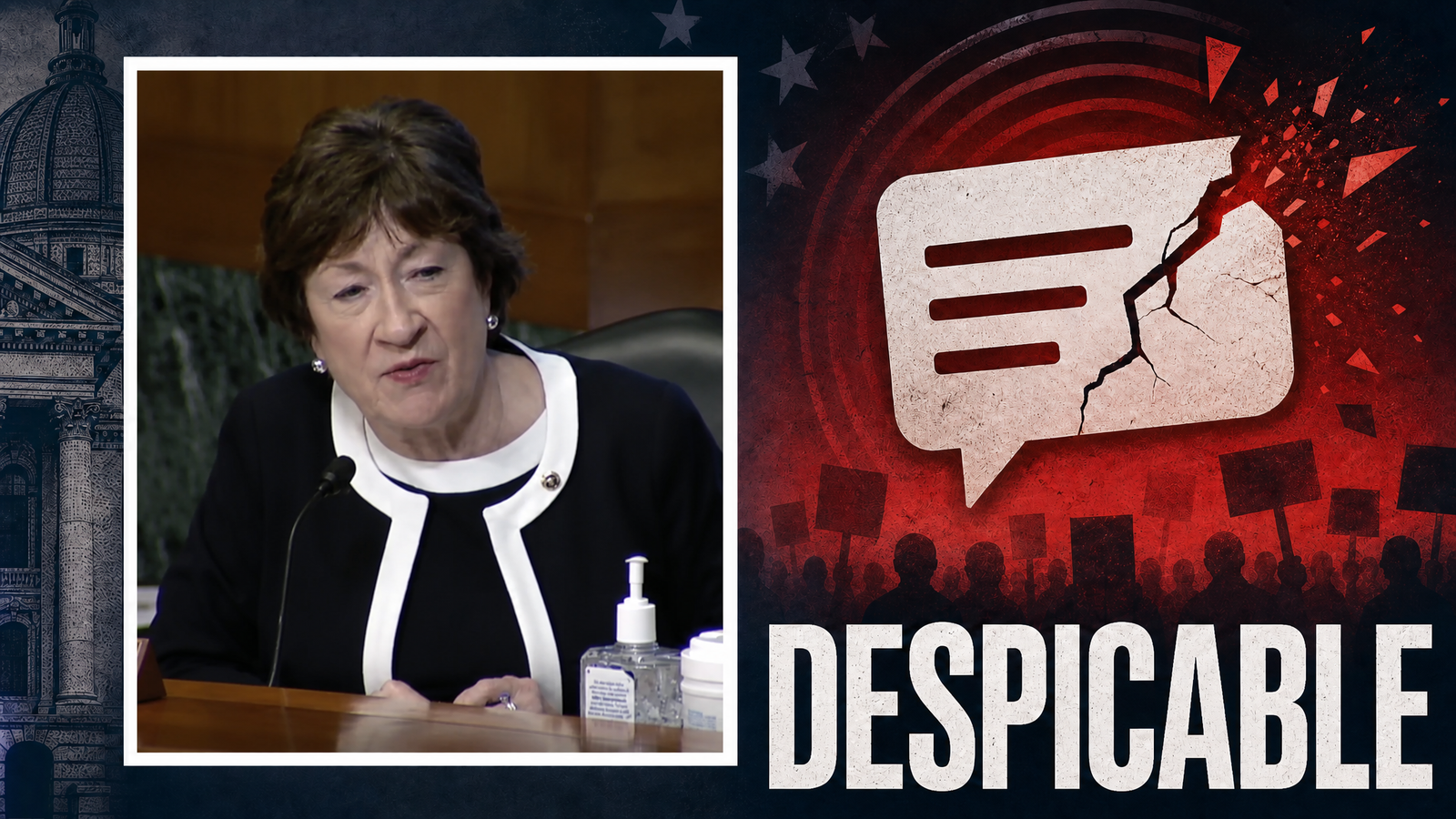
Collins, when asked about O’Brien’s comment, sharply condemned the remark, calling it “just despicable” and criticizing what she described as a growing culture of political violence.
The Maine Republican Party also called on the Maine AFL-CIO to denounce the comment and remove O’Brien from his position, arguing that violent political rhetoric has no place in Maine politics.
O’Brien and his defenders pushed back on the criticism, saying the phrase was not intended as a literal threat. They pointed to Douglas Adams’ science-fiction satire The Hitchhiker’s Guide to the Galaxy, where a similar phrase is used as a darkly comic jab at the marketing department of a fictional corporation.
But the comment landed in the middle of an already bitter Senate race that has exposed deep fractures inside Maine’s Democratic coalition.
Platner, a Marine veteran and oyster farm hobbyist from Sullivan, won the Democratic nomination on June 9 and will face Collins in November in a race expected to draw national attention. Maine Public reported that Platner’s primary victory came after months of controversy, including scrutiny of his past social media posts and continued doubts from some Democratic operatives about whether he can defeat Collins.
Those Democratic divisions did not end with the primary. Gov. Mills, who suspended her campaign in late April but remained on the ballot, did not endorse Platner in her post-primary statement, according to Maine Public. The outlet also reported that some Mills-aligned Democrats openly questioned Platner’s viability and that some vowed not to support him in November.
The AFL-CIO’s endorsement of Platner came before the primary and was presented as a major organizational boost for his campaign. At the endorsement event, union leaders said they would be “out canvassing” and speaking with members across the state to support him.
That support has also tied the labor organization more closely to Platner’s campaign and its political fallout.
In its endorsement announcement, the Maine AFL-CIO framed Platner as a candidate who would challenge corporations, billionaires, and the political establishment. The union also used the endorsement to sharply criticize Collins, accusing her of voting against the interests of working Mainers.
But the comment landed at a time when political violence is no longer theoretical.
Conservative activist Charlie Kirk was assassinated on September 10, 2025, while speaking at a Turning Point USA event at Utah Valley University in Orem, Utah. Prosecutors have charged Tyler James Robinson with aggravated murder in the case and have indicated they may seek the death penalty if he is convicted.
President Donald Trump has also survived multiple assassination attempts, including the July 13, 2024, shooting at a campaign rally near Butler, Pennsylvania, where he was wounded and rallygoer Corey Comperatore was killed. Two months later, on September 15, 2024, Trump survived another assassination attempt at Trump International Golf Club in West Palm Beach, Florida.
Against that backdrop, public officials, political operatives, union leaders, activists, and campaign surrogates face a higher standard when invoking language that even appears to suggest violence against political opponents.
What may once have been brushed off by some as a literary reference or internet sarcasm now lands in a country where candidates, activists, and civilians have been shot, killed, or targeted over politics. In that environment, calls for violence, jokes about firing squads, or casual references to putting opponents “against the wall” are not simply rhetorical flourishes. They are dangerous, reckless, and corrosive to public life.
The dispute over O’Brien’s comment now adds another flashpoint to a race already defined by sharp rhetoric, questions over political judgment, and a widening fight over the direction of the Democratic Party in Maine.
For Republicans, the comment offers a new opening to argue that Platner’s coalition is tolerant of radical language. For Platner’s supporters, the backlash is being dismissed as bad-faith outrage over a decades-old literary reference.
But in a political climate increasingly shaped by concerns about threats and violence, even sarcastic references to putting political opponents “against the wall” are unlikely to pass quietly.




Did Platner condemn him, Pingree, Dunlop, King, Mills, any democrat condemn this?
Falls in line with a Platner post “that true political change only come with a gun not an election”. Sounds like the union is only supporting that since deleted post
I’m not voting for another rino aipac servant.
Susan Collins is an aipac first girl commie.
I’m not voting for girls, aipac servants or rino’s.
I’m not sold on Platner outside of his awesome mustache and masculinity but he’s not a dumb girl. He’ll probably become an aipac servant like the rest of them if he gets elected though. And he might. Everyone is sick and tired of 30 year aipac servants. 30 years this dumb girl has been a senator and Maine slides down hill a little bit every term. Just look at Lewiston.
Dump commie Sue!
Lenny is a Commie ….Susan Collins is a Leo
A ugly troll is always an ugly troll , no matter what mask it wears .
Why doesn’t this one go play with the Blue Sky people , I’m sure he’d be more appreciated there .
I don’t really care how much money he contributes , or to what !
Like the man said ….Never argue with an idiot .
“War On Iran: –
Trump Requested Briefing For War Renewal
The White House is eager to return to outright war on Iran.
According to the Wall Street Journal U.S. President Donald Trump requested new plans to attack Iran but was briefed (archived) that any attempt to do such was too much of a risk:
President Trump has weighed a return to all-out war with Iran, holding multiple conversations in recent days with Defense Secretary Pete Hegseth and Chairman of the Joint Chiefs of Staff Gen. Dan Caine on more strikes, but has decided to stick with diplomatic talks for now, according to U.S. officials familiar with the discussion.
The conversations have centered on whether the U.S. should abandon negotiations and resume full-scale attacks on Iran, the officials said, a move some of them describe as “finishing the job.”
…
[T]he latest discussions suggest [Trump] is looking for ways to break the deadlock with Tehran and hasn’t yet ruled out a return to fighting.
All reasonable military options the U.S. has are still no better than they were when the U.S. filed for a ceasefire.
Iran’s deterrence, which comes in two forms, is still sufficient. Its ballistic missiles and drones are able to hit any target in the Middle East. Its ability to blockade the Strait of Hormuz make any campaign against Iran a very risky endeavor. The consequences of a new blockade could easily ruin the global economy.
As Trump acknowledged weeks ago:
“If we go and bomb, which we can do very easily if we want, and we spend another two or three weeks bombing, they’ll have nothing left whatsoever, but you won’t have the strait opened for months.
At the same time Iran’s geography and defense capabilities make any attempt to invade or occupy even parts of it a suicide endeavor.
That said – Trump’s current reluctance to renew an attack on Iran is unlikely to hold forever. Even with a low chance of winning he well get enticed to again throw the dice.”
Moon of Alabama
Like I always say when we are in session… take a deep breath and wipe the foam off your mouth.
As someone old enough to actually remember the Cold War, I’d like to point out the fact that Israel was an ally with the United States, while the Arab countries, including Egypt, were allied with the Soviet Union. The communists.
Enhance, it’s impossible for somebody who supports Israel to be communist.
And has someone who knows the history of the French Revolution, Mein Oyster Fuher is right about how the interest Democrats will be the first up against the wall. The centuries Democrats will be viewed as a greater threat than the Republicans and they will be killed first.
And if they’re too stupid to realize that, well sucks to be them.
George Santana warrant about why we need to understand history….
Union mouthpiece spewing ,outloud, the Communist way. Lenin said he was for the workers too. How many did he and Stalin kill?
Andy O’Brien, a maine spokesman for the American Federation of Labor, rings true in that he has no tolerance for views that conflict with his own. Somehow, his remarks bring to mind the Trump poster that showed him saying, “It’s not me they’re after – it’s YOU. I’m just in the way.” O’Brien states a chilling and frightening truth about Democrats: they wouldn’t hesitate to put all Republicans against the wall if they could get away with it.Take heed, fellow Republicans. We might have to defend ourselves someday.
WHAT IS GOING ON IN MAINE?! I was just reading an article about Maine’s radical Democrat U. S. Senate candidate Graham Platner’s involvement with a far left paramilitary training group called the Socialist Rifle Association. I am already painfully aware that our U. S. Representative Chellie Pingree has voted with antisemites. And now this garbage from the mouth of the COMMUNICATIONS director of Maine’s AFL-CIO. Here in Maine the loons are usually found only on the lakes!