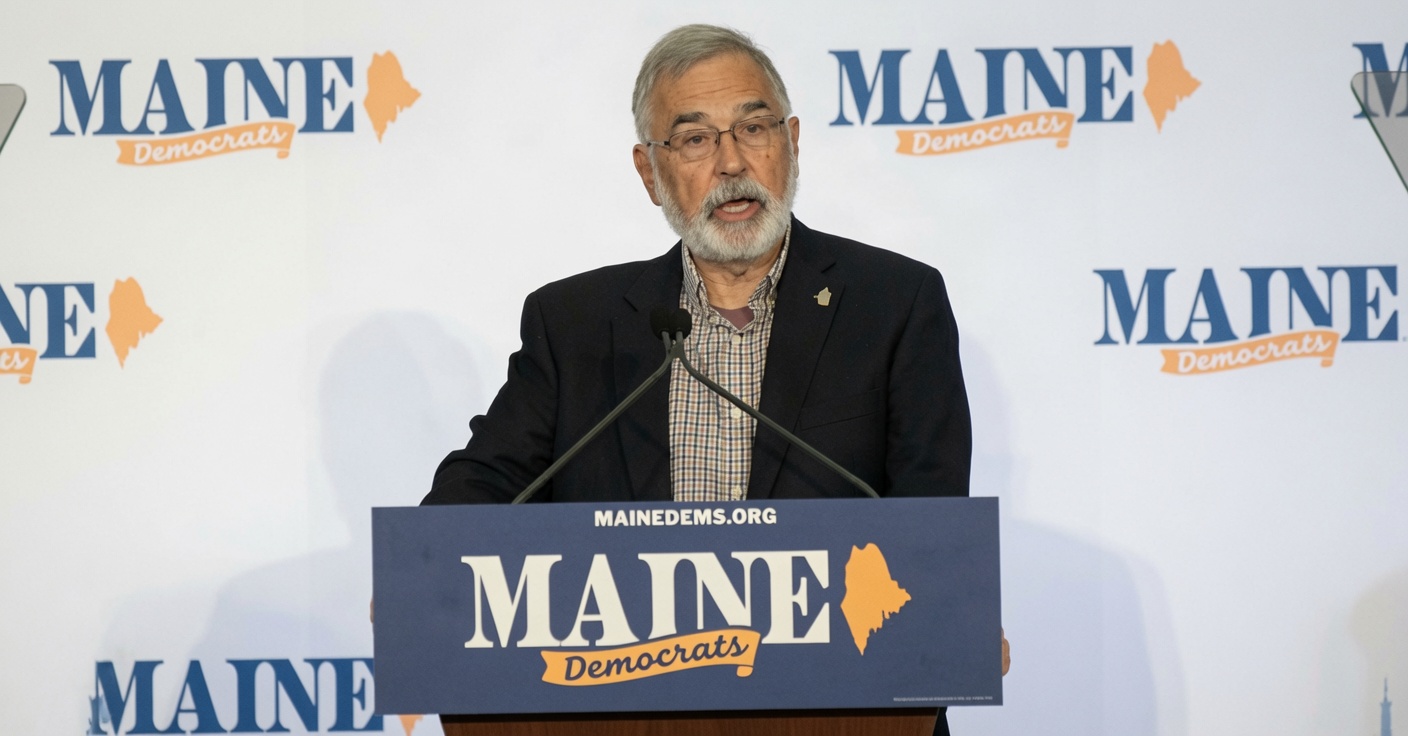
Before delegates formally handed former Senate President Troy Jackson the Democratic nomination for U.S. Senate on Saturday, Maine Democratic Party Chairman Charlie Dingman began the state convention with a familiar progressive ritual: declaring that the event was being held on the ancestral homeland of Maine’s Indigenous people.
The land acknowledgment lasted only moments, but it immediately became one of the most talked-about parts of the convention outside the nomination itself.
Within hours, Dingman’s remarks were circulating online, where critics ridiculed what they described as yet another performative display from a Democratic Party that routinely speaks about “stolen land” while continuing to own property, collect taxes, campaign for office, and exercise political power on that same land.
The criticism raises an obvious question that Democrats rarely answer.
If Maine is “stolen land,” why isn’t the Maine Democratic Party giving any of it back?
Why isn’t the Cross Insurance Center being turned over to the Wabanaki?
Why aren’t Democratic officeholders donating their homes, campaign headquarters or party offices?
And if the land is truly illegitimate, why do the same politicians insist every Mainer continue paying property taxes on it?
A Progressive Ritual
Land acknowledgments have become commonplace throughout progressive politics. Democratic conventions, universities, nonprofits and government meetings increasingly begin by recognizing that Indigenous people occupied the land long before European settlement.
The acknowledgments reference the Wabanaki Nations—including the Penobscot, Passamaquoddy, Mi’kmaq and Maliseet (Wolastoqey)—whose ancestors lived throughout what is now Maine.
Supporters say the statements recognize historical injustices, educate the public and demonstrate respect for tribal communities.
Critics see something very different.
They argue the acknowledgments have become little more than political virtue signaling—a symbolic performance designed to demonstrate ideological credentials without requiring anyone to sacrifice anything.
Words Without Action?
There is little dispute that Native Americans lost enormous amounts of land through centuries of war, disease, displacement, unequal treaties and government policies.
The debate begins with what should happen today.
If political leaders genuinely believe the land they occupy was unjustly taken, critics argue, the logical response would be to return property or advocate for meaningful land transfers—not simply recite a scripted acknowledgment before proceeding with business as usual.
Instead, opponents argue, Democrats make the declaration, accept campaign donations, nominate candidates, own property, collect taxes and then move on as if nothing had happened.
For many Mainers, the acknowledgment increasingly sounds less like a call for justice and more like a political ritual expected within progressive circles.
The Property Tax Contradiction
Perhaps the most glaring contradiction, according to critics, involves taxation.
Maine homeowners are legally required to pay property taxes every year.
Failing to do so can ultimately result in foreclosure by the government.
If elected officials are willing to publicly describe the land as having been wrongfully taken, critics ask why they continue enforcing taxes on that same property instead of advancing proposals to restore ownership or compensate those they believe were wronged.
No answers were offered during Saturday’s convention.
Symbolism Over Substance
Saturday’s convention ultimately belonged to Troy Jackson, who was overwhelmingly selected as Democrats’ nominee to challenge Republican Sen. Susan Collins this November.
But before delegates cast a single vote, the convention showcased a growing divide in modern Democratic politics.
To supporters, the land acknowledgment represented respect, inclusion and historical awareness.
To critics, it perfectly illustrated what they see as today’s Democratic Party: quick to embrace symbolic gestures, reluctant to take actions that would require political or personal sacrifice.
As the applause faded and the convention moved on, one question remained unanswered:
If Democrats sincerely believe they are standing on stolen land, what is stopping them from giving it back?