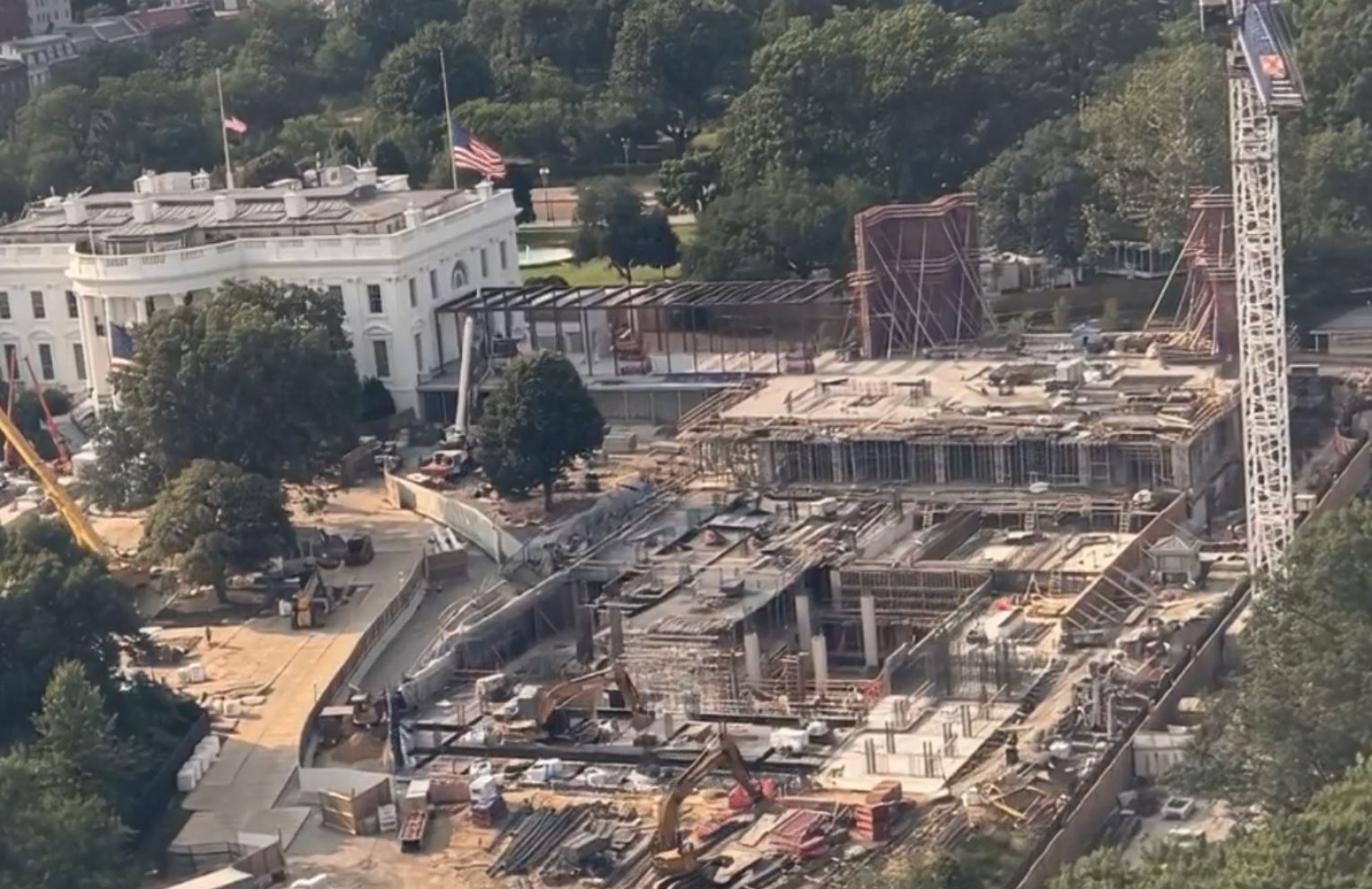
President Donald Trump’s proposed $400 million White House ballroom has hit another legal roadblock after a divided federal appeals court upheld an injunction blocking above-ground construction while a lawsuit challenging the project moves forward.
In a 2-1 decision, a panel of the U.S. Court of Appeals for the District of Columbia Circuit declined to lift a preliminary injunction preventing the Trump administration from proceeding with above-ground construction of the roughly 90,000-square-foot ballroom.
The ruling represents a significant setback for one of Trump’s most ambitious plans for the White House grounds and leaves the future of the project tied up in federal court.
Judges Patricia Millett and Bradley Garcia formed the majority, concluding that the Constitution gives Congress authority over federal property and raising serious questions about whether the executive branch can undertake a project of this scale without congressional authorization.
“Each President is a temporary tenant, not the owner, of the White House and its Executive Residence,” the judges wrote. “Whether or not a massive ballroom should be constructed is for Congress to decide and is not a matter for Executive self-help.”
The case was brought by the National Trust for Historic Preservation, which has challenged the administration’s authority to move forward with the project.
Judge Neomi Rao, who was appointed to the appeals court by Trump during his first term, dissented.
Rao argued that the National Trust lacks legal standing to bring the case and criticized the injunction as an improper intrusion by the judiciary into the executive branch’s management of the White House complex.
The dispute centers on Trump’s plan to construct a roughly 90,000-square-foot ballroom at the White House at an estimated cost of $400 million.
The project would represent a major physical addition to one of the nation’s most historically significant government properties.
The appeals court’s decision does not permanently kill the ballroom project or represent a final ruling on the underlying lawsuit. Instead, it leaves the preliminary injunction in place while the broader legal challenge proceeds.
That means the administration remains prohibited from moving ahead with above-ground construction unless the injunction is subsequently overturned, modified or stayed by a higher court.
The sharply divided ruling could also set the stage for additional appeals as the Trump administration fights to regain authority to proceed with construction.
At the heart of the case is a larger constitutional question extending beyond the ballroom itself: how much authority does a president have to make substantial structural changes to the White House without first obtaining approval from Congress?
For now, the appeals court’s answer has left Trump’s ballroom plans on hold.