Up For Growth (UFG), a nonprofit membership organization which was “founded to elevate and amplify the need for solutions” to the housing issue, recently published a report on the state of housing supply in the United States. It was sponsored by numerous entities like the Amazon Housing Equity Fund, Habitat for Humanity, the Walton Family Foundation, and the National Association of Realtors.
Summarizing the report’s findings, the authors note that “with 3.8 million homes short of meeting housing needs, double the number from 2012, the nation is in an extreme state of Housing Underproduction™.” Nearly every state in the union faces this challenge.
The UFG report considers the housing supply from 2000 to 2020, looking at all 309 US Census-defined “Metropolitan Statistical Areas (MSAs)” in the country as well as 505 non-metro regions. Overall, “forty seven states and Washington, DC saw the underproduction of homes rise, and six states that did not have underproduction in 2012 now do. Only Vermont saw an improvement.”
As evidence of the dire shortage, the authors point to the rapid rise in housing costs and subsequent increase in the number of households who are considered “rent-burdened,” meaning that rent makes up at least 30% of household income. In every county in Maine (except Franklin County, which is excluded for lack of data), at least 40% of renting households are cost-burdened; in Oxford County, this population makes up more than half of renters.
The report used regional, as well as state-level, data to allow readers “to see variation within a state. In many cases, housing is underproduced in one part of a state but balanced in other parts.” This is exceptionally true when looking at Maine.
UFG estimates that Maine is short about 9,000 housing units to meet workforce demand. In a state with 1.3 million residents, that doesn’t seem so bad. The catch is that more than 8,000 of those units are needed in the Portland-South Portland MSA, made up of York and Cumberland counties. The region has about 540,000 residents, or 40% of the state’s population, living in nearly 227,000 households.
Maine, and specifically greater Portland, are not alone in the region facing this problem. The UFG report shows other metropolitan areas of eastern and central New England are feeling the housing crunch as well.
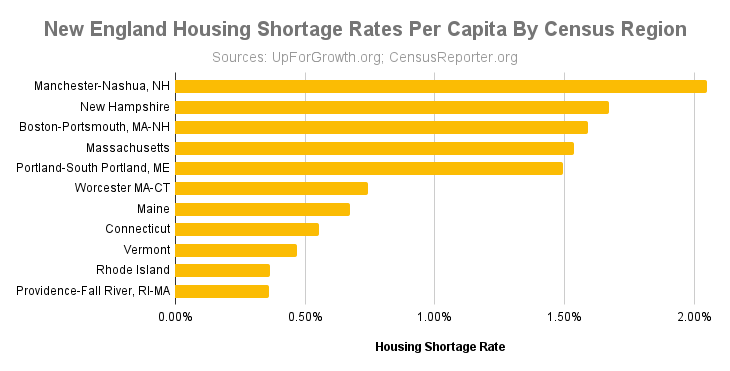
Comparing the ratio of each metro area’s UFG “Housing Underproduction” estimate to its population, southern Maine faces a similar burden to that of the greater Boston metro area, which includes New Hampshire’s Strafford and Rockingham counties, as well as Eastern Massachusetts (except the Taunton-New Bedford area, which is within the Providence, RI MSA). Through this lens, the worst-stressed New England metropolitan area is Manchester-Nashua, NH, though it makes up a modest 37% of its state’s overall housing shortage problem.
As WGME accurately summarized, “nearly all of Maine’s housing shortage is in the Portland area.” Essentially, 90% of the housing issue affects only about 40% of residents. Southern Maine’s housing crunch is more than 12-times worse than the rest of the state.
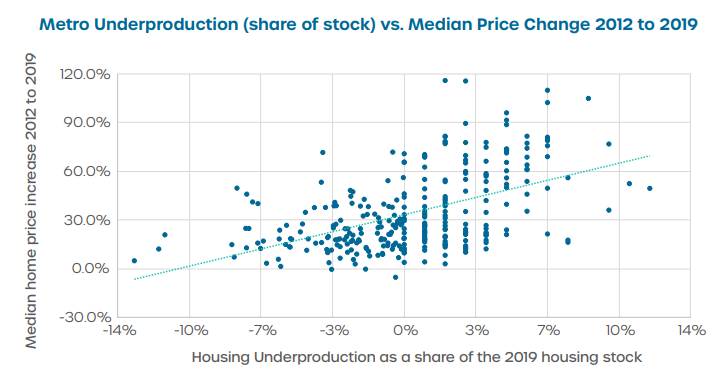
Nationally, the UFG report shows that supply shortages and corresponding price increases have been driven in the metro areas with greater shares of the nation’s 2019 housing stock. Maine’s smaller-to-medium-sized towns and cities should see this phenomenon as an opportunity. Building more housing of all types will only help the state and region grow.
As the Pine Tree State is recognized for its innate beauty and as a destination, not only for vacationing Americans but for those with flexible and remote work options, the next decade presents a golden opportunity for Mainers to instill a culture of growth at both the state and local level.
True growth, driven by entrepreneurial innovation and competition for customers and employees, will force many smaller towns to deal with the housing issue. Granted, they should be preparing for that moment now, but an overall healthier economy will naturally spur growth outside of the southern population centers.
Unfortunately, the idea that economic health is achieved with a lighter regulatory touch and a simpler, lower-tax environment is not shared by Maine’s legislative majority.
The passage of LD 2003, the top priority of Speaker Ryan Fecteau (D-Biddeford) during the 130th Maine Legislature, greatly opens the door to top-down regulation and planning of local development goals, without adequately addressing the need for real economic growth in the areas most affected by the housing shortage.
Though it was framed as a free-market approach by proponents, changes made in LD 2003 will centralize local zoning and community growth management. The bill will enable central planners at the Department of Economic and Community Development and the Maine State Housing Authority to establish regional housing production goals with which municipalities would be required to comply.
While LD 2003 allowed single-family homeowners to construct an additional dwelling unit, it superseded local decision-making on residential zone density, even in small towns where it may not be necessary to build more units. During the debate over LD 2003, Cape Elizabeth City Councilor Tim Reiniger argued that the state was not in a “housing crisis,” and that the bill was simply giving the state and federal governments more power over Maine communities. The bill also promotes creation of state- and federally-subsidized “affordable housing,” instead of the all-of-the-above, market-centered approach the region really needs.
Despite a key provision in Article IX, Section 21 of the Maine State Constitution which states that “the State may not require a local unit of government to…necessitate additional expenditures from local revenues unless the State provides annually 90% of the funding for these expenditures,” LD 2003 did not include funds to remedy these potential issues for localities. As opponents argued, these mandates could result in the need for extensive overhaul of local infrastructure and a rapid rise in the need for more local spending, triggering this clause and its requirement that it “must be liberally construed.”
This concern, in combination with other issues of the bill regarding federal overreach, is why Maine Policy ultimately advocated for a governor’s veto, after initially testifying neither for nor against the measure.
Since Governor Mills signed LD 2003 in April, the Maine Department of Economic and Community Development (DECD) expects to begin rulemaking later this year, and recommends municipalities update their zoning ordinances to comply with the law by the time it comes into effect on July 1, 2023.
This less-than-targeted approach, combined with calls to further certain housing development via short-sighted local referenda from Maine Democratic Socialists of America, threaten to undermine this critical moment to define the state’s future. They must be reminded that there are no shortcuts to economic vitality.