

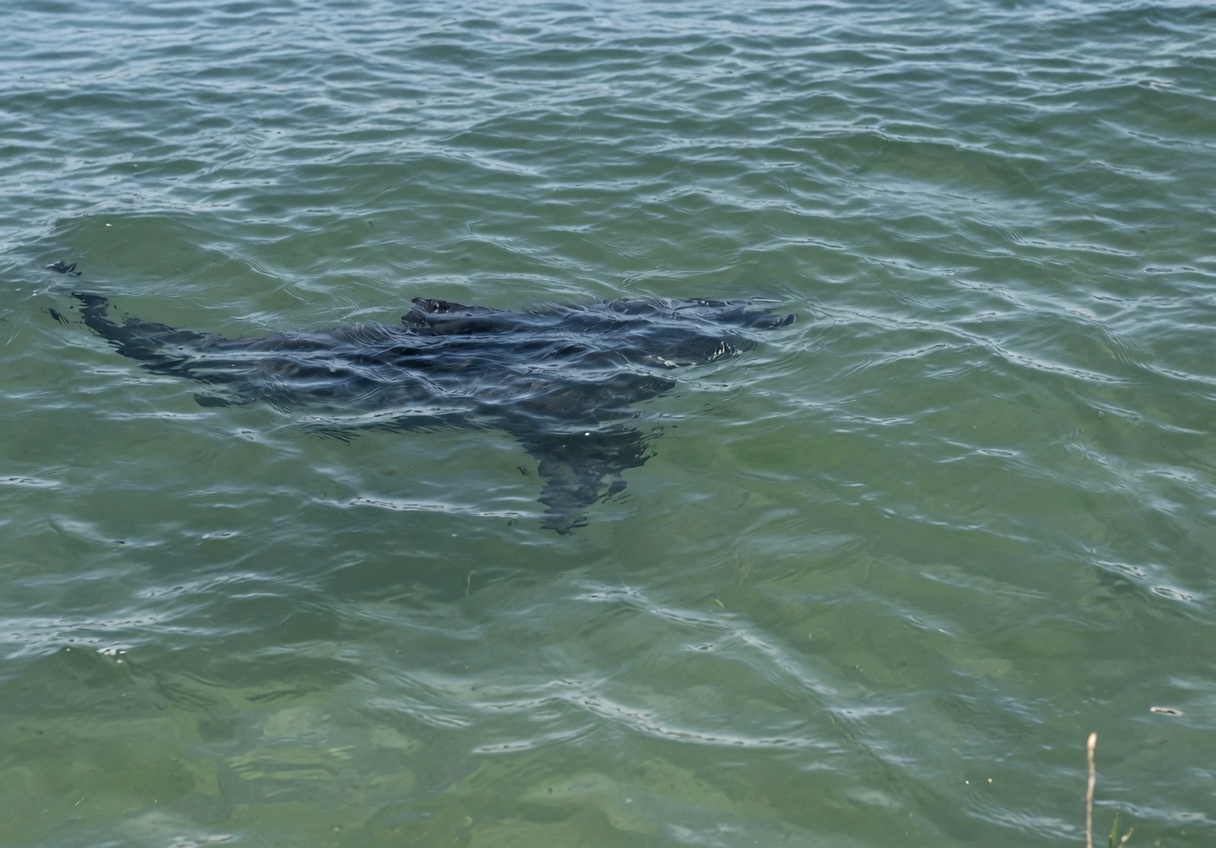
Nearly a dozen sharks were spotted near Pine Point over a two-day stretch as researchers investigate whether juvenile great whites are beginning to treat southern Maine waters as a regular summer home.
Great white sharks are no longer an occasional curiosity off southern Maine.
They are becoming increasingly familiar summer visitors in Saco Bay — and some are showing up remarkably close to beaches packed with swimmers, surfers, paddleboarders and families.
Nearly a dozen great whites were spotted near Pine Point Beach in Scarborough over a two-day period last week, including juvenile sharks estimated at six to eight feet long and several larger animals believed to measure as much as 10 to 12 feet.
For Scarborough Marine Resource Officer Daryen Granata, who has spent more than three decades working along the coast, the concentration stood out.
“Usually we’ll see one or two here and there,” Granata told CBS Boston. “This is a large volume, larger than I’ve seen, and I’ve worked this area for 30-plus years.”
Two juvenile great whites were confirmed Aug. 4 near the southern end of Prouts Neck and the mouth of the Scarborough River.
A day later, a drone operator monitoring the area spotted another five to seven sharks swimming and feeding near Pine Point.
The location is significant.
These were not sharks being observed miles offshore.
They were moving around the sandbars, tidal channels and nearshore waters off one of southern Maine’s most heavily used stretches of coastline, an area where people routinely swim, fish and paddle.
No injuries or aggressive encounters with people were reported.
But the sightings are adding urgency to a question marine researchers are now trying to answer:
Are great whites simply passing through Saco Bay, or are some beginning to make southern Maine a regular summer destination?
Saco Bay is emerging as a shark hotspot
The recent sightings fit a broader pattern documented by the Maine Department of Marine Resources.
State monitoring data show that waters around Scarborough Beach, Higgins Beach and Saco Bay recorded some of Maine’s highest levels of tagged white shark activity in 2025.
Scarborough Beach recorded tagged sharks on 33 days.
Higgins Beach recorded activity on 31 days.
Saco Bay recorded detections on 27 days.
State researchers said similar concentrations were observed during the summer of 2024.
That does not mean dozens of sharks were constantly circling southern Maine beaches. Acoustic receivers only detect tagged sharks that swim within range, and many sharks in Maine waters have never been tagged.
But the pattern has been consistent enough to get scientists’ attention.
Three of the most active white sharks detected in Maine in 2024 were juveniles that had been tagged in southern Maine that summer — the first white sharks ever tagged in Maine waters.
Two of those same sharks were responsible for much of the receiver activity recorded again in 2025.
That raises the possibility that at least some juvenile great whites may be returning to the same sections of Maine coastline year after year.
Scientists say more data are needed before calling the sharks permanent or seasonal residents.
But researchers are now looking directly at that possibility.
Researchers focus on Old Orchard Beach and Scarborough
University of Massachusetts Dartmouth biology professor Diego Bernal and the Bernal Fish Ecophysiology Lab have launched a study focused on juvenile white sharks in Saco Bay.
The project is centered largely around Scarborough and Old Orchard Beach.
Researchers hope to tag approximately 30 juvenile white sharks and track where they travel, how long they remain in Maine waters and whether they return during future summers.
“Is this an anomaly, or are these animals becoming residents of your coastal waters?” Bernal told the Portland Press Herald.
That distinction could become increasingly important for communities that rely heavily on summer tourism.
Scarborough, Old Orchard Beach and neighboring coastal communities draw thousands of residents and visitors to beaches each summer.
Researchers are now studying whether some of those same waters have also become increasingly attractive habitat for young great whites.
Rumors swirl over nighttime shark research
The research project has already attracted controversy.
Social media posts circulated claiming scientists were “chumming” the waters around Old Orchard Beach at night and potentially drawing sharks closer to swimmers.
Bernal denied the allegation.
“We are NOT chumming the waters, and are following all the rules set forth by DMR,” he told the Bangor Daily News.
Researchers instead use bait attached to fishing gear several hundred yards offshore as part of an effort to capture, tag and release juvenile sharks.
The work is performed under a special Maine Department of Marine Resources license.
Researchers have said they notify Maine Marine Patrol and municipalities before operating, conduct the work primarily between sunset and sunrise, avoid weekends and suspend operations if members of the public are nearby in the water.
Bernal also said the high-profile Pine Point shark sightings occurred before his team began working in the area that week.
“These fish are in the region and we are just trying to understand their movement patterns and residency in the area,” he said.
Why are more great whites showing up?
One major factor is food.
White sharks have always existed in New England waters, but scientists say the western North Atlantic population appears to be recovering after decades of conservation measures.
Federal protections for white sharks adopted in the 1990s helped reduce fishing pressure.
At the same time, decades of federal marine mammal protections allowed New England’s seal population to rebound dramatically.
For mature white sharks, seals are a major food source.
Juvenile sharks typically eat smaller prey, including bony fish, squid and smaller sharks, before shifting toward marine mammals as they grow.
Saco Bay provides plenty of potential prey.
Large schools of baitfish routinely move through the area, and seals are common along southern Maine’s coastline.
The result is a food chain that increasingly appears capable of supporting large marine predators surprisingly close to shore.
Maine dramatically expanded shark monitoring after fatal attack
Maine’s approach toward white sharks changed dramatically following the state’s first fatal shark attack.
In July 2020, 63-year-old Julie Dimperio Holowach was killed by a great white while swimming near Bailey Island in Harpswell.
The attack was extraordinarily rare, but it prompted Maine to expand its shark monitoring network and public safety efforts.
By 2025, DMR was operating 36 passive acoustic monitoring sites stretching from Ogunquit to the Canadian border.
One real-time receiver is positioned near Scarborough Beach and can automatically transmit detections of tagged sharks.
During 2025 alone, state equipment logged more than 9,500 detections involving 19 individual tagged white sharks across 95 separate days.
Since Maine’s monitoring effort began in 2020, 105 individual tagged white sharks have been detected in state waters.
Those numbers require some context.
A single shark swimming repeatedly past a receiver can generate numerous detections, meaning 9,500 detections do not represent 9,500 sharks.
And because many white sharks are untagged, the state’s network cannot determine exactly how many sharks are swimming off Maine at any given time.
Still, the data confirm something beachgoers and fishermen have increasingly noticed themselves:
Great whites are regularly moving through Maine waters.
And Saco Bay appears to be one of the places where they are spending significant amounts of time.
From Pine Point to Old Orchard Beach
The geography of the recent activity is difficult to ignore.
Pine Point Beach: Multiple sharks were observed near the Scarborough River mouth and surrounding sandbars, including juveniles and sharks estimated at up to 12 feet.
Prouts Neck: Confirmed sightings have occurred around the southern end of the peninsula, immediately adjacent to Saco Bay.
Higgins Beach: State acoustic monitoring has recorded some of Maine’s highest numbers of days with tagged shark activity.
Scarborough Beach: DMR has identified the area as another concentration point and operates real-time shark monitoring equipment nearby.
Old Orchard Beach: Researchers are using portions of the waters off one of Maine’s most popular tourist beaches as part of the new juvenile white shark study.
Together, the locations form a relatively compact stretch of southern Maine coastline.
And all of them are heavily used by people.
Don’t panic, but don’t ignore them either
State officials continue to stress that attacks on humans remain exceptionally rare.
The presence of a shark does not automatically mean swimmers are in imminent danger.
But officials are also urging people to use common sense.
DMR recommends staying close to shore, avoiding swimming alone and remaining away from seals or large concentrations of baitfish.
Swimmers should also exercise additional caution in murky water and around dawn or dusk, when visibility is reduced and many marine predators are active.
Anyone who sees a shark should leave the water and alert lifeguards or public safety personnel.
Officials say people should follow beach closures or swimming restrictions whenever they are issued.
The Atlantic White Shark Conservancy’s Sharktivity application also allows users to view reported and researcher-verified white shark sightings throughout New England.
The bigger question
Maine is not Cape Cod.
At least not yet.
Cape Cod remains one of the world’s best-known seasonal gathering areas for great white sharks, fueled largely by its enormous seal population.
State researchers have emphasized that overall shark activity in Maine remains considerably lower.
But what is happening around Scarborough deserves attention.
Tagged juvenile sharks are repeatedly showing up.
Some are returning.
Researchers are now conducting a dedicated residency study.
And this month, nearly a dozen sharks were reportedly observed over just two days in the waters around Pine Point.
The scientific question is no longer simply whether great white sharks visit Maine.
That has already been answered.
They do.
The question now confronting researchers, and potentially southern Maine’s coastal communities, is whether some of these predators are beginning to spend substantially more of their summers here.
For residents and tourists enjoying Pine Point, Higgins Beach, Scarborough Beach or Old Orchard Beach this August, there is no reason for panic.
But there is increasingly good reason to pay attention to what may be swimming just beyond the breakers.




Researchers were on the shore at Ocean Park at the mouth of Goose Fair brook last week fly bait by drone some 200 ft off the beach and dropping the bait it. Then caching 5 to 6 ft. sharks and tagging them. They were here last summer about the same time, midnight to dawn.
Don’t worry they are just some of the New Mainers that Janet has invited to Maine.
Couldn’t possibly be related to global warming, could it? Naaah.