

Shake Shack denies that refusing to leave a gratuity triggers higher prices and says it is investigating the incident at a Salt Lake City airport location.
A viral video showing the price of a Shake Shack order apparently increasing moments after a customer selected “No Tip” at a self-service kiosk is fueling fresh outrage over America’s increasingly aggressive tipping culture.
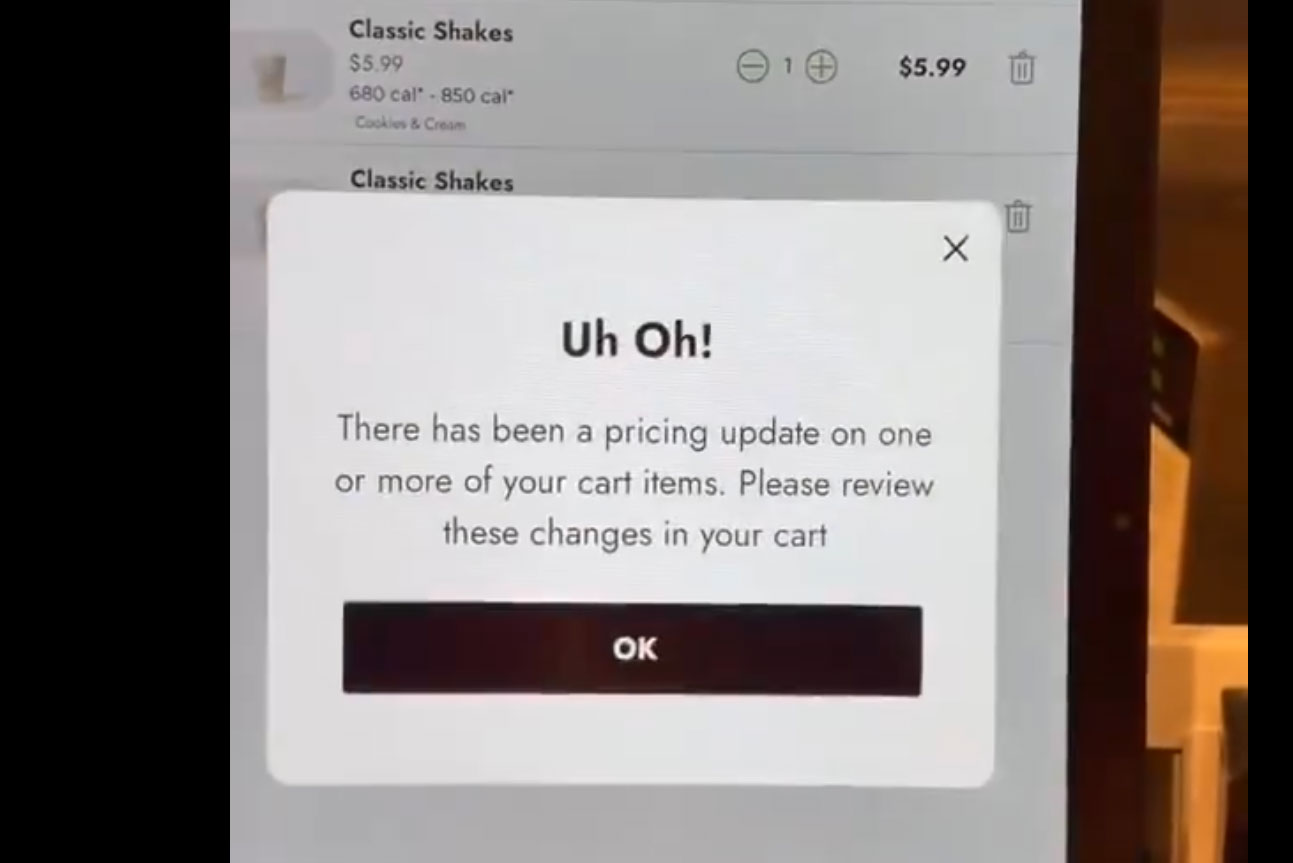
The video, recorded at a Shake Shack inside Salt Lake City International Airport, shows a customer and his wife ordering three Classic Shakes priced at $5.99 each. One of the shakes included a 49-cent whipped cream add-on.
Everything appeared routine until the couple reached the payment screen.
After the kiosk prompted the customer to leave a gratuity, he selected “No Tip.”
Almost immediately, the machine displayed a warning.
“Uh Oh! There has been a pricing update on one or more of your cart items. Please review these changes in your cart.”
When the customer returned to the cart, the prices of the shakes appeared to have increased by roughly 50 cents each — raising the order by approximately $1.50.
The timing was hard to miss.
The customer had declined to leave a tip. Seconds later, the kiosk announced a pricing change and the cost of the drinks went up.
“Making sure everybody knows: Do not go there,” the customer, identified in reporting as B.D. Powell, said in the video.
The footage quickly spread across social media, where users accused Shake Shack of imposing what some described as a hidden “no-tip surcharge.”
But there is an important distinction between what the video appears to show and what can currently be proven.
The footage does not establish that selecting “No Tip” caused the price increase, and Shake Shack says charging customers more because they refuse to leave a gratuity is not company policy.
“Thank you for bringing this to our attention. This is not a Shake Shack policy, and we’re currently looking into it with our licensee, HMSHost, that operates the Salt Lake City airport location and kiosk system,” Shake Shack said in a response posted to the viral video.
That explanation leaves one significant question unanswered: Why did the prices change immediately after the customer declined to tip?
The Salt Lake City restaurant is not operated like a traditional company-owned Shake Shack. It is run by airport concessionaire HMSHost under a licensing arrangement, and Shake Shack said HMSHost also operates the kiosk system involved in the incident.
No explanation for the apparent price adjustment has yet been publicly confirmed.
It could ultimately prove to be a software error, an improperly loaded menu price, an airport-specific price adjustment or another technical issue unrelated to tipping.
But the sequence captured on video could hardly have been worse for a restaurant industry already facing widespread consumer frustration over tipping prompts.
Customers are now routinely asked to leave gratuities at coffee shops, fast-food restaurants and self-service kiosks, sometimes before they have received their food and sometimes after placing the entire order themselves.
That frustration appears to be growing.
A 2026 Popmenu survey found that 78 percent of American consumers reported experiencing “tipping fatigue,” up from 65 percent in 2025. Forty-four percent said they were tipping less than they had the previous year, while 42 percent said they were becoming increasingly comfortable declining gratuities for certain services.
The Shake Shack episode adds another layer to that debate.
There is currently no verified evidence that Shake Shack deliberately raises menu prices when customers refuse to tip.
There is, however, a video showing a customer pressing “No Tip,” followed almost immediately by a pricing-update warning and a $1.50 increase in the cost of his order.
Shake Shack says the two events are not connected by company policy.
Now the company and its airport operator will have to explain what caused the price change and why it happened at perhaps the worst possible moment.

You cannot run a restaurant without help. So pay up or eat at home.