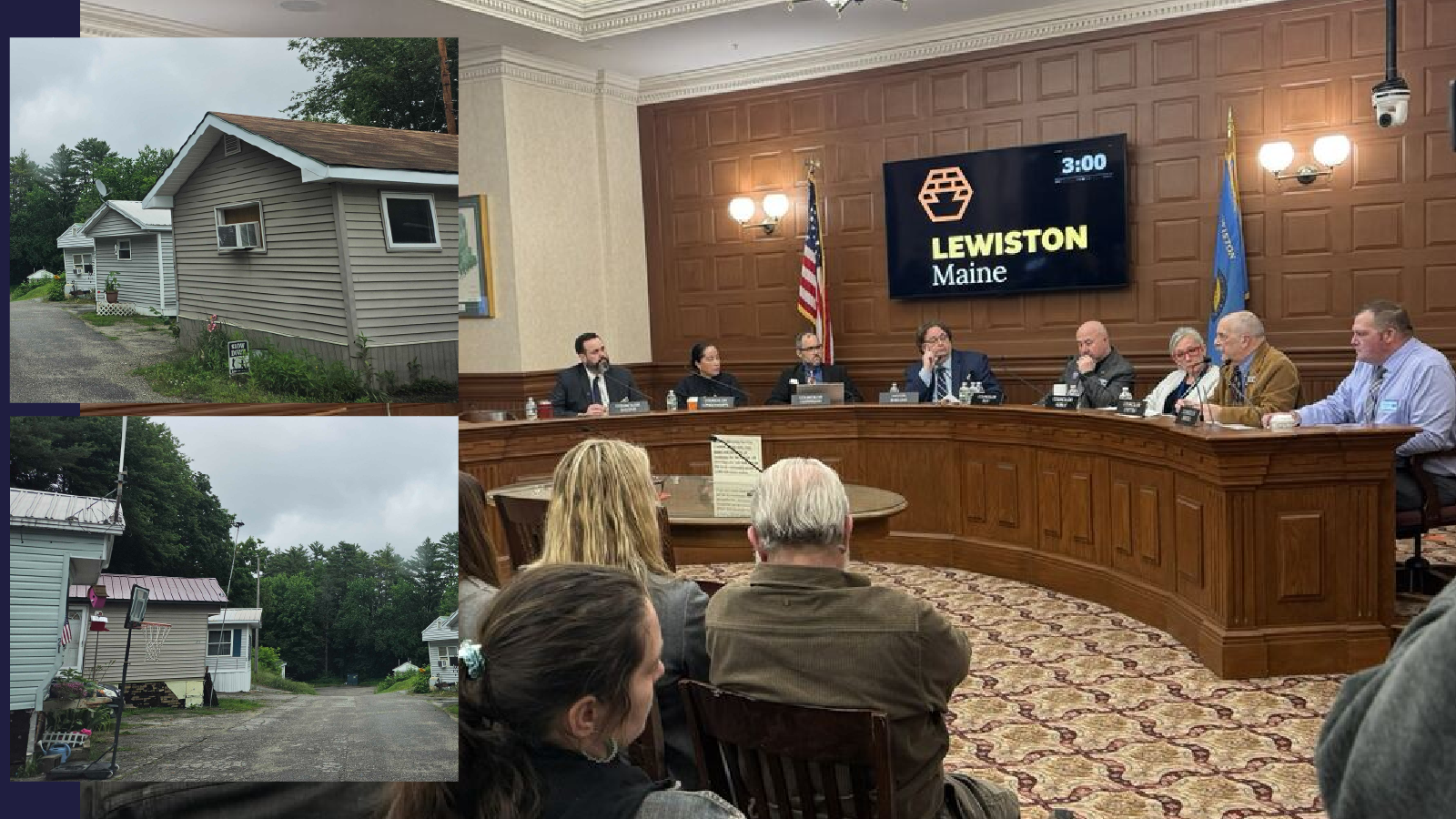
The Lewiston City Council rejected a proposal to extend the city’s temporary moratorium on mobile home park lot rent increases Tuesday, with a majority of councilors concluding that property owners should not be barred from adjusting rents while the city continues work on a permanent rent stabilization ordinance.
The six-month extension failed on a 5-2 vote following a lengthy debate that exposed competing concerns over protecting residents living on fixed incomes and preserving the property rights of mobile home park owners facing rising operating costs.
Mayor Carl Sheline and Councilor Roy voted in favor of extending the moratorium. Councilors Longchamps, Chittim, Nagine, Martel and the Ward 4 councilor voted against it. Councilor Noble was absent.
The vote means the existing moratorium is scheduled to expire Sept. 28, allowing park owners to pursue rent increases under current state law while the city continues refining its proposed ordinance.
The Housing Committee sought the extension after municipal legal counsel concluded the proposed rent stabilization ordinance required additional revisions before it could return to the council for final approval.
Assistant Community Development Manager Jackie Sawyer said the committee spent the past six months developing an ordinance intended to balance the interests of mobile homeowners with those of park owners.
The proposal would establish a graduated formula for future lot rent increases based on market conditions, affordability, inflation and comparable lot rents.
Sawyer said city attorneys recommended additional legal review to clarify language, strengthen enforcement provisions and improve the ordinance’s legal defensibility. Completing that review is expected to require roughly 40 to 50 billable hours.
She told councilors the committee hoped to bring the ordinance back within two to three months and noted the moratorium could be lifted before six months if the work was completed sooner.
Housing Committee Chairman Craig Saddlemeyer defended the committee’s work, saying members spent months gathering feedback from both residents and park owners rather than simply adopting the state’s model ordinance.
“Our goal was always to get it in a presentable state to council before the end of the moratorium,” Saddlemeyer said.
Council Majority Says Extension Went Too Far
Although nearly every councilor praised the committee’s work, the majority concluded another six-month freeze would unfairly burden property owners.
Councilor Chittim described the ordinance as one of the most complicated pieces of municipal legislation he had reviewed.
“I think it’s bent over backwards to recognize the needs of the owners as well as the needs of the tenants,” Chittim said.
Despite that praise, Chittim said extending the moratorium would continue preventing park owners from responding to increasing expenses.
“We have already forestalled any increases of mobile home park owners’ income for six months,” he said.
He also questioned how Maine’s 90-day notice requirement for rent increases would interact with the expiration of the moratorium, noting city attorneys had not yet provided an opinion.
Councilor Longchamps said she believed extending the moratorium risked discouraging future investment in one of the city’s most affordable housing options.
“While I do understand the intent, I do worry it could discourage future mobile home park development and even incentivize existing parks to redevelop for other uses,” Longchamps said.
Councilor Martel echoed those concerns, arguing mobile home parks represent naturally affordable housing that depends on continued private investment.
“Mobile home parks represent the most organically affordable housing I believe that we have in Lewiston,” Martel said.
He warned that additional government regulation could encourage owners to convert their properties into other commercial uses.
“We are telling investors loud and clear that Lewiston is not a conducive place to do business,” Martel said.
Councilor Nagine acknowledged that many mobile home residents are seniors, disabled residents or households living on fixed incomes but questioned whether restricting park owners’ income was the best solution.
“I would much rather explore solutions that would directly support residents to assist those experiencing financial hardship,” Nagine said, suggesting the city instead consider targeted financial assistance programs.
Public Testimony Revealed Sharp Divide
Residents and park owners delivered sharply contrasting testimony before the vote.
John Deary, a resident of Fox Run Mobile Home Park, urged the council to keep the moratorium in place until the ordinance could be completed.
“I would like to see protections for us until there’s a chance for a vote on the ordinance,” Deary said.
Park owners argued the moratorium had already imposed significant financial consequences.
John Gordon, co-owner of Sunset Gardens Mobile Home Park, said most Lewiston parks charge lot rents below the Housing Committee’s own calculated target rent of roughly $503 per month.
He said Sunset Gardens charges approximately $384 per month while taxes, utilities, insurance, labor and maintenance costs continue climbing.
“If you pass the moratorium, you’re going 18 months from the last time we gave a rent increase,” Gordon said. “This isn’t little things. This is business.”
Gordon’s business partner, Chris Saroy, testified that uncertainty surrounding the ordinance had already cost the owners a sale of two mobile home parks.
According to Saroy, an executed purchase agreement fell through, and a subsequent offer came in approximately 26 percent lower.
“That’s a 26 percent hit to our retirement,” Saroy said.
Housing Committee member Dash Padham also urged the council to reject the extension, noting the committee had never formally voted to recommend another six months.
Instead, Padham suggested allowing temporary rent increases capped at 5 percent while legal review continued.
Work on Permanent Ordinance Continues
Despite rejecting the extension, councilors from both sides of the debate encouraged the Housing Committee and city staff to continue refining the ordinance and return with a final proposal as quickly as possible.
Mayor Sheline, who supported extending the moratorium, said he hoped the ordinance could be completed without delay.
Councilor Roy also praised the committee’s months of work and expressed confidence the proposal could return to the council well before six months had passed.
For now, the council’s vote leaves the current moratorium set to expire Sept. 28, clearing the way for mobile home park owners to pursue rent increases under existing Maine law while Lewiston continues developing what could become one of the state’s most comprehensive local rent stabilization ordinances.