

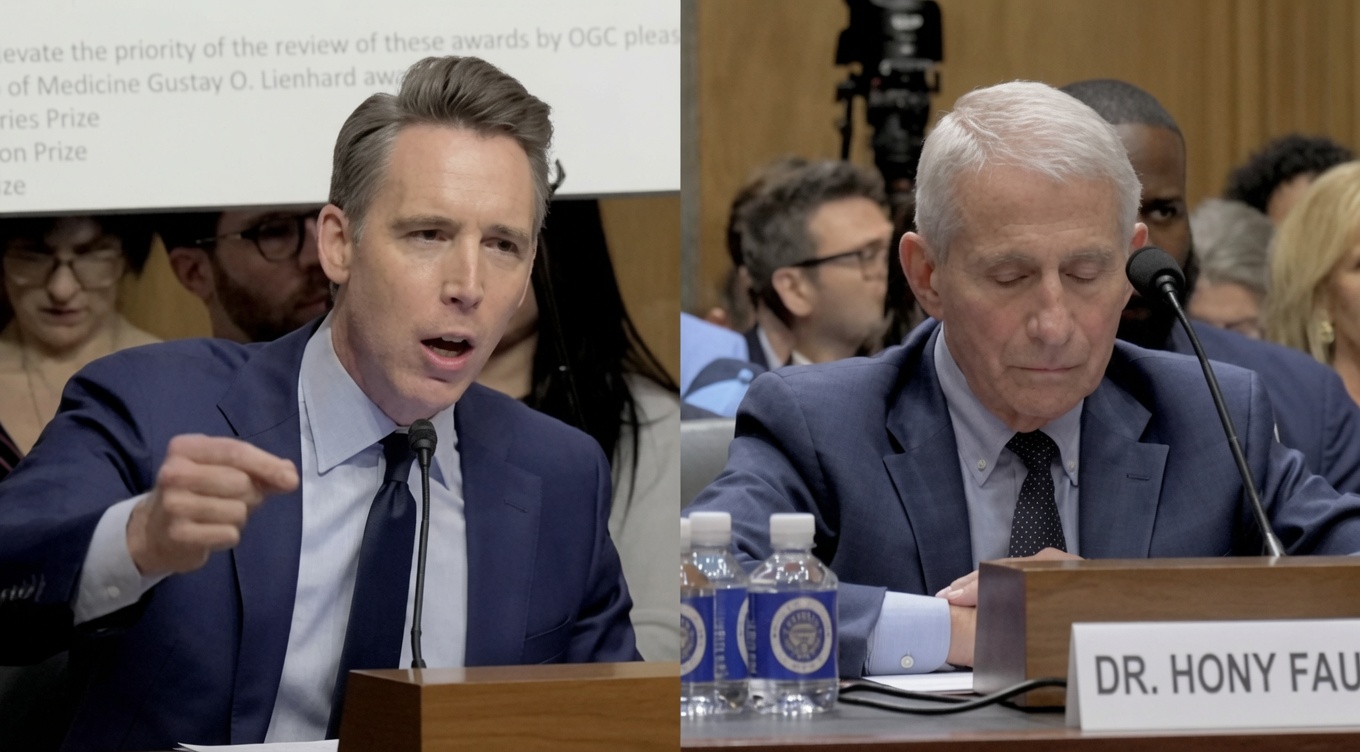
The Senate Homeland Security and Governmental Affairs Committee is scheduled to vote Thursday on whether to hold Dr. Anthony Fauci in contempt of Congress after the former federal health official repeatedly refused to answer questions about the origins of COVID-19 and the government’s handling of the pandemic.
The committee’s business meeting is scheduled for 8:30 a.m. on Aug. 6, according to the committee’s official calendar. Chairman Rand Paul, R-Ky., announced the contempt proceedings after Fauci invoked his Fifth Amendment right against self-incrimination 111 times during a contentious July 29 hearing.
Fauci, who served as director of the National Institute of Allergy and Infectious Diseases for nearly four decades, appeared under subpoena as part of the committee’s investigation into the federal response to the pandemic, the origins of the virus and American funding that supported coronavirus research conducted through EcoHealth Alliance and the Wuhan Institute of Virology.
Paul and other Republican lawmakers have spent years questioning whether Fauci misled Congress about the nature of research financed by the National Institutes of Health, including experiments involving bat coronaviruses in China. Paul referred Fauci to the Justice Department for possible prosecution in 2023 and renewed that referral in July 2025. Fauci has consistently denied lying to Congress or approving research that caused the pandemic.
The July 29 hearing was intended to press Fauci about those issues, along with internal government deliberations over a possible laboratory origin of COVID-19, pandemic restrictions and apparent differences between Fauci’s public statements and his private communications.
Instead, the hearing quickly descended into a constitutional standoff.
Acting on the advice of his attorneys, Fauci declined to answer more than 100 questions. His Fifth Amendment invocations extended beyond questions about federal research funding and the virus’s origin to relatively basic inquiries about his government service and pandemic-era activities.
Fauci argued that Paul’s longstanding efforts to refer him for prosecution created a legitimate danger that anything he said could be used against him. He accused the chairman of pursuing what he called an “unhinged obsession” with putting him in prison and described the proceeding as an effort to trap him into making statements that could later support a perjury prosecution.
The confrontation intensified when one of Fauci’s attorneys attempted to intervene during questioning. Paul ordered the attorney removed from the hearing room, maintaining that counsel could advise Fauci but could not answer questions or disrupt the committee’s proceedings.
Paul and several Republican committee members argued that Fauci did not have a valid basis for refusing to testify because former President Joe Biden issued him a sweeping preemptive pardon before leaving office.
The pardon covered potential federal offenses committed between Jan. 1, 2014, and Jan. 20, 2025, related to Fauci’s government service. Republicans contend that the pardon eliminated any reasonable risk of federal prosecution for conduct during that period, undercutting Fauci’s claim that his testimony could incriminate him.
Paul also argued that Fauci may have waived at least part of his Fifth Amendment privilege by delivering a substantive opening statement defending his conduct and attacking the legitimacy of the investigation before refusing to answer questions.
Fauci’s attorneys dispute that interpretation. They maintain that the Biden pardon does not necessarily protect Fauci from every conceivable prosecution, including potential state charges, conduct outside the pardon’s timeframe or accusations arising from his testimony itself.
The constitutional question is largely untested. Legal experts told Reuters that courts have not clearly determined whether a person who receives a broad presidential pardon can still invoke the Fifth Amendment when questioned about pardoned conduct. Any prosecution could therefore become a significant test of both congressional investigative authority and the constitutional protection against self-incrimination.
The hearing followed Paul’s release of more than 1,000 pages of Fauci’s pandemic-era diary entries, which were reportedly recovered from government computers.
Paul said the writings provided new evidence about how Fauci privately viewed the pandemic and the possibility of a laboratory origin. Republicans highlighted entries that they said showed Fauci privately discussing natural immunity, questions surrounding mask effectiveness and early scientific concerns that COVID-19 may have emerged from a laboratory.
However, an Associated Press review concluded that some of the diary entries were broadly consistent with positions Fauci expressed publicly. One entry showed Fauci recognizing early that the Wuhan market may have amplified the outbreak rather than served as the virus’s original source, while other entries documented internal scientific debate over whether a laboratory accident was possible.
The diaries also offered an unfiltered account of Fauci’s relationship with President Donald Trump during the first Trump administration. Fauci privately described Trump in sharply critical terms and documented disagreements over testing, infection rates and the severity of the pandemic.
Democrats have accused Paul of using the committee to pursue a personal and political vendetta rather than conduct a legitimate fact-finding investigation. They have described the contempt push as a “show trial” and defended Fauci’s right to invoke the same constitutional protection available to any other witness.
Republicans argue that Fauci cannot deliver an opening statement defending himself, benefit from a presidential pardon covering his government conduct and then refuse to answer congressional questions about decisions that affected millions of Americans.
If the committee approves the resolution Thursday, the matter would move into uncertain legal territory. A traditional criminal contempt referral generally requires approval by the full Senate before being sent to the Justice Department, although Paul could separately send his own referral or request for prosecution directly to federal authorities.
The Justice Department would then decide whether to pursue the matter, and any criminal charge would likely require approval from a federal grand jury. Prosecutors would have to establish that Fauci willfully refused to answer questions that were relevant to a valid congressional investigation and that his Fifth Amendment claim was legally insufficient.
The contempt vote marks the latest escalation in a yearslong battle over pandemic accountability, government transparency and the still-disputed origins of COVID-19.
For Fauci’s critics, the 111 invocations amounted to a refusal by one of the pandemic’s most powerful public officials to account for decisions that closed schools, shuttered businesses and fundamentally altered American life.
For Fauci and his defenders, the hearing demonstrated why the Fifth Amendment exists: to protect witnesses from being compelled to testify when lawmakers have already made clear that they want to see them prosecuted.
Thursday’s vote will not settle those competing arguments. It could, however, move the dispute out of a Senate hearing room and into the federal courts.




I’m praying there is accountability. This will really show the people where we stand with the government. I’m concerned, but hopeful. Thank you John.