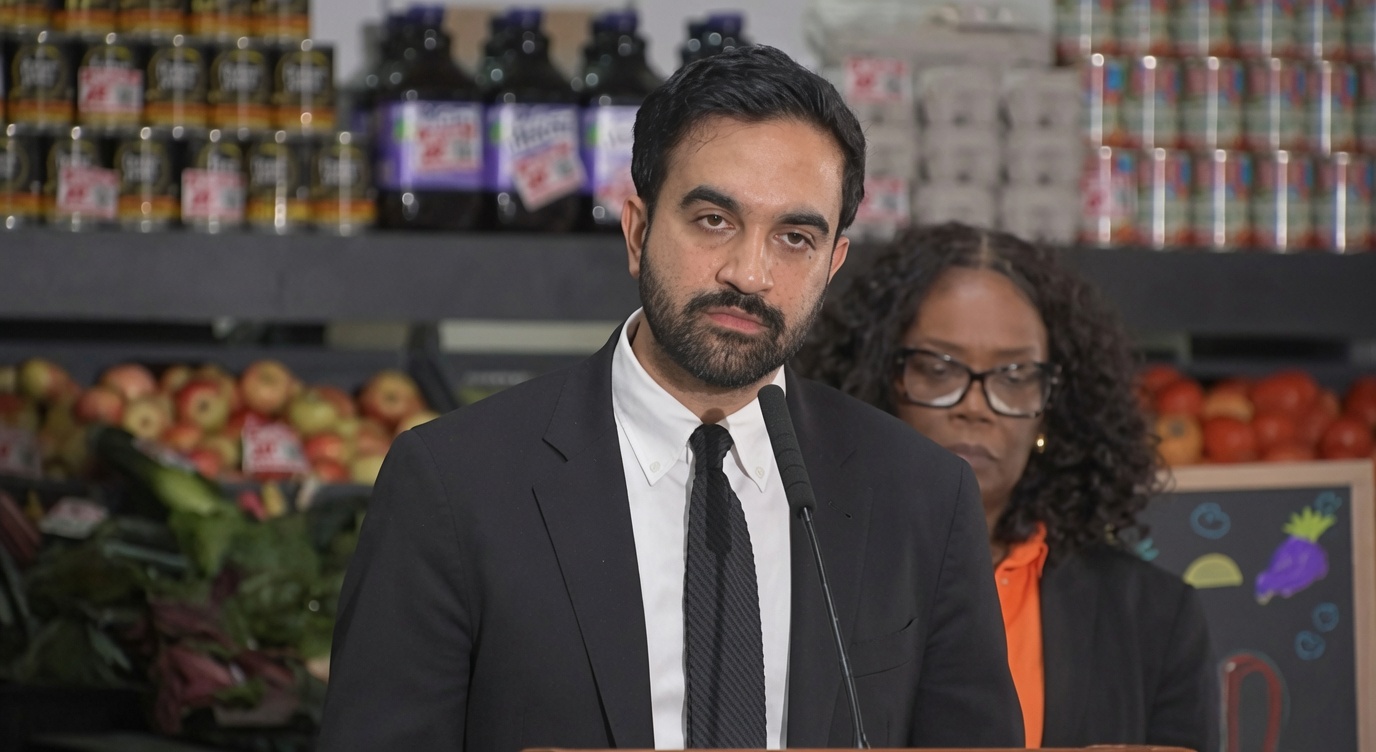
New York City taxpayers will spend at least $70 million to establish five government-backed grocery stores offering steeply discounted food to anyone who walks through the doors—including tourists and people who do not live in the city.
Mayor Zohran Mamdani’s administration has confirmed that shoppers will not be required to show identification, demonstrate financial need or provide proof of New York City residency to receive discounts subsidized through city-owned property and public financing.
The plan, a signature initiative of Mamdani’s democratic socialist agenda, calls for opening one municipal grocery store in each of the city’s five boroughs by the end of his mayoral term in 2029.
The stores will guarantee prices 30 percent below traditional retail rates on a designated “core basket” that includes all fresh produce, meat and seafood, as well as basic staples such as milk, bread, cheese and eggs. Those prices will be set monthly in an effort to shield customers from the weekly fluctuations common in private supermarkets.
Mamdani has presented the stores as a direct government response to rising food prices and food insecurity. Critics, however, say the city is preparing to use taxpayer money, tax-free real estate and rent-free storefronts to compete against privately owned supermarkets, neighborhood grocers and bodegas that must pay their own rent, property taxes, insurance and operating costs.
The absence of a residency requirement has further intensified the controversy.
Because shoppers will not need to establish that they live in New York City, residents of neighboring communities, commuters and tourists could potentially purchase food at prices subsidized by city taxpayers. The administration has proposed a voluntary membership card to monitor inventory and discourage bulk purchases for resale, but participation will not be mandatory.
That leaves the city without an obvious way to ensure that the publicly financed discounts are reserved for New Yorkers or limited to households facing food insecurity.
Supporters argue that identification requirements could prevent homeless residents, undocumented immigrants and other vulnerable populations from accessing affordable food. Opponents say the policy removes basic safeguards from a program financed by taxpayers and creates an invitation for abuse.
The debate reaches beyond grocery prices. Mamdani’s proposal is emerging as an early test of whether the Democratic Socialists of America can successfully move essential services away from the private market and place them under direct government control in the nation’s largest city.
Under the proposed business model, New York City will finance construction on city-controlled property and select private companies to operate the stores. Those operators will pay neither traditional commercial rent nor property taxes, allowing them to sell certain food products at prices private competitors may be unable to match.
Independent grocers have warned that the arrangement could force longtime neighborhood businesses to compete not merely against another supermarket, but against the financial power of City Hall.
The administration has attempted to soften that threat by promising that municipal stores will not sell cigarettes, lottery tickets, alcohol, hot prepared meals or deli products, items that often provide critical revenue for bodegas and small markets.
Whether those restrictions will be enough to protect private businesses remains uncertain.
The first municipal store is expected to open in late 2027 at the Peninsula development in Hunts Point in the Bronx, where the administration says 77 percent of households face severe food insecurity. A second location is planned for La Marqueta in East Harlem.
Locations in Brooklyn, Queens and Staten Island have not yet been announced.
Mamdani’s administration estimates that the program could reduce a participating family’s total grocery costs by approximately 15 percent, producing savings of about $90 per month or roughly $1,000 annually.
Those savings will not be limited to low-income families.
There will be no income test, eligibility review or verification that shoppers are city residents. The discounts will be available to anyone able to reach the stores.
That structure reflects Mamdani’s broader political philosophy. A member of the Democratic Socialists of America, Mamdani has advocated a larger government role in housing, transportation, child care and the cost of basic necessities.
The DSA argues that important parts of the economy should be removed from private ownership and placed under public, cooperative or worker control. Its members have supported government-run health care, expanded public housing, free public transportation, aggressive rent regulation and public alternatives to private businesses.
Mamdani’s election gave the movement an opportunity to test those policies on a scale rarely seen in the United States.
Supporters see the grocery plan as proof that government can intervene when private markets fail to make necessities affordable. Critics see an ideological experiment in which taxpayers assume the financial risk while private employers face subsidized competition.
The city has not yet provided a complete estimate of the stores’ long-term operating costs or explained how taxpayers will cover potential losses.
That question could become critical. Grocery stores generally operate on narrow profit margins, while Mamdani’s plan combines deep discounts, publicly financed buildings, higher labor expectations and restrictions on several products that traditionally produce stronger revenue.
Municipal grocery experiments elsewhere have delivered mixed results, with some stores providing food in underserved neighborhoods and others closing after financial losses, weak sales or operational problems.
Meanwhile, private discount chains continue expanding in New York without relying on direct city ownership.
Aldi has opened a Midtown Manhattan location near Times Square, placing a major discount grocer in one of the city’s most heavily traveled areas. Wegmans has also continued experimenting with changes intended to make shopping more convenient for customers.
Those private-sector developments establish a sharp contrast with Mamdani’s approach.
Private companies are attempting to win shoppers through pricing, efficiency and competition. Mamdani is betting that government-subsidized real estate and taxpayer financing can produce better results.
The outcome will help determine whether the municipal stores become a model for affordable food or an expensive socialist experiment that leaves taxpayers covering the losses while private neighborhood businesses pay the price.